Loading market data...
Shaan Patel Asset Management, led by 22-year-old Shaan Patel, enters India's booming Category III AIF sector with a ₹36 crore quant-driven strategy. Explore FinScann's analysis of this dynamic launch.

A new force has emerged in India's dynamic alternative investment sector as Shaan Patel Asset Management (SPAM), founded by the 22-year-old Shaan Patel, officially launched its operations. As of March 2026, the quantitative investment firm reports managing assets worth approximately ₹36 crore, positioning Patel as one of the nation's youngest fund managers. Operating as a SEBI-registered Category III Alternative Investment Fund (AIF), SPAM aims to disrupt traditional wealth management by seamlessly integrating cutting-edge quantitative analysis with deep fundamental research for discerning investors.
The Catalyst
Shaan Patel's journey from a state-level cricketer to the helm of a sophisticated asset management firm is a testament to the evolving landscape of Indian finance. Driven by a passion for financial markets, Patel honed his expertise with a BSc in Finance and Investment, followed by two MSc degrees in Data Science and Artificial Intelligence from UK universities. This strong academic foundation enabled him to develop proprietary investment models, which he successfully tested with his own capital from September 2023. The significant increase in his portfolio's value over 18 months, driven by performance rather than marketing, laid the groundwork for formalizing Shaan Patel Asset Management. The firm officially received SEBI approval as a Category III AIF in March 2025 and launched its Flexi-Cap Strategy on July 10, 2025, with an initial asset base of ₹25 crore.
Financial Forensics
Shaan Patel Asset Management (SPAM), with its current Assets Under Management (AUM) around ₹36 crore, operates within the highly regulated framework of a SEBI-registered Category III AIF. This category allows for complex trading strategies, including the use of leverage and derivatives for both hedging and speculative purposes, making it suitable for sophisticated investors seeking higher, albeit riskier, returns. SPAM’s Flexi-Cap Strategy, which commenced with ₹25 crore, employs a unique "intelligent churning" approach guided by quant signals, enabling dynamic entry and exit points based on valuations to enhance compounded returns. The fund’s initial target corpus was ₹200 crore, primarily aimed at High Net Worth Individuals (HNIs) and family offices. Patel aims to grow the AUM to ₹100 crore by the end of 2026.
The broader Indian AIF market has witnessed exponential growth, reflecting a significant shift in investor preference towards alternative avenues.
Growth of Alternative Investment Funds (AIFs) in India
| Metric | December 2024 (₹ Lakh Crore) | December 2025 (₹ Lakh Crore) | Growth (YoY) |
|---|---|---|---|
| Total AIF Commitments | 13.05 | 15.74 | 20.6% |
| Category III AIF Funds Raised | 1.29 (estimated) | 1.96 | 51.2% |
Note: December 2024 Category III funds raised calculated from December 2025 figure and 51.2% growth.
This table highlights the robust expansion, particularly in Category III AIFs, which recorded the fastest growth in funds raised, increasing by 51.2% to ₹1.96 lakh crore as of December 2025. The overall commitments to AIFs reached ₹15.74 lakh crore by December 2025, a substantial 20.6% increase from the previous year.
Market Impact
The entry of Shaan Patel Asset Management signals a critical juncture in India's burgeoning alternative investment landscape. The firm's data-driven, quantitative approach caters directly to a new generation of HNIs and Ultra-HNIs who are increasingly seeking sophisticated, diversified, and technologically advanced investment solutions beyond traditional equity and debt instruments. With over 1,800 registered AIFs as of early March 2026, the sector is a hotbed of innovation. SPAM's focus on combining algorithmic models, artificial intelligence, and advanced data science with fundamental research positions it well to attract investors looking for enhanced risk-adjusted returns and a departure from conventional long-only strategies. This trend underscores a broader market maturation where specialized expertise, especially in quantitative investing, is gaining significant traction amidst evolving market complexities and geopolitical tensions impacting the Nifty 50 and Sensex.
Key Takeaways for Investors
FinScann Verdict
Shaan Patel Asset Management represents a compelling blend of youthful ambition and advanced quantitative prowess in India’s alternative investment space. FinScann believes that SPAM's unique strategy, coupled with the founder's strong academic background in AI and data science, positions it as a significant player to watch in the burgeoning Category III AIF segment. Its success will be a key indicator of how quickly quantitative investing can redefine wealth creation strategies for sophisticated Indian investors.
What is a Category III AIF? A: A Category III AIF (Alternative Investment Fund) is a SEBI-regulated fund in India that employs complex trading strategies, including the use of leverage and derivatives, for both hedging and speculative purposes. These funds invest in listed and unlisted securities and aim to generate short-term or absolute returns, catering to sophisticated investors with a higher risk appetite.
Who is Shaan Patel? A: Shaan Patel is the 22-year-old founder and Chief Investment Officer of Shaan Patel Asset Management (SPAM). He is recognized as India's youngest fund manager, leveraging a background in finance, data science, and artificial intelligence to build a quantitative investment platform. He is a former state-level cricketer.
What is the minimum investment in Shaan Patel Asset Management's AIF? A: As a Category III AIF, Shaan Patel Asset Management would typically require a minimum investment of ₹1 crore from investors, in line with SEBI regulations for Alternative Investment Funds.
What is the investment strategy of SPAM? A: SPAM's investment strategy combines quantitative analysis (using algorithmic models, artificial intelligence, and advanced data science techniques) with traditional fundamental research. The firm focuses on an "intelligent churning" strategy guided by quant signals to actively monitor positions, take partial exits when valuations are stretched, and re-enter when new opportunities arise.
Disclaimer: For information only; not investment advice. Stock market investments carry risks. Please consult a SEBI-registered advisor before investing. FinScann assumes no liability for decisions made based on this report.

Financial journalist specializing in market analysis, stock research, and investment trends. Dedicated to providing accurate, timely insights for informed decision-making.
Credentials: Experienced financial journalist with expertise in equity markets and economic analysis
The information provided in this article is for educational and informational purposes only and should not be construed as financial, investment, or legal advice. Finscann does not provide personalized investment recommendations.
For detailed terms and conditions, please read our Disclaimer and Terms of Service.

Indian stock markets declined sharply on March 6 as banking and financial stocks led losses amid rising crude oil prices and geopolitical tensions in...

Reliance Industries Ltd. leverages a US waiver to boost Russian oil imports. Discover the financial impact, market implications, and strategic...

Foreign Institutional Investors offloaded ₹17,000 crore in Indian IT stocks in February 2026, sparking fears of AI disrupting software services.

Indian stock market plunges in March 2026 as Sensex nears 700-point drop. Global tensions and surging crude oil prices fuel volatility.
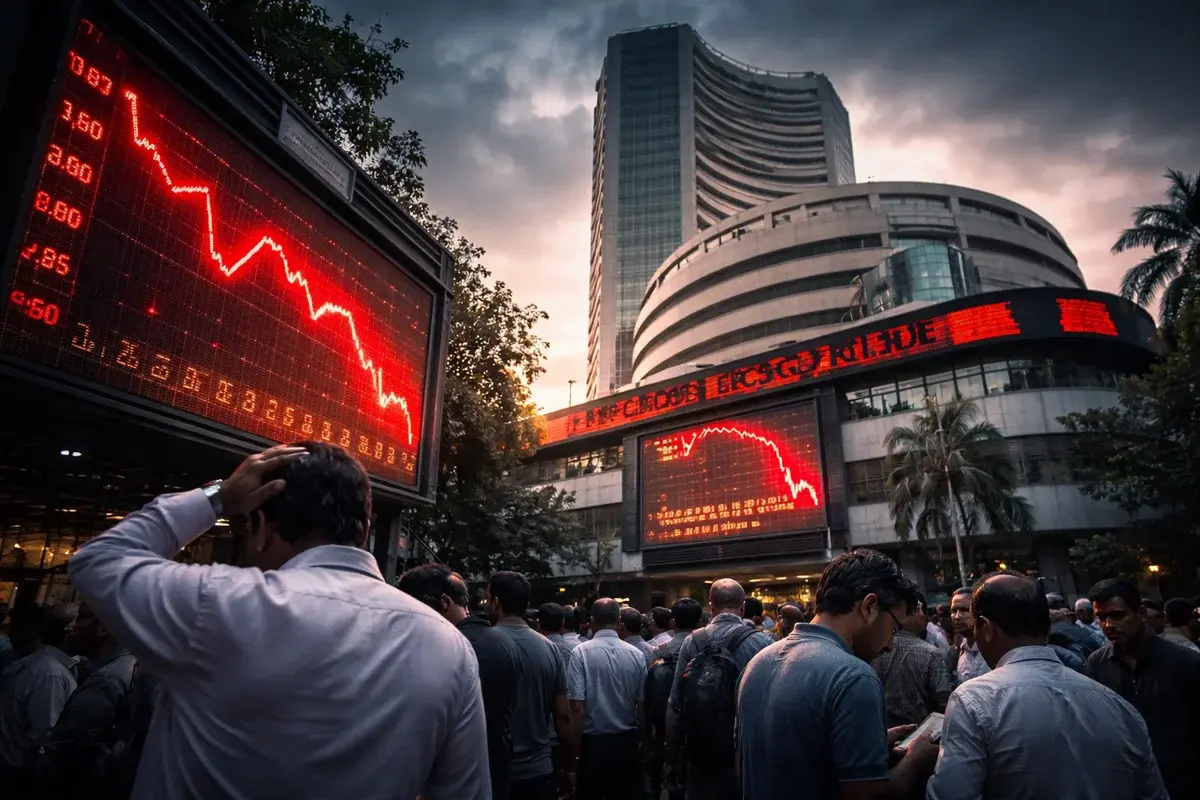
The decline in Indian stock markets reflects the growing influence of geopolitical risks and global commodity prices on investor sentiment.