Loading market data...
Vivox AI raises $1.5M in March 2026 for its regulator-ready AI agents in financial crime compliance. Explore this RegTech funding and its impact on global and Indian fintech.
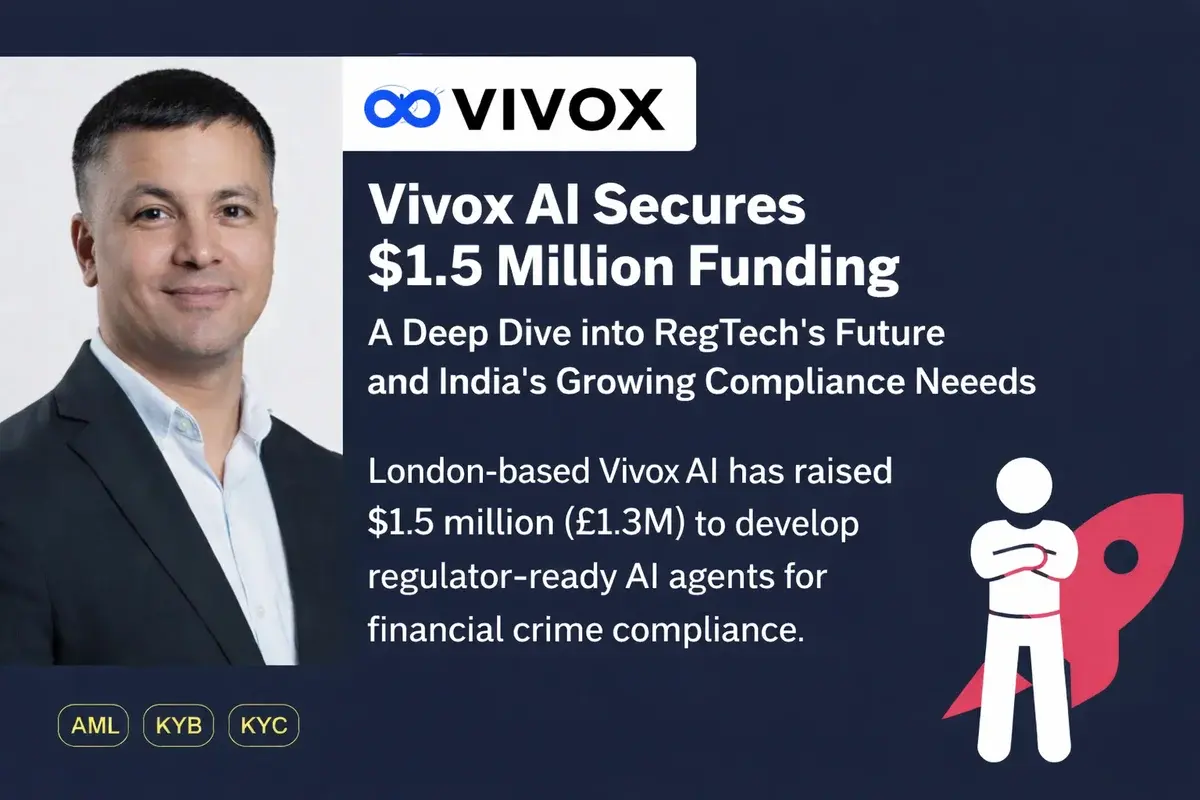
The race to modernize financial crime compliance is accelerating, and artificial intelligence is quickly becoming the industry’s most powerful tool. London-based RegTech startup Vivox AI has secured $1.5 million (£1.3M) in fresh funding, positioning itself to expand its platform of AI-driven compliance agents designed specifically for regulated financial institutions.
The funding round, announced on March 5, 2026, reflects the growing global demand for AI-powered regulatory technology (RegTech) solutions as financial institutions struggle to manage increasingly complex compliance obligations. Governments and regulators across the world including the Reserve Bank of India (RBI) and the Securities and Exchange Board of India (SEBI) are tightening oversight of anti-money laundering (AML), sanctions screening, and customer verification frameworks.
As financial systems become more digitized and cross-border transactions surge, traditional compliance processes are proving inefficient. For banks, fintech firms, and payment companies, the challenge is no longer just regulatory compliance it is compliance at scale. Vivox AI’s technology aims to address that problem by deploying specialized AI agents capable of performing compliance tasks faster, more accurately, and with greater audit transparency.
Regulatory technology has emerged as one of the fastest-growing sectors within financial technology, driven largely by rising regulatory complexity and the escalating cost of compliance. Institutions must now monitor vast datasets across multiple jurisdictions, a process that can overwhelm manual review systems.
Vivox AI focuses on building “regulator-ready AI agents” that automate complex compliance workflows such as know-your-customer (KYC), know-your-business (KYB) verification, sanctions monitoring, and transaction risk analysis. These AI agents are designed to integrate with financial institutions’ internal systems and external data providers, enabling faster decision-making while maintaining regulatory oversight.
According to industry estimates, the global RegTech market is expanding rapidly as financial institutions invest heavily in compliance automation.
| Metric | Details |
|---|---|
| Company | Vivox AI |
| Founded | London, United Kingdom |
| Funding Raised | $1.5 million (£1.3M) |
| Funding Round | Undisclosed Growth Round |
| Announcement Date | March 2026 |
| Sector | RegTech / AI Compliance Automation |
| Key Use of Funds | Platform expansion, AI agent development, hiring engineering teams |
The new funding will allow the company to expand its product capabilities and strengthen its engineering and product development teams. The capital will also support the rollout of additional AI agents tailored for highly regulated financial sectors.
The investment round attracted a group of influential technology and financial industry leaders. Among the notable participants are Axel Weber, former chairman of UBS, Dan Cobley, former managing director at Google, as well as senior executives from Barclays.
Other investors include Kos Stiskin, co-founder of Finom, European accelerator Startup Wise Guys, fintech entrepreneur James Janis Berdigans, and venture firm Venture Together.
The involvement of such investors reflects a broader trend: compliance technology is becoming a strategic priority rather than just a regulatory requirement. As financial institutions face mounting compliance costs, automation solutions are increasingly viewed as essential infrastructure.
| Investor | Background |
|---|---|
| Axel Weber | Former UBS Chairman, ex-Bundesbank President |
| Dan Cobley | Former Google UK Managing Director |
| Barclays executives | Senior banking leadership |
| Startup Wise Guys | European startup accelerator |
| Venture Together | Global venture capital firm |
The funding round also signals growing investor confidence in companies that combine artificial intelligence with regulatory frameworks, an area expected to see strong demand in the coming decade.
What differentiates Vivox AI from traditional compliance platforms is its “atomic agent” architecture. Instead of deploying a single large AI model, the company uses multiple specialized AI agents each designed for a specific compliance function.
For example, individual agents can independently analyze corporate registries, verify beneficial ownership structures, perform sanctions screening, or conduct enhanced due diligence reviews. These agents operate as auditable units, meaning financial institutions can track exactly how decisions are made a key requirement for regulators.
This modular architecture also improves operational efficiency. Early deployments indicate that complex compliance investigations that previously required several hours of manual analysis can now be completed in around 30 minutes. The platform has also demonstrated a reduction in false-positive alerts by up to 86%, a major improvement in large-scale screening systems.
| Business Metric | Details |
|---|---|
| Compliance processing time | Reduced from ~6 hours to ~30 minutes |
| False positive reduction | Up to 86% |
| AI architecture | Modular atomic agents |
| Integration | Internal and external compliance data sources |
| Target users | Banks, fintechs, payment platforms |
By making AI decisions transparent and traceable, Vivox AI aims to solve one of the biggest challenges regulators face when evaluating artificial intelligence systems.
The funding news also resonates strongly with developments in India, where financial regulators are increasingly encouraging the responsible use of AI in financial services.
India’s RegTech sector is expected to expand significantly as compliance requirements intensify and digital financial services grow rapidly. Analysts estimate that the Indian RegTech market could grow from approximately $257 million in 2023 to over $1 billion by 2029, representing a CAGR of nearly 24%.
The Reserve Bank of India, through its proposed Framework for Responsible and Ethical Enablement of Artificial Intelligence (FREE-AI), has emphasized principles such as transparency, accountability, and auditability for AI systems used in financial services.
These principles align closely with the architecture developed by Vivox AI, suggesting that platforms built with regulator-friendly design principles could see strong adoption in markets like India.
| Market Indicator | Data |
|---|---|
| Indian RegTech Market Size (2023) | $257 million |
| Projected Market Size (2029) | $1.03 billion |
| CAGR | ~23.9% |
| Key Drivers | Compliance automation, AI adoption, regulatory oversight |
Indian banks and fintech companies are already adopting AI technologies for fraud detection, transaction monitoring, and customer service automation. Compliance automation represents the next major opportunity.
The investment in Vivox AI highlights a broader shift underway in the global financial industry. Compliance is transitioning from a reactive function to a technology-driven strategic capability.
As regulators demand greater transparency and as financial crimes become more sophisticated, institutions must rely on advanced technologies to maintain oversight without dramatically increasing operational costs.
However, the rise of AI-powered compliance systems also introduces new challenges. Regulators are increasingly scrutinizing how AI models make decisions, requiring explainability and audit trails. Companies that design transparent and accountable AI architectures are therefore likely to gain a competitive advantage.
For startups like Vivox AI, the opportunity lies in becoming a trusted infrastructure layer for financial institutions navigating this new regulatory environment.
The $1.5 million funding round for Vivox AI highlights a major trend shaping the financial technology industry: the rapid expansion of AI-driven compliance platforms. As financial institutions face rising regulatory scrutiny, the demand for scalable compliance solutions is accelerating worldwide.
From startup funding and market expansion to the broader transformation of industry growth and investment trends, RegTech companies are emerging as critical players in the financial ecosystem. Firms that successfully combine artificial intelligence with regulatory transparency are expected to lead the next phase of innovation in financial infrastructure.
For investors, banks, and fintech startups alike, the message is clear AI-powered compliance is no longer optional; it is becoming a core component of modern financial strategy.

Financial journalist specializing in market analysis, stock research, and investment trends. Dedicated to providing accurate, timely insights for informed decision-making.
Credentials: Experienced financial journalist with expertise in equity markets and economic analysis
The information provided in this article is for educational and informational purposes only and should not be construed as financial, investment, or legal advice. Finscann does not provide personalized investment recommendations.
For detailed terms and conditions, please read our Disclaimer and Terms of Service.

Evervault raises €21M in Series B funding led by Ribbit Capital to expand its data encryption platform, securing sensitive information for global...

Automotive technology startup Drivn raises $80 million to expand its AI-powered vehicle data and fleet intelligence platform.

Neysa’s $600 million funding round represents a defining moment for India’s artificial intelligence infrastructure sector.

London-based biomaterials startup Shellworks secures $15 million in Series A funding to scale its biodegradable plastic alternative Vivomer.

Deeptech startup Turiyam AI secures $4 million (₹36 Cr) in pre-seed funding led by Ankur Capital and Micelio Fund.