Loading market data...
Indian stock market plunges in March 2026 as Sensex nears 700-point drop. Global tensions and surging crude oil prices fuel volatility. FinScann analyzes impact and outlook.

The Indian stock market experienced significant turbulence on Friday, March 6, 2026, with the benchmark BSE Sensex tumbling over 600 points in early trade, briefly nearing a 700-point decline, while the NSE Nifty 50 also slipped below the crucial 24,600-mark. This sharp downturn, extending a period of volatility seen throughout early March 2026, was primarily triggered by intensifying geopolitical tensions in the Middle East and a subsequent surge in global crude oil prices, unsettling investor sentiment across Dalal Street. The market's cautious mood reflects broader concerns about potential inflationary pressures, a widening current account deficit, and sustained Foreign Institutional Investor (FII) outflows.
The Catalyst
The primary driver behind the recent Indian stock market corrections in early March 2026 has been the escalation of geopolitical tensions in the Middle East, involving the United States, Israel, and Iran. This heightened conflict has sent shockwaves through global commodity markets, particularly impacting crude oil prices. Brent crude, the international benchmark, surged to a roughly 20-month high around $84-$85 per barrel, fueled by fears of supply disruptions through the strategically vital Strait of Hormuz. India, as the world's third-largest crude importer, with over 85% of its oil requirements met through imports and a substantial portion routed via the Strait of Hormuz, is particularly vulnerable to these price spikes. This "war premium" on oil directly translates into higher import bills, potential fiscal strain, and renewed concerns over domestic inflation.
Financial Forensics
The ripple effects of global instability are clearly visible in the recent performance of India's key indices and institutional investment flows. On March 6, 2026, the Sensex traded at 79,443.47 points after shedding 572.43 points in early trade, while the Nifty 50 was at 24,587.15 points, down 178.75 points. This follows earlier significant declines, including a 1,000-point drop for the Sensex on March 2nd, closing at 80,238.85, and a 1,123-point fall on March 4th, ending at 79,116. The Nifty 50 also closed at 24,865.70 on March 2nd and 24,480.50 on March 4th.
A critical factor exacerbating the market's vulnerability has been the sustained selling pressure from Foreign Institutional Investors (FIIs). On March 5, 2026, FIIs offloaded equities worth ₹3,752.52 crore, and on March 4, 2026, they were net sellers to the tune of ₹8,752.65 crore in the cash market. This consistent outflow of foreign capital signals a global "risk-off" sentiment, where international investors reduce their exposure to emerging markets like India.
Counterbalancing this, Domestic Institutional Investors (DIIs) have stepped in as significant buyers, providing crucial support and cushioning the market's fall. On March 5, 2026, DIIs bought stocks worth ₹5,153.37 crore, and on March 4, 2026, their buying amounted to ₹12,068.17 crore. This divergence highlights the domestic resilience and confidence in the Indian market's long-term prospects.
The Indian Rupee has also depreciated, weakening against the US dollar to around 91.30-91.40, reflecting pressure from rising crude prices and foreign capital outflows. A weaker rupee makes imports more expensive, further fueling inflationary concerns. The Reserve Bank of India (RBI), in its February 2026 Monetary Policy Committee (MPC) meeting, maintained its key repo rate at 5.25%, signaling a neutral stance amidst the evolving macroeconomic landscape, with inflation for FY2025-26 projected at 2.1%.
| Indicator | March 2, 2026 (Close) | March 4, 2026 (Close) | March 6, 2026 (Early Trade) |
|---|---|---|---|
| BSE Sensex | 80,238.85 (Down ~1.29%) | 79,116.19 (Down ~1.4%) | 79,443.47 (Down ~0.7%) |
| NSE Nifty 50 | 24,865.70 (Down ~1.24%) | 24,480.50 (Down ~1.6%) | 24,587.15 (Down ~0.7%) |
| Brent Crude | ~$82.37/barrel (Up ~7.4%) | ~$85/barrel (Up ~9%) | ~$84.41/barrel (Down ~1.17%) |
| FII Net Cash Flow | -₹3,295.64 Cr | -₹8,752.65 Cr | -₹3,752.52 Cr (March 5) |
| DII Net Cash Flow | +₹8,593.87 Cr | +₹12,068.17 Cr | +₹5,153.37 Cr (March 5) |
| Source: BSE, NSE, ICICIdirect, BlissMoney, NiftyTrader, StockEdge (data from various search snippets for early March 2026) |
Market Impact
The current market volatility has had a broad impact across various sectors within the Indian economy. Sectors highly sensitive to crude oil prices, such as oil marketing companies, aviation, paint and chemical manufacturers, and auto and tyre stocks, have faced significant margin pressures due to elevated input costs. The realty and financial services sectors have also seen declines amid concerns over broader macroeconomic stability.
However, some sectors exhibit a degree of resilience or even potential long-term opportunities. IT stocks have shown some gains, possibly benefiting from a defensive shift or specific company-level factors. The defence sector may also see long-term opportunities as nations globally increase their defence spending in an environment of heightened geopolitical risks. Despite the short-term headwinds, market analysts and institutional investors remain largely bullish on the overall Indian equity market outlook for 2026, citing India's strong economic growth, which is expected to be the fastest globally next year, and domestic institutional support.
Key Takeaways for Investors
FinScann Verdict
The recent 700-point decline in the Sensex underscores the immediate impact of global geopolitical tensions and elevated crude oil prices on the Indian stock market in March 2026. While short-term volatility is likely to persist, FinScann analysis suggests that India's underlying economic fundamentals and robust domestic institutional buying provide a strong buffer. Investors should maintain a disciplined approach, focusing on fundamentally sound companies and using market corrections as strategic entry points for long-term wealth creation, rather than reacting to short-term fear.
Q: Why is the Indian stock market falling significantly in early March 2026? A: The primary reason for the significant fall in the Indian stock market in early March 2026 is the escalation of geopolitical tensions in the Middle East, particularly the conflict involving the US, Israel, and Iran. This has led to a sharp surge in crude oil prices globally, directly impacting India's import bill, raising inflationary concerns, and triggering a "risk-off" sentiment among Foreign Institutional Investors (FIIs) who are selling off equities.
Q: How do rising crude oil prices affect the Indian economy and stock market? A: As India imports over 85% of its crude oil, a surge in prices like the recent jump to $80-$85 per barrel significantly impacts the economy. It leads to a wider current account deficit, higher domestic inflation, pressure on the Indian Rupee (making imports costlier), and increased operating costs for many industries. This can squeeze corporate profit margins and dampen consumer spending, subsequently affecting stock market performance, especially for oil-sensitive sectors.
Q: What is the role of FII and DII in the current market scenario? A: Foreign Institutional Investors (FIIs) have been net sellers, pulling out significant capital from Indian equities in response to global uncertainties. This outflow contributes to market downturns and volatility. Conversely, Domestic Institutional Investors (DIIs) have emerged as strong net buyers, actively investing and cushioning the market's fall, reflecting domestic confidence and liquidity. Their sustained buying has been crucial in stabilizing the market amidst foreign selling pressure.
Q: Which sectors are most affected by the current global tensions and oil price volatility? A: Sectors most affected include oil marketing companies, aviation, paint and chemical companies, auto and tyre manufacturers, realty, and financial services. These industries face higher input costs and potential demand slowdowns. Additionally, sectors like fertilisers, ceramics, and certain capital goods companies with significant Middle East trade exposure or reliance on imported LNG are also vulnerable to supply chain disruptions and increased freight costs.
Q: Should investors consider selling their holdings during such market corrections? A: FinScann advises against panic selling during market corrections. While volatility is high, historical trends indicate that such geopolitical shocks often lead to temporary dips, followed by strong rebounds. Long-term investors should consider this a period to review their portfolios, potentially rebalance, and identify quality stocks available at attractive valuations. Consult a SEBI-registered advisor to tailor strategies to your individual financial goals and risk tolerance.
Disclaimer: For information only; not investment advice. Stock market investments carry risks. Please consult a SEBI-registered advisor before investing. FinScann assumes no liability for decisions made based on this report.

Financial journalist specializing in market analysis, stock research, and investment trends. Dedicated to providing accurate, timely insights for informed decision-making.
Credentials: Experienced financial journalist with expertise in equity markets and economic analysis
The information provided in this article is for educational and informational purposes only and should not be construed as financial, investment, or legal advice. Finscann does not provide personalized investment recommendations.
For detailed terms and conditions, please read our Disclaimer and Terms of Service.

Indian stock markets declined sharply on March 6 as banking and financial stocks led losses amid rising crude oil prices and geopolitical tensions in...

Reliance Industries Ltd. leverages a US waiver to boost Russian oil imports. Discover the financial impact, market implications, and strategic...

Foreign Institutional Investors offloaded ₹17,000 crore in Indian IT stocks in February 2026, sparking fears of AI disrupting software services.
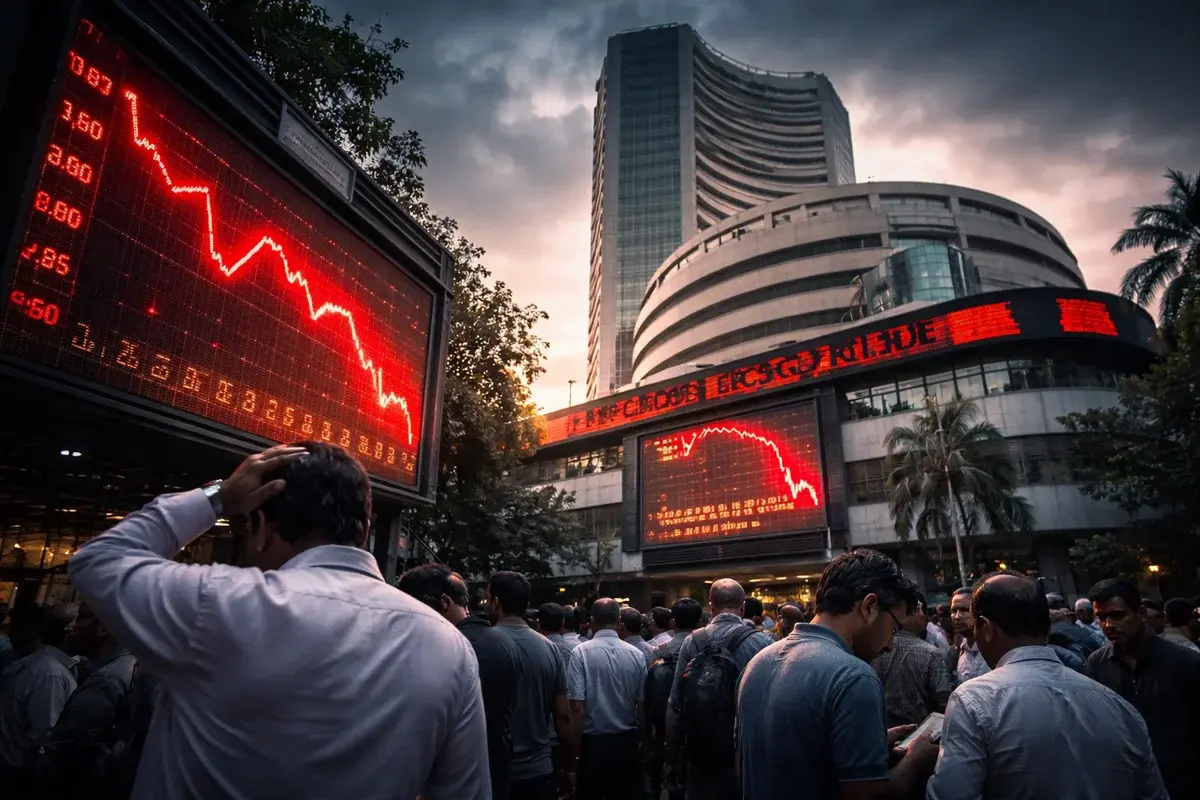
The decline in Indian stock markets reflects the growing influence of geopolitical risks and global commodity prices on investor sentiment.

The decline in Indian equity markets highlights how global geopolitical developments continue to shape investor sentiment and financial performance.