Loading market data...
Reliance Industries Ltd. leverages a US waiver to boost Russian oil imports. Discover the financial impact, market implications, and strategic advantages for RIL in March 2026.

Reliance Industries Ltd. (RIL) is poised to significantly enhance its Russian crude oil imports, seizing a crucial opportunity presented by a temporary 30-day waiver from the United States, granted to India on March 6, 2026. This strategic move allows Indian refiners, including the Mumbai-headquartered conglomerate, to access Russian oil cargoes already stranded at sea, offering critical short-term relief amidst escalating global energy market tensions, particularly from the Middle East. The development saw RIL's share price surge by 2.5% on Friday, March 6, reaching an intraday high of ₹1,424 per share on the BSE, reflecting strong investor optimism.
The Catalyst
The geopolitical landscape has been volatile, with sanctions against Russian oil impacting global supply chains. However, India, a vital U.S. ally, received a temporary exemption from the U.S. Treasury Department, allowing Indian refiners to process Russian crude loaded on vessels as of March 5, 2026, with the waiver valid until April 3, 2026. This decision, announced by US Treasury Secretary Scott Bessent, aims to stabilize global energy markets, particularly in light of disruptions from the Strait of Hormuz crisis and Iran's efforts to disrupt global energy supplies. While a deliberately short-term measure, primarily authorizing transactions involving oil already stranded at sea, it provides a crucial window for Indian refiners to secure supplies without violating sanctions. This waiver marks a significant, albeit temporary, shift from previous U.S. pressure on India to reduce its Russian oil purchases.
Financial Forensics
The ability to access discounted Russian crude offers substantial financial benefits for Reliance Industries Ltd., particularly for its refining complex in Jamnagar, Gujarat – the world's largest single-location refining complex. Historically, Russian Urals crude has traded at a discount to Brent, providing cost advantages. While this specific waiver applies to oil already stranded, thus potentially limiting significant financial benefits to the Russian government, it provides a cost-effective feedstock for RIL.
Analysts suggest that securing cheaper crude imports can significantly enhance RIL's Gross Refining Margins (GRM). Each $1 increase in GRM can add approximately ₹4,500 crore to RIL's annual EBITDA. With diesel cracks surging to between $35-$42 per barrel from around $20, refining margins are expected to expand significantly, particularly for complex refiners like RIL with high diesel yields. The company's diversified petrochemical feedstock, with limited dependency (25%) on crude-linked naphtha, also positions its Oil-to-Chemicals (O2C) business for near-term benefits from rising petrochemical margins alongside crude price increases.
Table: Potential Impact of Russian Crude on RIL's Refining Margins (Illustrative)
| Metric | Pre-Waiver Scenario (Estimated) | Post-Waiver Scenario (Estimated, Short-Term) | Potential Impact (Annualized) |
|---|---|---|---|
| Crude Cost (per barrel) | Higher (e.g., ~$85 Brent) | Lower (due to discount/stranded oil) | Reduced input costs |
| Diesel Crack (per barrel) | ~$20 | ~$35 - $42 | Significant uplift |
| Gross Refining Margin (GRM) Uplift | Base GRM | ~$4-5/bbl increase | ₹4,500 Cr per $1 GRM increase |
| O2C Business Margin | Stable | Likely rise | Positive |
| Overall Profitability | Steady | Expected boost | Enhanced EBITDA and PAT |
Source: FinScann Analysis, based on market reports and analyst commentary
Market Impact
The announcement of the waiver and Reliance's intention to secure Russian crude has already injected positive sentiment into the Indian markets. RIL shares rose over 2% following the news, reflecting investor optimism for stabilization of crude supply for domestic refining operations. This temporary measure provides immediate relief and flexibility to Indian refiners, ensuring continued inflow of crucial crude supplies while global energy markets grapple with geopolitical uncertainties. This could help India manage energy inflation, import costs, and currency stability in the near term. While the waiver is for 30 days, it addresses an immediate supply disruption that could have impacted the broader market and other Indian refiners.
Key Takeaways for Investors
Moat Analysis
A company's 'moat' refers to its sustainable competitive advantage. For Reliance Industries Ltd., its massive scale, integrated operations, and strategic flexibility form a formidable moat. The Jamnagar refinery's capability to process diverse and heavier crude grades positions RIL to extract maximum value from various sources, including discounted Russian oil. This temporary waiver, while short-lived, reinforces RIL's operational resilience and its ability to navigate complex global supply dynamics, ensuring feedstock availability and optimizing costs, thereby strengthening its cost advantage in the refining sector. Furthermore, RIL's ongoing diversification into new energy and retail further broadens its revenue streams, reducing sole reliance on its O2C business.
FinScann Verdict
The US temporary waiver allowing Indian refiners, prominently Reliance Industries Ltd., to procure Russian crude is a clear strategic advantage in the current volatile global energy market. While the 30-day window limits its long-term impact, it provides an immediate boost to RIL's refining economics and profitability outlook for Q1 FY27. Investors should view this as a positive catalyst for near-term performance, reinforcing RIL's robust operational capabilities and its pivotal role in India's energy security strategy.
Q: What is the significance of the US temporary waiver for Reliance Industries? A: The waiver allows Reliance Industries Ltd. to legally purchase Russian crude oil that was already loaded on vessels as of March 5, 2026, for a 30-day period. This helps RIL secure feedstock at potentially discounted rates, stabilizing its refining operations and potentially boosting gross refining margins amidst global energy market disruptions.
Q: How will this impact Reliance's refining margins? A: Access to Russian crude, especially at discounted prices or as otherwise stranded cargoes, is expected to improve RIL's Gross Refining Margins (GRM) by reducing input costs. Analysts anticipate a significant uplift in GRMs, potentially by $4-5 per barrel, given the surge in diesel cracks to $35-$42 per barrel.
Q: Is this a long-term solution for India's energy needs? A: No, the waiver is explicitly a short-term, 30-day measure expiring on April 3, 2026. While it provides immediate relief and flexibility to Indian refiners, it does not address India's fundamental long-term energy supply vulnerabilities or the structural risks in global oil markets. The US also expects India to gradually diversify its energy imports and increase purchases of American oil in the longer run.
Q: What was the immediate market reaction to this news? A: Reliance Industries Ltd. shares reacted positively, gaining over 2% on March 6, 2026, with the stock hitting an intraday high of ₹1,424 on the BSE. This surge reflects investor confidence in the company's ability to navigate supply challenges and benefit from improved refining economics.
Q: How does this align with Reliance's broader energy strategy? A: While Reliance has an ambitious target to achieve net-zero carbon status by 2035 and is investing heavily in new energy businesses like solar, wind, and green hydrogen, hydrocarbons will remain vital for India for several years. This move demonstrates RIL's strategy to excel in traditional energy while simultaneously building the energy system of the future and ensuring energy security for India.
Disclaimer: For information only; not investment advice. Stock market investments carry risks. Please consult a SEBI-registered advisor before investing. FinScann assumes no liability for decisions made based on this report.

Financial journalist specializing in market analysis, stock research, and investment trends. Dedicated to providing accurate, timely insights for informed decision-making.
Credentials: Experienced financial journalist with expertise in equity markets and economic analysis
The information provided in this article is for educational and informational purposes only and should not be construed as financial, investment, or legal advice. Finscann does not provide personalized investment recommendations.
For detailed terms and conditions, please read our Disclaimer and Terms of Service.

Indian stock markets declined sharply on March 6 as banking and financial stocks led losses amid rising crude oil prices and geopolitical tensions in...

Foreign Institutional Investors offloaded ₹17,000 crore in Indian IT stocks in February 2026, sparking fears of AI disrupting software services.

Indian stock market plunges in March 2026 as Sensex nears 700-point drop. Global tensions and surging crude oil prices fuel volatility.
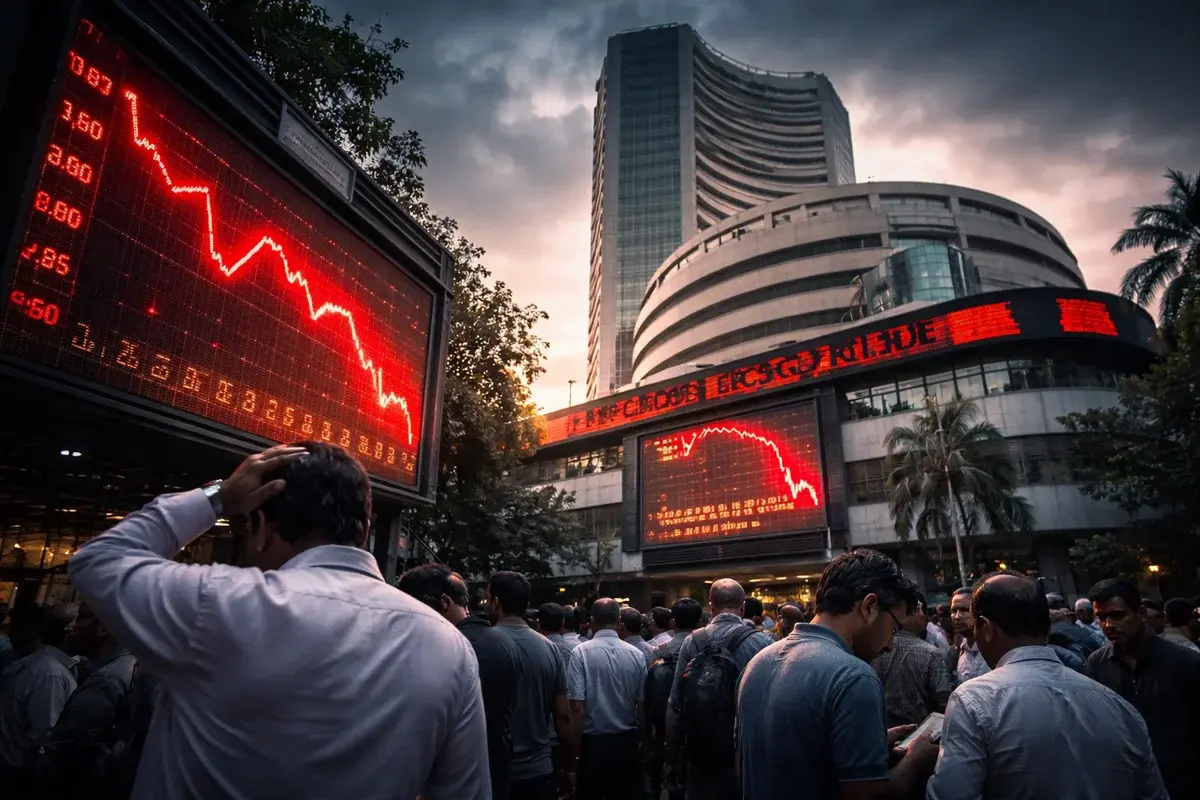
The decline in Indian stock markets reflects the growing influence of geopolitical risks and global commodity prices on investor sentiment.

The decline in Indian equity markets highlights how global geopolitical developments continue to shape investor sentiment and financial performance.