Loading market data...
The decline in Indian stock markets reflects the growing influence of geopolitical risks and global commodity prices on investor sentiment. Profit booking combined with rising crude oil prices and foreign capital outflows triggered a sharp drop in benchmark indices such as the Sensex and Nifty 50. As markets navigate uncertainty driven by international conflicts and macroeconomic pressures, investors are closely tracking oil price movements, capital flows, and sector performance to assess future market expansion and financial performance trends.
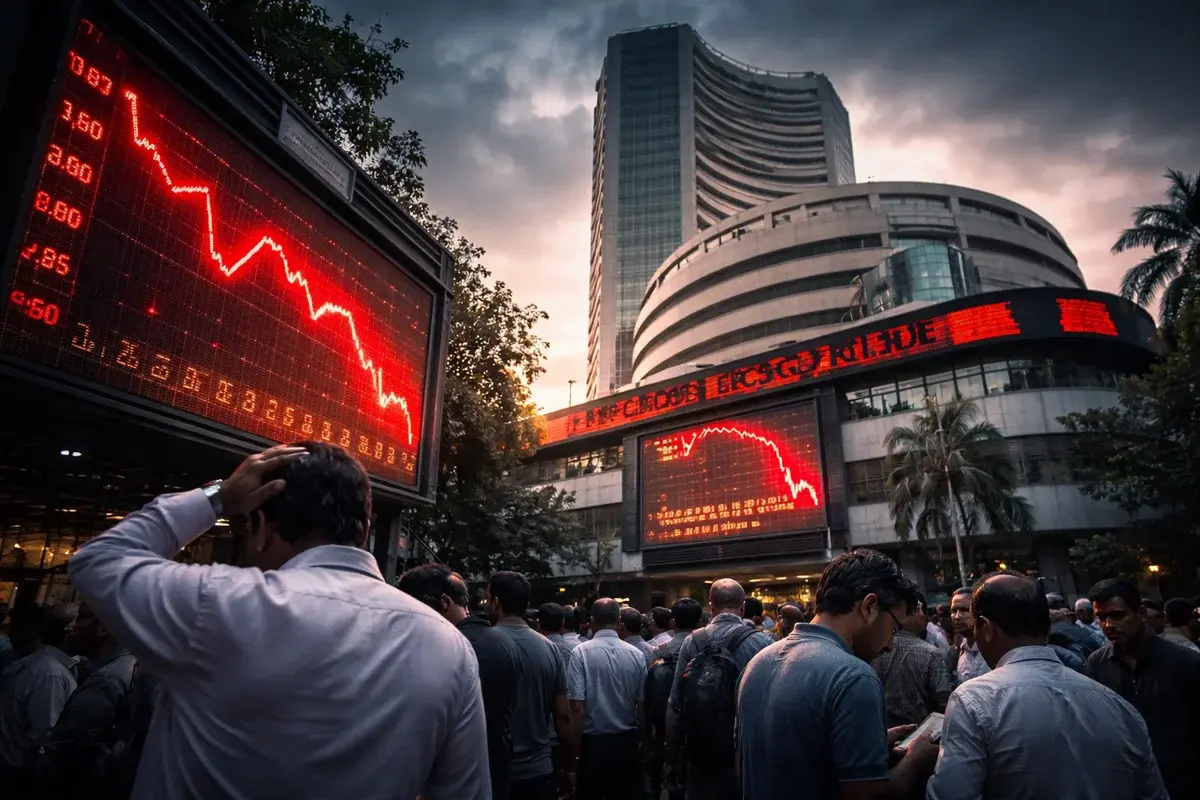
Indian equity markets witnessed a sharp correction today as investors turned cautious amid rising geopolitical tensions and profit booking after the previous session’s rally. The benchmark BSE Sensex dropped nearly 700 points, slipping close to the 79,346 intraday level, while the Nifty 50 declined by nearly 200 points, touching 24,575 during the session.
The downturn highlights the fragile sentiment currently prevailing in global financial markets. Escalating tensions surrounding the United States–Iran conflict have pushed crude oil prices higher, triggering concerns about inflationary pressures and potential disruptions to global energy supplies.
For India, which depends heavily on imported crude oil, fluctuations in global oil prices often have an outsized impact on financial markets. As a result, investors reacted swiftly by locking in profits and reducing exposure to riskier assets.
A key factor behind the market decline was profit booking after the strong gains recorded in the previous trading session. Traders who had accumulated positions during the rally chose to exit positions, triggering selling pressure across several sectors.
During the trading session, the Sensex fell to an intraday low of 79,346, while the Nifty 50 slipped to around 24,575, reflecting broad-based weakness across large-cap stocks.
The selling pressure also resulted in a noticeable erosion of market capitalization across companies listed on the Bombay Stock Exchange.
| Market Metric | Details |
|---|---|
| Sensex Intraday Low | 79,346 |
| Nifty 50 Intraday Low | 24,575 |
| Sensex Decline | ~700 points |
| Nifty Decline | ~200 points |
| Market Sentiment | Risk-off |
Although the correction was significant, analysts note that such pullbacks are common after strong rallies, especially when external uncertainties dominate market narratives.
The sharp fall in benchmark indices translated into a substantial decline in the overall market value of listed companies.
The total market capitalization of firms listed on the Bombay Stock Exchange dropped from ₹453 lakh crore to approximately ₹452 lakh crore, resulting in an erosion of about ₹1 lakh crore in investor wealth within a single session.
Such rapid shifts in market capitalization underscore how quickly investor sentiment can change in response to geopolitical developments.
| Market Indicator | Data |
|---|---|
| Previous Market Cap | ₹453 lakh crore |
| Current Market Cap | ₹452 lakh crore |
| Investor Wealth Loss | ₹1 lakh crore |
| Primary Driver | Profit booking and global tensions |
While the decline appears substantial, it represents a relatively modest percentage drop compared to past geopolitical shocks.
Another major factor weighing on the market is the recent rise in global crude oil prices following escalating tensions between the United States and Iran.
Higher oil prices tend to have multiple ripple effects across the Indian economy. They increase fuel costs, push inflation higher, and widen the country’s trade deficit.
Since India imports a large portion of its energy needs, sustained increases in crude oil prices can put pressure on both government finances and corporate profitability.
| Oil Market Indicator | Impact |
|---|---|
| Rising Brent Crude | Inflation risk |
| Higher Fuel Costs | Pressure on transport and manufacturing |
| Trade Deficit Risk | Increased import bill |
| Market Reaction | Cautious sentiment |
Investors are therefore closely monitoring developments in global energy markets as geopolitical tensions continue to evolve.
In addition to profit booking, foreign institutional investor (FII) activity has played a role in amplifying market volatility.
During periods of global uncertainty, foreign investors often reduce exposure to emerging markets and reallocate funds to safer assets such as US Treasury bonds or gold.
This shift in capital flows can trigger sharp fluctuations in stock markets, particularly in emerging economies like India where foreign investments account for a significant portion of market liquidity.
| Investor Activity | Impact |
|---|---|
| FII Outflows | Increased volatility |
| Risk Aversion | Capital shifts to safe assets |
| Emerging Market Impact | Higher sensitivity |
Domestic institutional investors often step in to stabilize markets, but short-term volatility can still occur when global factors dominate investor sentiment.
Certain sectors are particularly vulnerable to fluctuations in crude oil prices. Industries such as aviation, logistics, chemicals, and transportation typically experience increased operational costs when fuel prices rise.
Similarly, sectors that rely heavily on imported raw materials may face margin pressure if energy prices remain elevated.
Market participants are therefore watching oil price trends closely, as prolonged increases could affect earnings forecasts for several industries.
Despite the day’s sharp decline, analysts believe that the broader structural outlook for Indian equities remains positive. Domestic economic fundamentals, strong consumption trends, and continued infrastructure investment provide long-term support for market growth.
However, in the short term, markets are likely to remain sensitive to global developments, particularly geopolitical tensions and commodity price movements.
Investors will continue monitoring the US-Iran situation, crude oil price levels, and foreign investment flows to gauge the next direction of the market.

Financial journalist specializing in market analysis, stock research, and investment trends. Dedicated to providing accurate, timely insights for informed decision-making.
Credentials: Experienced financial journalist with expertise in equity markets and economic analysis
The information provided in this article is for educational and informational purposes only and should not be construed as financial, investment, or legal advice. Finscann does not provide personalized investment recommendations.
For detailed terms and conditions, please read our Disclaimer and Terms of Service.

Reliance Industries Ltd. leverages a US waiver to boost Russian oil imports. Discover the financial impact, market implications, and strategic...

Foreign Institutional Investors offloaded ₹17,000 crore in Indian IT stocks in February 2026, sparking fears of AI disrupting software services.

Indian stock market plunges in March 2026 as Sensex nears 700-point drop. Global tensions and surging crude oil prices fuel volatility.
The decline in Indian equity markets highlights how global geopolitical developments continue to shape investor sentiment and financial performance.

FinScann presents a deep dive into Indian stocks to watch on March 6, 2026. Navigate market volatility driven by crude oil, geopolitics, and...