Loading market data...
Foreign Institutional Investors offloaded ₹17,000 crore in Indian IT stocks in February 2026, sparking fears of AI disrupting software services. FinScann analyzes the market impact.

Foreign Institutional Investors (FIIs) have staged a significant exodus from the Indian technology sector, offloading nearly ₹17,000 crore worth of Indian IT stocks in February 2026. This aggressive selling comes amidst mounting concerns that the rapid advancements in artificial intelligence (AI) could fundamentally disrupt the traditional software services model, reshaping the landscape for India's $250 billion IT industry. The rout has pushed the Nifty IT index down over 20% so far in 2026, marking its worst monthly fall since the 2008 global financial crisis.
The Catalyst
The primary driver behind this sharp sell-off is the intensifying apprehension surrounding the transformative, and potentially disruptive, power of generative AI on the global IT services industry. Brokerage firms globally have begun reassessing their outlook for the sector, with some painting a grim picture of a future where AI structurally alters the IT business mix. The concerns escalated after an AI startup, Anthropic, demonstrated its Claude tool's ability to streamline COBOL code, raising fears about the viability of long-standing revenue streams for technology companies. This development sent shockwaves across global tech stocks, including a 13% plunge in IBM shares overnight, its worst single-day selloff in approximately 25 years.
Financial Forensics: The FII Exodus & Brokerage Outlook
The FII selling spree accelerated in the latter half of February, with investors dumping ₹5,993 crore of IT stocks between February 15-28, following an initial ₹11,000 crore sell-off in the first fortnight, according to NSDL data. This sustained outflow highlights a profound shift in foreign investor sentiment towards Indian IT.
Leading global brokerages have reacted by slashing earnings estimates and price targets for Indian IT majors.
However, the outlook isn't uniformly negative. Nuvama maintains a contrarian view, asserting that the Indian IT services industry could emerge stronger from Gen AI disruption, with a net increase in its Total Addressable Market (TAM), similar to past technological shifts. Some analysts believe that while short-term volatility will persist, the medium to long-term view remains positive. Firms like Infosys and HCLTech are still preferred picks for some brokerages like Citi, and TCS and Infosys are seen as strong players with AI transformation revenue opportunities and global digital transformation partnerships.
Market Impact: Nifty IT's Decline & Sectoral Shifts
The Nifty IT index has been the worst-performing sector in February 2026, plunging over 20% and wiping out approximately ₹6.4 lakh crore (equivalent to $68.6 billion) in market capitalization across its constituent companies. Major IT companies like Infosys, TCS, HCLTech, Mphasis, LTIMindtree, and Coforge experienced significant declines.
The selling extended beyond IT, with FIIs also offloading ₹5,238 crore worth of consumer services stocks and ₹1,775 crore of telecom stocks in the second fortnight of February. This indicates a broader de-risking from sectors perceived as vulnerable to technological disruption or shifting consumer trends.
In stark contrast, FIIs were net buyers in sectors such as capital goods, auto, construction, metals, power, and financials. This suggests a strategic shift towards sectors tied to India's domestic infrastructure and consumption growth story, reflecting confidence in the country's broader economic fundamentals. Domestic Institutional Investors (DIIs) also provided strong buying support, absorbing some of the FII selling pressure, particularly on specific days in February. This growing domestic liquidity acts as a counterbalancing force, reducing India's over-reliance on foreign capital.
FII Net Inflows/Outflows (February 2026, select sectors)
| Sector | FII Net Flow (₹ Crores) | Trend |
|---|---|---|
| IT Services | -17,000 | Outflow |
| Consumer Services | -5,238 | Outflow |
| Telecom | -1,775 | Outflow |
| Capital Goods | Net Buyer | Inflow |
| Auto | Net Buyer | Inflow |
| Financials | Net Buyer | Inflow |
| Power | Net Buyer | Inflow |
| Metals | Net Buyer | Inflow |
Source: FinScann analysis based on NSDL data and brokerage reports.
Key Takeaways for Investors
FinScann Verdict
The significant FII sell-off in Indian IT stocks during February 2026 underscores a genuine concern regarding AI's potential to disrupt traditional software services. While some near-term pain and valuation reset are likely, FinScann believes this disruption will ultimately lead to a transformation rather than an extinction event for the resilient Indian IT industry. Investors should exercise caution, focusing on companies demonstrating clear strategies for AI adoption, innovation, and value creation beyond mere labour arbitrage, while also considering diversified exposure to India's burgeoning domestic growth story.
Q: How has AI impacted Indian IT services so far? A: AI has rapidly moved from experimentation to enterprise adoption, leading to concerns about automation, particularly for entry-level roles. While some experts caution against "AI washing" (cost-cutting being attributed to AI), there is a wide shift in how developers and engineers use AI tools, leading to increased efficiency and potentially reduced human hours for tasks. This has sparked fears of revenue and margin compression for traditional service models.
Q: What is the long-term outlook for Indian IT companies in the age of AI? A: The long-term outlook is mixed, with divergent views. While some brokerages foresee a structural change towards consulting/implementation and away from managed services, increasing cyclicality, others believe the Indian IT industry will emerge stronger, with AI potentially expanding its total addressable market (TAM). The key will be companies' ability to adapt, evolve revenue models from effort-based to outcome-based, and invest in reskilling and innovation.
Q: Which sectors are FIIs currently favoring in India? A: In February 2026, FIIs were net buyers in sectors such as capital goods, auto, construction, metals, power, and financials. This indicates a preference for sectors linked to India's domestic infrastructure, manufacturing push, and consumption story, reflecting a rotation away from perceived risks in the IT sector.
Q: Should investors exit all Indian IT stocks? A: Not necessarily. While the sector faces significant headwinds and near-term volatility, some analysts maintain a positive medium-to-long-term view, identifying selective opportunities. The current correction has also brought valuations to lower levels. However, investors should conduct thorough due diligence, focusing on companies with strong balance sheets, clear AI adoption strategies, and diversified service offerings that can thrive in an evolving technological landscape.
Disclaimer: For information only; not investment advice. Stock market investments carry risks. Please consult a SEBI-registered advisor before investing. FinScann assumes no liability for decisions made based on this report.

Financial journalist specializing in market analysis, stock research, and investment trends. Dedicated to providing accurate, timely insights for informed decision-making.
Credentials: Experienced financial journalist with expertise in equity markets and economic analysis
The information provided in this article is for educational and informational purposes only and should not be construed as financial, investment, or legal advice. Finscann does not provide personalized investment recommendations.
For detailed terms and conditions, please read our Disclaimer and Terms of Service.

Indian stock markets declined sharply on March 6 as banking and financial stocks led losses amid rising crude oil prices and geopolitical tensions in...

Reliance Industries Ltd. leverages a US waiver to boost Russian oil imports. Discover the financial impact, market implications, and strategic...

Indian stock market plunges in March 2026 as Sensex nears 700-point drop. Global tensions and surging crude oil prices fuel volatility.
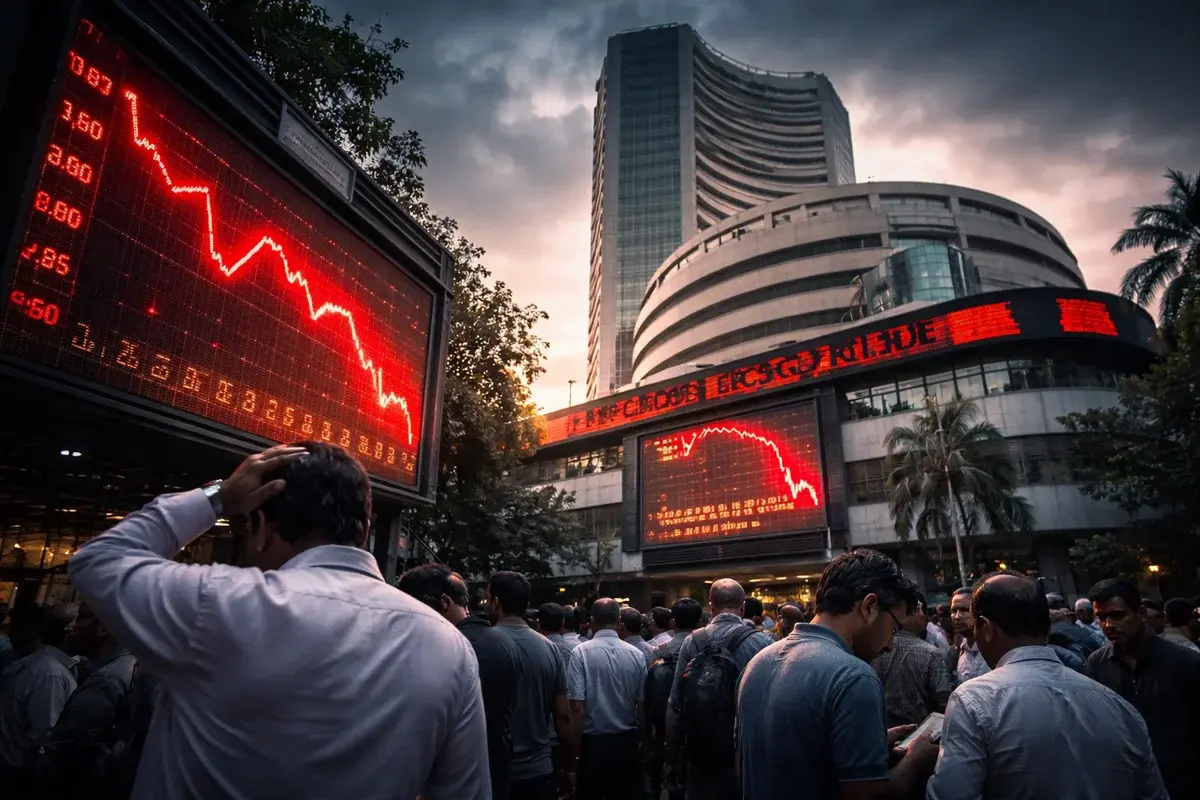
The decline in Indian stock markets reflects the growing influence of geopolitical risks and global commodity prices on investor sentiment.

The decline in Indian equity markets highlights how global geopolitical developments continue to shape investor sentiment and financial performance.