Loading market data...
Discover how a single Japanese-backed company built a 60% dominance in India’s automotive OEM paint industry. Explore the Maruti connection, Japanese supply chain advantage, high entry barriers, margin challenges, and the evolving competitive landscape.
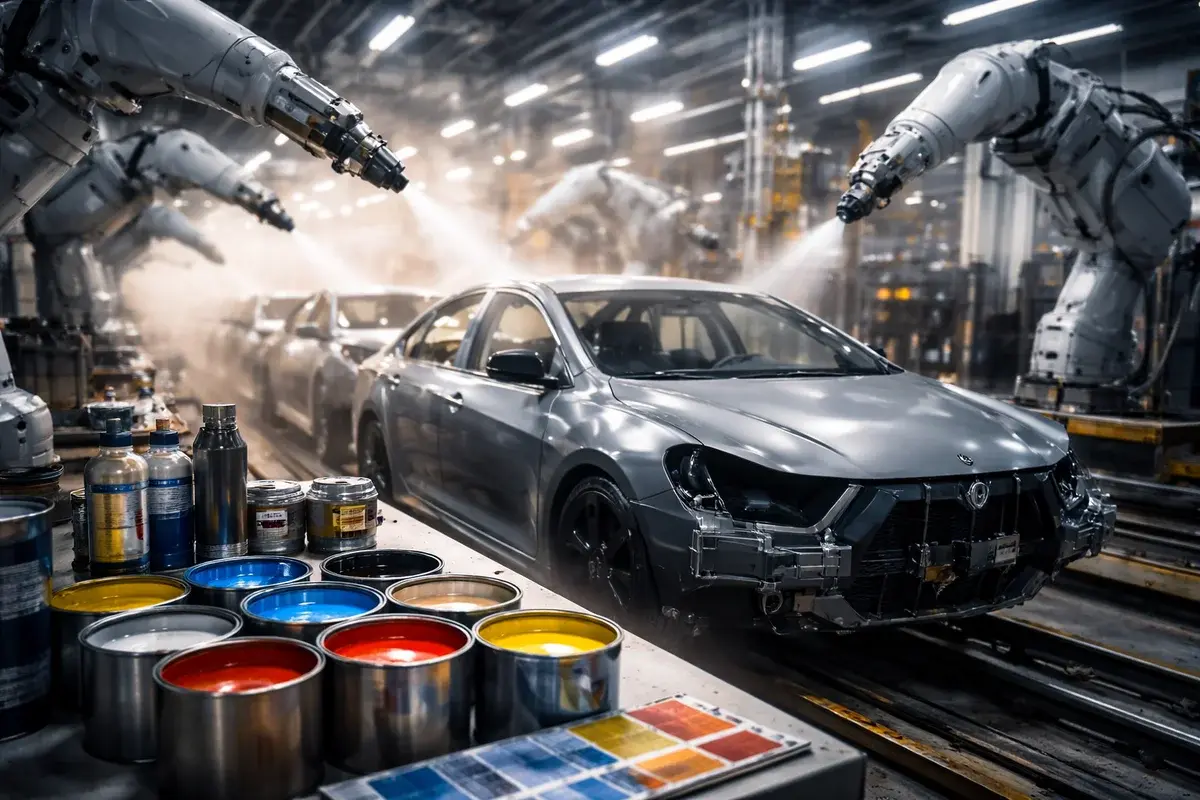
While Asian Paints dominates India’s decorative segment, a Japanese backed company quietly controls more than 60 percent of the automotive OEM paint market in India. Kansai Nerolac built this dominance through deep integration with Japanese automakers, high technical entry barriers, and decades of supply chain alignment. Yet despite this commanding market share, its margins remain structurally constrained due to OEM bargaining power and crude-linked raw material volatility.
India’s paint industry is often discussed through the lens of decorative leaders like Asian Paints. But beyond home walls lies a far more technical and strategically complex battlefield: automotive coatings.
One company dominates this segment.
Kansai Nerolac Paints commands over 60 percent share of the automotive OEM paint market in India.
This leadership is not driven by advertising. It is built on engineering, integration, and industrial trust.
The story begins in the 1980s.
When the Indian government partnered with Suzuki Motor Corporation to launch the Maruti 800, Kansai Nerolac, then Goodlass Nerolac, was selected as the paint supplier.
As Maruti Suzuki India Limited grew into India’s largest passenger vehicle manufacturer, Kansai Nerolac scaled alongside it.
This early integration created structural advantages:
• Technical embedding in production lines • Manufacturing plants located near OEM hubs • Long term trust with Japanese management
Once embedded, Nerolac was not simply a vendor. It became part of the production ecosystem.
The deeper layer of the moat comes from Japan’s industrial supply chain structure.
Parent company Kansai Paint Co., Ltd. is a major global coatings supplier to Japanese automotive brands.
India’s automotive market has long been shaped by Japanese OEMs such as:
• Maruti Suzuki • Toyota • Honda • Yamaha
Because Kansai Paint already supplies many of these brands globally, Kansai Nerolac becomes the default trusted supplier for Indian assembly operations.
This advantage is institutional, not transactional.
It is based on compatibility, testing validation, and long term industrial relationships.
Automotive coatings are among the most technically demanding industrial products.
They must withstand:
• Extreme heat and cold • Corrosion for over a decade • UV exposure • Environmental compliance norms • Robotic spray calibration
Approval cycles for a new paint supplier can take years. Switching suppliers requires:
• Full corrosion revalidation • Production line recalibration • Risk of warranty claims • Downtime at assembly plants
The switching cost is massive.
That is the real moat.
Despite commanding over 60 percent market share, Kansai Nerolac has limited pricing flexibility.
Automotive OEMs operate at large scale and exert strong bargaining power.
Raw materials used in automotive paints are crude oil derivatives. When crude prices rise:
• Resin costs increase • Solvent prices spike • Pigment prices move higher
But OEM contracts are often fixed or tightly negotiated.
Passing cost increases is slow and difficult.
As a result, EBITDA margins in automotive coatings are structurally lower than decorative paints.
This creates a fascinating contrast.
While decorative leaders like Asian Paints enjoy strong retail pricing power, Kansai Nerolac’s largest business operates in a margin sensitive B2B environment.
Other global coatings players have struggled to penetrate OEM assembly lines at scale.
Major competitors include:
• PPG Asian Paints • AkzoNobel India
Instead of challenging OEM dominance directly, these companies have focused on the Auto Refinish market.
Auto refinish paints are used in body shops after accidents. This segment offers:
• Higher margins • Branding opportunities • Less dependency on OEM contracts
It has become the alternative battlefield.
India’s automotive landscape is evolving.
Non-Japanese OEMs are growing aggressively:
• Tata Motors • Mahindra & Mahindra • JSW MG Motor India • Hyundai Motor India
This diversification reduces historic reliance on Japanese supply chains.
New EV platforms, new suppliers, and new material technologies could gradually open doors for competitors.
This represents both opportunity and strategic risk for Kansai Nerolac.
Kansai Nerolac understands the profitability gap between B2B automotive coatings and B2C decorative paints.
That is why it has been investing heavily in the decorative segment.
The objective is clear:
• Improve margin profile • Reduce cyclicality • Strengthen brand visibility • Increase retail distribution
However, competing against entrenched decorative leaders is not easy. Dealer networks, brand recall, and retail trust take decades to build.
| Advantage | Explanation |
|---|---|
| Early OEM Integration | Maruti partnership foundation |
| Japanese Ecosystem Support | Global Kansai Paint alignment |
| High Switching Costs | Long approval cycles |
| Technical Complexity | Robotic production embedding |
| Geographic Manufacturing | Plants near auto hubs |
| Risk | Impact |
|---|---|
| Crude Oil Volatility | Margin compression |
| OEM Bargaining Power | Limited pricing flexibility |
| EV Material Innovation | Need for R&D adaptation |
| Decorative Competition | High retail intensity |
Can Kansai Nerolac maintain automotive dominance while successfully scaling decorative paints?
If EV platforms demand new coating technologies, incumbency advantage may be tested.
If non-Japanese OEMs expand market share, supplier dynamics could shift.
But as of today, Kansai Nerolac remains deeply embedded in India’s automotive production backbone.
While Asian Paints colors Indian homes, Kansai Nerolac quietly coats India’s highways.
Its dominance was built through engineering alignment, supply chain trust, and structural entry barriers.
The coming decade will determine whether this B2B fortress evolves into a broader consumer champion or remains a technical specialist in automotive coatings.
Either way, the automotive paints industry in India is far more strategic and complex than most investors realize.

Financial journalist specializing in market analysis, stock research, and investment trends. Dedicated to providing accurate, timely insights for informed decision-making.
Credentials: Experienced financial journalist with expertise in equity markets and economic analysis
The information provided in this article is for educational and informational purposes only and should not be construed as financial, investment, or legal advice. Finscann does not provide personalized investment recommendations.
For detailed terms and conditions, please read our Disclaimer and Terms of Service.
Paras Defence shares surged 13% as West Asia tensions escalate, coinciding with its bold entry into advanced semiconductor packaging (OSAT) for AI...
FinScann analyzes Indian defence stocks like BEL, BDL surging on geopolitical tensions. Plus, Citi's cautious outlook on IT giants Infosys and HCL...

FinScann's latest analysis on Fino Payments, Adani Green, Tata Steel, Mahanagar Gas, and Laurus Labs for March 4, 2026.
Explore the legacy of Ratan Tata and the enduring strength of the Tata Group. A deep look into leadership vision, corporate governance, global...
Deep-dive analysis of Adani Group covering all listed companies including Adani Ports, Adani Green, Adani Power, Adani Enterprises, Ambuja Cement and...