Loading market data...
Crude oil prices surge 20% to $111 amid US-Iran conflict, triggering a Nifty 50 gap-down and global market sell-off. FinScann analyzes inflation fears.

The global financial landscape is in turmoil this morning as crude oil prices have dramatically surged by 20%, hitting a 52-week high of $111.24 per barrel. This significant escalation, primarily fueled by ongoing tensions from the US-Iran conflict, has sent shockwaves across commodities and equity markets worldwide, with safe-haven assets like gold and silver experiencing sharp declines of up to 5%. Asian stock markets, including India's Nifty 50, are poised for a challenging open as inflation fears intensify.
The Catalyst
The core driver behind this abrupt market shift is the intensifying geopolitical conflict between the US and Iran. Recent US-Israeli military strikes on Iran, which commenced on February 28, 2026, and Iran's subsequent retaliatory actions, have triggered widespread concern over global energy supplies. Crucially, the conflict has led to disruptions and threats to shipping through the Strait of Hormuz, a vital chokepoint through which approximately 20% of the world's oil supply normally flows. This potential for prolonged supply disruption has injected a substantial risk premium into crude oil prices, pushing Brent crude past $100 per barrel for the first time in over three and a half years.
Financial Forensics
The immediate financial repercussions are stark. Brent crude, the international benchmark, saw its price soar, at one point topping $114 a barrel on Sunday, before moderating slightly to around $107.50 on Monday. Similarly, West Texas Intermediate (WTI) crude, the U.S. benchmark, was trading around $107.06 a barrel, marking a 16.2% increase from its Friday settlement. This sharp rise in energy costs directly impacts inflation outlooks globally. The International Monetary Fund estimates that every sustained 10% rise in oil prices can lead to a 0.4% increase in inflation and a 0.15% reduction in global economic growth.
Conversely, safe-haven assets, which typically perform well during uncertainty, have paradoxically fallen. Spot gold declined by 2% to $5,064.71 per ounce, while gold futures dropped 1.6% to $5,073.21 per ounce. Spot silver also saw a significant fall of 2.5% to $82.12270 per ounce. This unusual movement suggests that the inflationary fears driven by surging oil prices, coupled with a strengthening US dollar, are prompting investors to reduce exposure to precious metals, fearing that central banks might adopt a more hawkish stance on interest rates.
Market Impact
Asian markets are already feeling the heat of these developments. The Gift Nifty index was trading around 23,800, signaling a potential gap-down opening for the Indian stock market with a decline of over 500 points, or 2%. Japan’s Nikkei 225 and South Korea’s Kospi both experienced significant drops of more than 6%, reflecting a strong risk-off sentiment.
For India, a net oil importer with approximately 85-90% of its crude oil requirements sourced from abroad, the situation is particularly critical. A sustained rise in global oil prices directly impacts the Indian economy, potentially widening the Current Account Deficit (CAD) by 0.4-0.5% of GDP for every $10 increase in crude oil price. Furthermore, it can push the Consumer Price Index (CPI) up by 30-40 basis points for every $10 jump, exerting pressure on the Indian Rupee (INR) and potentially leading to Foreign Portfolio Investor (FPI) outflows.
The Nifty 50 index finished last week at 24,450, logging a weekly loss of 2.90%, while the BSE Sensex crashed from 82,248 to 78,918, recording a weekly loss of over 4%. Technical analysts note that the Nifty 50 would need to sustain crucial support at 24,300 to avert further declines.
Key Takeaways for Investors
FinScann Verdict
The current crude oil price surge, driven by escalating US-Iran tensions, presents a significant headwind for global and Indian markets. While short-term volatility is inevitable, investors should closely monitor geopolitical developments and their impact on oil supply, inflation, and central bank actions. FinScann believes that strategic patience and a focus on robust, resilient companies will be key to navigating these turbulent waters.
Q: Why have crude oil prices surged so dramatically? A: Crude oil prices have surged due to escalating geopolitical tensions from the US-Iran conflict, particularly threats to the Strait of Hormuz which is a critical shipping route for about 20% of global oil supply. This has created fears of significant supply disruptions.
Q: How does this oil price hike affect the Indian economy? A: As a major oil importer, India faces increased import bills, which can widen its Current Account Deficit (CAD) and lead to Rupee depreciation. Higher crude prices also fuel inflation, potentially impacting the RBI's monetary policy and consumer purchasing power.
Q: Why are gold and silver prices falling if there's geopolitical uncertainty? A: While gold and silver are traditional safe havens, their prices are falling primarily due to the surge in crude oil stoking inflation fears and strengthening the US dollar. Investors may be anticipating that higher inflation could lead central banks to maintain or even raise interest rates, which typically makes non-yielding assets like precious metals less attractive.
Q: What is the outlook for the Indian stock market (Nifty 50, Sensex) for the coming days? A: The Indian stock market is expected to remain highly volatile with a cautious to negative bias. The Gift Nifty indicates a gap-down opening, and sustained selling pressure is likely due to global risk aversion and inflation concerns. Key support levels for the Nifty 50, such as 24,300, will be crucial to watch.
Disclaimer: For information only; not investment advice. Stock market investments carry risks. Please consult a SEBI-registered advisor before investing. FinScann assumes no liability for decisions made based on this report.

Financial journalist specializing in market analysis, stock research, and investment trends. Dedicated to providing accurate, timely insights for informed decision-making.
Credentials: Experienced financial journalist with expertise in equity markets and economic analysis
The information provided in this article is for educational and informational purposes only and should not be construed as financial, investment, or legal advice. Finscann does not provide personalized investment recommendations.
For detailed terms and conditions, please read our Disclaimer and Terms of Service.

Silver prices in India have seen strong volatility and long-term growth driven by industrial demand, investment demand, and global economic...

Gold prices in India vary slightly across states and cities due to taxes, logistics, and demand patterns.

The Iran–US–Israel conflict has created major volatility in global oil markets. Rising geopolitical tensions and shipping risks have pushed crude oil...
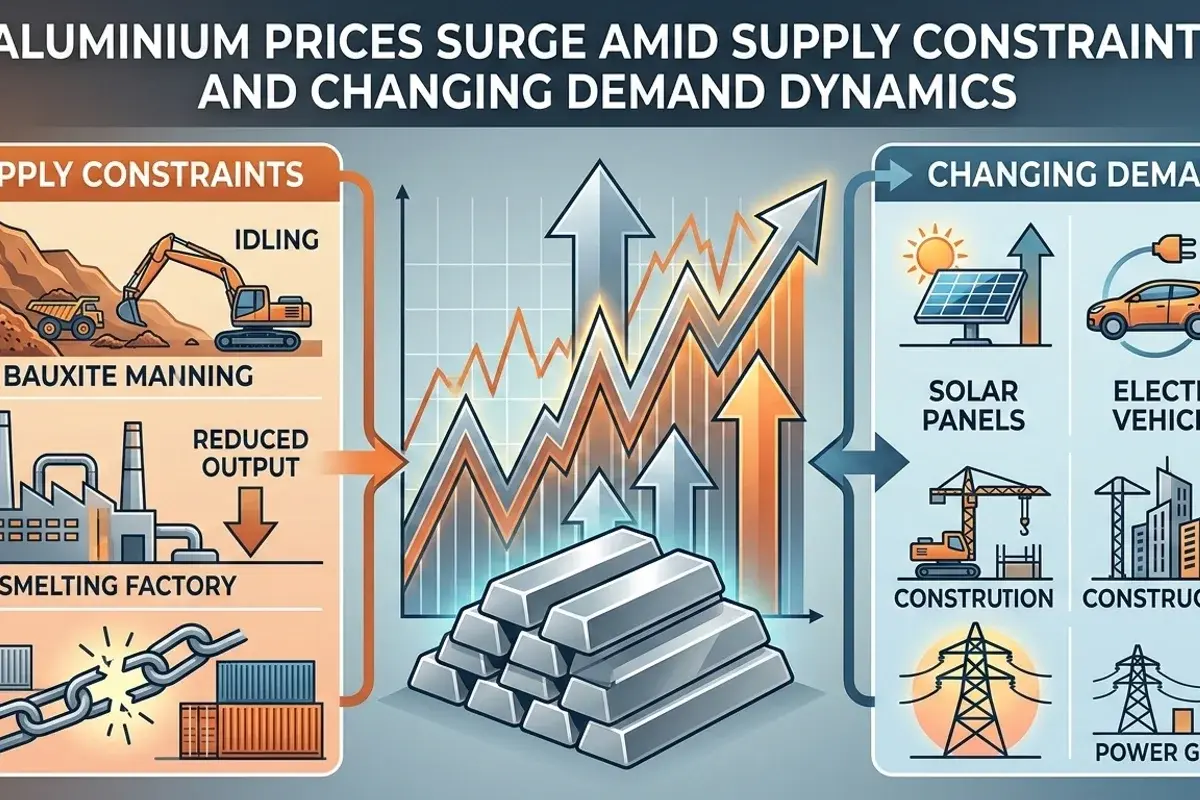
Aluminium prices have seen a significant rise of over 30% in the past two years, driven by increasing demand from clean energy initiatives and...

The ongoing West Asia conflict is causing unprecedented oil disruption, warning Daniel Yergin.