Loading market data...
Silver prices in India have seen strong volatility and long-term growth driven by industrial demand, investment demand, and global economic uncertainty. This detailed analysis explores silver prices across Indian states and major cities, along with market trends, demand drivers, and regional price variations.
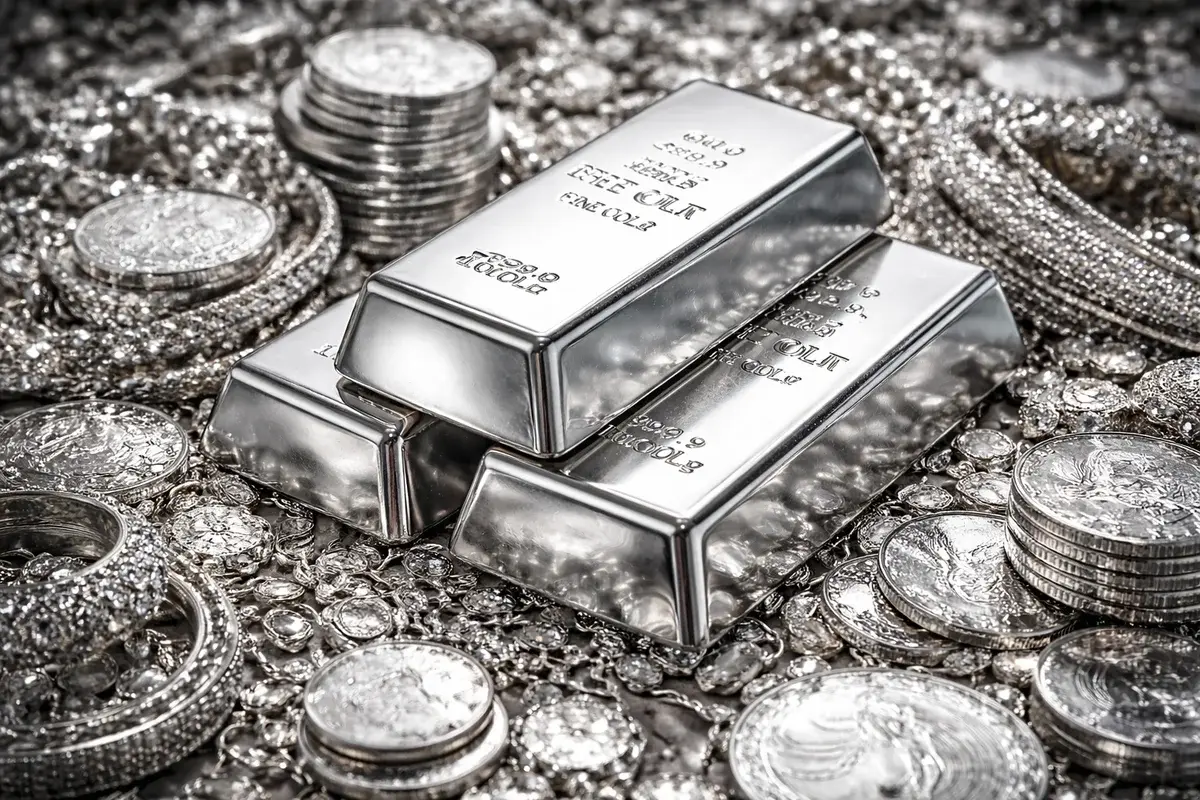
Silver has emerged as one of the most dynamic commodities in the global precious metals market. In India, silver plays an important role not only as a jewellery metal but also as a major investment asset and industrial material. Unlike gold, silver has extensive industrial applications, making its price movements closely tied to economic growth, manufacturing activity, and technological demand.
India is one of the largest consumers of silver globally, with strong demand coming from jewellery, silverware, electronics manufacturing, solar panels, and investment products such as coins and bars. In 2026, silver prices have remained highly volatile due to global macroeconomic uncertainty, rising industrial demand, and increased investor interest in precious metals.
Currently, the average silver price in India is around ₹285 per gram or approximately ₹2.85 lakh per kilogram, though the price fluctuates daily depending on global bullion markets and currency movements.
Silver prices in India are typically quoted per gram, per 10 grams, and per kilogram. The following table shows the approximate benchmark price levels based on current market averages.
| Silver Quantity | Average Price |
|---|---|
| 1 Gram | ₹285 |
| 10 Gram | ₹2,850 |
| 100 Gram | ₹28,500 |
| 1 Kilogram | ₹2,85,000 |
Domestic silver prices are largely influenced by international spot prices and the rupee-dollar exchange rate. When the rupee weakens or global silver prices rise, Indian retail prices typically increase as well.
Although silver prices remain broadly consistent nationwide, small differences appear across states due to logistics costs, transportation, and local market demand.
| State | Silver Price (1 kg) | Silver Price (10g) |
|---|---|---|
| Andhra Pradesh | ₹2,86,000 | ₹2,860 |
| Arunachal Pradesh | ₹2,87,000 | ₹2,870 |
| Assam | ₹2,86,500 | ₹2,865 |
| Bihar | ₹2,86,200 | ₹2,862 |
| Chhattisgarh | ₹2,86,100 | ₹2,861 |
| Goa | ₹2,85,800 | ₹2,858 |
| Gujarat | ₹2,86,000 | ₹2,860 |
| Haryana | ₹2,86,300 | ₹2,863 |
| Himachal Pradesh | ₹2,86,500 | ₹2,865 |
| Jharkhand | ₹2,86,200 | ₹2,862 |
| Karnataka | ₹2,85,700 | ₹2,857 |
| Kerala | ₹2,85,500 | ₹2,855 |
| Madhya Pradesh | ₹2,86,100 | ₹2,861 |
| Maharashtra | ₹2,85,900 | ₹2,859 |
| Manipur | ₹2,87,200 | ₹2,872 |
| Meghalaya | ₹2,87,000 | ₹2,870 |
| Mizoram | ₹2,87,200 | ₹2,872 |
| Nagaland | ₹2,87,100 | ₹2,871 |
| Odisha | ₹2,86,000 | ₹2,860 |
| Punjab | ₹2,86,200 | ₹2,862 |
| Rajasthan | ₹2,86,000 | ₹2,860 |
| Sikkim | ₹2,87,000 | ₹2,870 |
| Tamil Nadu | ₹2,85,800 | ₹2,858 |
| Telangana | ₹2,85,900 | ₹2,859 |
| Tripura | ₹2,87,000 | ₹2,870 |
| Uttar Pradesh | ₹2,86,100 | ₹2,861 |
| Uttarakhand | ₹2,86,300 | ₹2,863 |
| West Bengal | ₹2,86,000 | ₹2,860 |
Southern states such as Kerala, Tamil Nadu, and Karnataka typically show slightly lower silver prices due to stronger bullion markets and high trading volumes.
Most silver trading occurs in large urban bullion markets. The following table shows the approximate silver prices in major Indian cities.
| City | Silver Price (1 kg) | Silver Price (10g) |
|---|---|---|
| Delhi | ₹2,85,000 | ₹2,850 |
| Mumbai | ₹2,84,800 | ₹2,848 |
| Chennai | ₹2,85,200 | ₹2,852 |
| Kolkata | ₹2,85,100 | ₹2,851 |
| Bangalore | ₹2,85,300 | ₹2,853 |
| Hyderabad | ₹2,85,400 | ₹2,854 |
| Ahmedabad | ₹2,85,000 | ₹2,850 |
| Jaipur | ₹2,85,200 | ₹2,852 |
| Lucknow | ₹2,85,300 | ₹2,853 |
| Patna | ₹2,85,100 | ₹2,851 |
| Pune | ₹2,84,900 | ₹2,849 |
| Kochi | ₹2,85,000 | ₹2,850 |
In most cities, the variation is generally within ₹200 to ₹1,000 per kilogram, depending on logistics costs and retailer margins.
Silver prices in India have experienced significant volatility over the past few years. The metal has seen strong price movements driven by global economic uncertainty, increasing industrial demand, and growing investor interest in precious metals.
Periods of inflation, geopolitical tensions, and financial market instability often push investors toward precious metals like silver. At the same time, expanding industrial applications—especially in electronics and renewable energy sectors—have increased global demand for the metal.
Unlike gold, silver is widely used in industries such as electronics, electric vehicles, and solar panel manufacturing. Rising demand in these sectors significantly influences prices.
Silver is increasingly viewed as a hedge against inflation and economic uncertainty. Investors often turn to silver during periods of geopolitical instability.
Since India imports most of its silver, fluctuations in the rupee-dollar exchange rate can impact domestic prices.
Silver prices in India closely track international bullion prices and futures markets.
Mining costs and global supply shortages can also push prices higher over time.
Silver has become increasingly popular among retail investors due to its relatively lower price compared to gold. Many investors consider silver an accessible entry point into precious metals.
Common ways Indians invest in silver include:
Rising demand from renewable energy sectors and electronics manufacturing is also expected to support long-term silver demand.
Market analysts expect silver to remain one of the most volatile commodities due to its dual role as both an industrial metal and a safe-haven asset. Global demand from renewable energy, electronics manufacturing, and investment markets is expected to influence future price trends.
With strong industrial demand and increasing investor interest, silver may continue to experience significant price fluctuations in the coming years.
Silver prices in India are influenced by a combination of global commodity trends, industrial demand, and domestic market dynamics. While prices remain relatively uniform across the country, minor differences appear between states and cities due to logistics costs and local market competition.
For investors and consumers, tracking regional price variations can help identify the best markets for purchasing silver. With its strong industrial demand and increasing role as an investment asset, silver is expected to remain an important component of India's precious metals market.

Financial journalist specializing in market analysis, stock research, and investment trends. Dedicated to providing accurate, timely insights for informed decision-making.
Credentials: Experienced financial journalist with expertise in equity markets and economic analysis
The information provided in this article is for educational and informational purposes only and should not be construed as financial, investment, or legal advice. Finscann does not provide personalized investment recommendations.
For detailed terms and conditions, please read our Disclaimer and Terms of Service.
Crude oil prices surge 20% to $111 amid US-Iran conflict, triggering a Nifty 50 gap-down and global market sell-off.
Gold prices in India vary slightly across states and cities due to taxes, logistics, and demand patterns.

The Iran–US–Israel conflict has created major volatility in global oil markets. Rising geopolitical tensions and shipping risks have pushed crude oil...
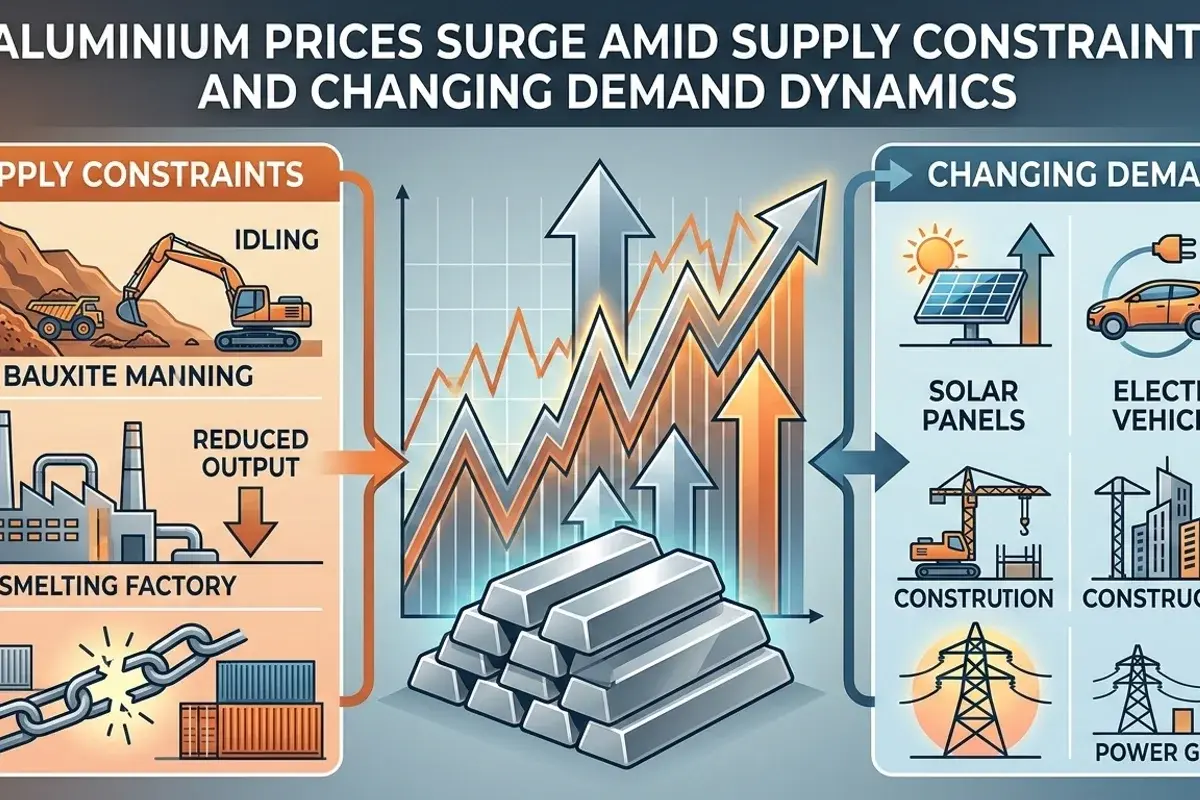
Aluminium prices have seen a significant rise of over 30% in the past two years, driven by increasing demand from clean energy initiatives and...

The ongoing West Asia conflict is causing unprecedented oil disruption, warning Daniel Yergin.