Loading market data...
Global crude oil prices have soared by 18% this week, with Brent nearing $85/barrel. FinScann analyzes the Middle East crisis, Strait of Hormuz risks, and the deep impact on India's economy and key stock market sectors.

Global crude oil prices have witnessed an alarming surge of nearly 18% this week, marking the largest weekly move since the pandemic-era volatility. As of March 6, 2026, Brent Crude is trading around $84 per barrel, while WTI Crude hovers near $78 per barrel. This sharp rally is predominantly fueled by intensifying geopolitical tensions across the Middle East, particularly the escalating US–Iran–Israel conflict and mounting fears of significant disruptions in the critical Strait of Hormuz, a waterway that accounts for approximately 20% of the world’s oil supply. FinScann analysis indicates that this volatile environment could severely impact global energy security and exert substantial pressure on net importing nations like India.
The Catalyst
The immediate catalyst for the current spike in crude oil prices is the alarming escalation of geopolitical instability in the Middle East. Recent US-Israel attacks on Iran and subsequent retaliatory strikes have pushed the region to the brink, triggering what some reports describe as an effective closure or de facto closure of the Strait of Hormuz. This crucial choke point, situated between Oman and Iran, is vital for oil exports from major producers including Saudi Arabia, Iraq, the UAE, and Qatar. The probability of Iran closing the Strait of Hormuz in 2026 has soared to an all-time high of 86.25% as of March 5, up from 71.95% on March 1, reinforcing the bullish outlook for oil prices. Such a prolonged disruption would lead to severe supply shortages and propel prices sharply higher.
Financial Forensics: Deep Macro Drivers Behind the Oil Rally
The current rally in crude oil is underpinned by a confluence of powerful macro-economic and geopolitical factors:
Middle East Geopolitical Crisis: The ongoing US–Iran–Israel tensions have instilled a significant risk premium into crude prices. The direct threat to the Strait of Hormuz, through which roughly 20% of global oil consumption moves, is the primary driver. Even a partial disruption can lead to dramatic price increases, with analysts warning of potential spikes to $120–$200 per barrel if a full blockade occurs. Rising tanker shipping costs further compound the issue, significantly increasing the effective price of oil globally.
Shipping & Supply Chain Stress: Beyond the direct threat to the Strait of Hormuz, the broader energy supply chains are under immense stress. Reports indicate that tankers are already reluctant to use the Strait, and even the Suez Canal, driving up freight costs for other goods as well. This logistic uncertainty adds considerable expense to energy transport, contributing to the higher global oil prices.
Geopolitical Risk Premium: Markets are factoring in a substantial risk premium, estimated to be between $4 and $10 per barrel, directly attributable to the war risk in the Middle East. This fear-driven component of pricing means that even without immediate physical supply disruptions, the mere threat of conflict is enough to keep prices elevated.
Strong Global Oil Demand: Despite the geopolitical turbulence, global oil demand continues to show resilience. OPEC estimates that oil demand will increase by approximately 1.4 million barrels per day (bpd) in 2026, primarily driven by robust growth in emerging markets. The IEA also forecasts a rise of 850,000 bpd in global oil demand for 2026, with non-OECD economies, particularly India and China, remaining the largest incremental consumers.
Technical Analysis: Key Levels for Traders
FinScann's technical analysis reveals crucial levels for both WTI and Brent crude amidst this heightened volatility.
WTI Key Levels (as of March 6, 2026):
Resistance: $80. A breakout above $78.10 could extend the rally towards $80.30 and potentially $83.60–$84.55.
Next Breakout Target: $85
Support: $67. The immediate support zone is identified between $68–$69. If WTI decisively breaks above $80, a rapid rally towards $90–$100 could ensue, driven by geopolitical panic buying.
Brent Key Levels (as of March 6, 2026):
Current Momentum: Brent crude continues its upward momentum, trading around $80.10-$84.70.
Key Breakout Range: Technical analysts are watching $71–$73 as a significant breakout range for Brent. A sustained weekly close above current psychological resistance highs could confirm a trend reversal if prices break through $82.60 resistance.
RSI: The Relative Strength Index (RSI) is currently above 70 on daily charts, indicating overbought conditions, though justified by the sudden geopolitical spike.
Can Crude Oil Reach $100? FinScann's Scenarios
The prospect of $100-a-barrel crude oil is no longer a distant possibility but a tangible risk in the current geopolitical climate.
Bullish Scenario: Escalation Drives Prices Higher A rapid ascent to $90–$100 is highly probable if the conflict escalates further. Key triggers include a full blockade of the Strait of Hormuz, a direct Iran–US military conflict, or widespread tanker attacks. JPMorgan experts suggest Brent prices could surge to $120 if the conflict persists, while Deutsche Bank does not rule out a spike to $200 in the event of a complete blockade of the Strait.
Neutral Scenario: Tensions Stabilize If the geopolitical tensions stabilize without further major escalation, crude oil prices would likely consolidate and trade within a range of $75–$85 per barrel. This scenario assumes that while risk premiums remain, actual supply disruptions are avoided.
Bearish Scenario: Long-Term Oversupply Returns Despite the short-term volatility, many long-term analysts maintain a bearish outlook for crude oil, predicting lower prices once geopolitical risks subside. The U.S. Energy Information Administration (EIA) forecasts Brent crude to average around $58 per barrel in 2026 and $53 per barrel in 2027, citing expectations that global oil production growth will persistently exceed consumption growth, leading to rising inventories. JPMorgan also expects Brent to average around $60 per barrel in 2026. This long-term view suggests that the current high prices are primarily driven by temporary geopolitical shocks rather than fundamental shifts in supply-demand balance.
Market Impact: India's Vulnerability and Sectoral Shifts
Higher crude oil prices generally have a significant negative impact on the Indian economy, as the nation imports approximately 80-85% of its crude oil requirements. This dependence makes India highly vulnerable to global oil price fluctuations. A sustained increase in crude oil prices can worsen the current account deficit, exacerbate the fiscal deficit, fuel inflation, and put downward pressure on the Indian Rupee.
The Indian stock market has already shown sensitivity to these developments. On March 4, 2026, Indian equities saw intense selling pressure, with the Nifty 50 falling by around 450 points and the Sensex dropping nearly 1,330 points, partly due to the crude oil spike and global risk-off sentiment.
Sectoral Impact in India:
| Sector Type | Impact from Rising Crude Oil Prices | Key Indian Stocks Affected (Examples) |
|---|---|---|
| Beneficiaries | Oil exploration and production companies tend to benefit from higher crude realizations, as their upstream profits increase. | ONGC, Oil India, GAIL (gas processing/transmission may see indirect benefits) |
| Sufferers | Airlines: Higher jet fuel costs directly impact operational profitability. Many carriers have already cancelled flights due to Middle East conflict.<br>Paint & Chemical Companies: Crude oil derivatives like naphtha, benzene, and propylene are key raw materials. Increased input costs squeeze margins, especially if price pass-through is difficult.<br>FMCG Companies: Higher transportation costs and potential for reduced consumer spending due to inflation can hit profitability.<br>Oil Marketing Companies (OMCs): Despite being in the oil sector, OMCs like IOC, BPCL, and HPCL often face margin pressure if they cannot fully pass on rising crude import costs to consumers, leading to losses. | Indigo, Asian Paints, Berger Paints, Chemical stocks, Indian Oil Corporation (IOC), BPCL, HPCL |
Key Takeaways for Investors
Heightened Volatility: Expect continued significant swings in crude oil prices, driven by evolving geopolitical news flow.
Risk-On/Risk-Off Dynamics: Global and Indian markets will remain highly sensitive to Middle East developments, with sharp corrections during periods of escalation.
Inflationary Pressures: Rising crude prices will fuel domestic inflation in India, potentially impacting the RBI's monetary policy decisions.
Strategic Allocation: Consider a defensive posture for oil-sensitive sectors while selectively evaluating upstream oil & gas companies.
Currency Impact: A weakening Indian Rupee against the US Dollar is a likely consequence of sustained high crude prices.
FinScann Verdict
The global crude oil market is currently a battleground between robust underlying demand and an unprecedented geopolitical risk premium. While long-term fundamentals suggest eventual moderation, the immediate threat of a Strait of Hormuz disruption injects extreme short-term bullish potential. FinScann believes crude oil prices are likely to remain elevated and volatile in the coming weeks. Investors should brace for potential spikes towards $90 or even $100+ if the Middle East conflict intensifies, requiring careful portfolio adjustments and a keen eye on real-time news.
Q: Why are crude oil prices rising today? A: Crude oil prices are rising primarily due to escalating geopolitical tensions in the Middle East, particularly the US-Iran-Israel conflict. This has introduced a significant risk premium into prices and created fears of disruption to oil supplies through the critical Strait of Hormuz, which handles approximately 20% of global oil consumption. Strong global demand, especially from emerging markets like India and China, also contributes to the upward pressure.
Q: What is the impact of rising crude oil on India? A: Rising crude oil prices negatively impact India significantly because the country imports 80-85% of its oil needs. This leads to higher import bills, a wider current account deficit, increased inflation, and potential depreciation of the Indian Rupee. It also affects the profitability of various sectors, including airlines, paint companies, chemical manufacturers, and oil marketing companies.
Q: Can crude oil reach $100 a barrel in March 2026? A: Yes, crude oil can reach $100 a barrel or higher if the conflict in the Middle East escalates further. Analysts suggest that a blockade of the Strait of Hormuz or a full-blown war involving the US and Iran could quickly push Brent crude prices to $120-$200 per barrel. Even without a full blockade, continued high tensions could see prices spike towards $90 in the short to medium term.
Q: Which Indian stocks are most sensitive to oil price changes? A: Indian stocks sensitive to oil price changes include:
Disclaimer: For information only; not investment advice. Stock market investments carry risks. Please consult a SEBI-registered advisor before investing. FinScann assumes no liability for decisions made based on this report.

Financial journalist specializing in market analysis, stock research, and investment trends. Dedicated to providing accurate, timely insights for informed decision-making.
Credentials: Experienced financial journalist with expertise in equity markets and economic analysis
The information provided in this article is for educational and informational purposes only and should not be construed as financial, investment, or legal advice. Finscann does not provide personalized investment recommendations.
For detailed terms and conditions, please read our Disclaimer and Terms of Service.

Gold and silver rates jump on MCX today amid dollar weakness and escalating US-Iran conflict.
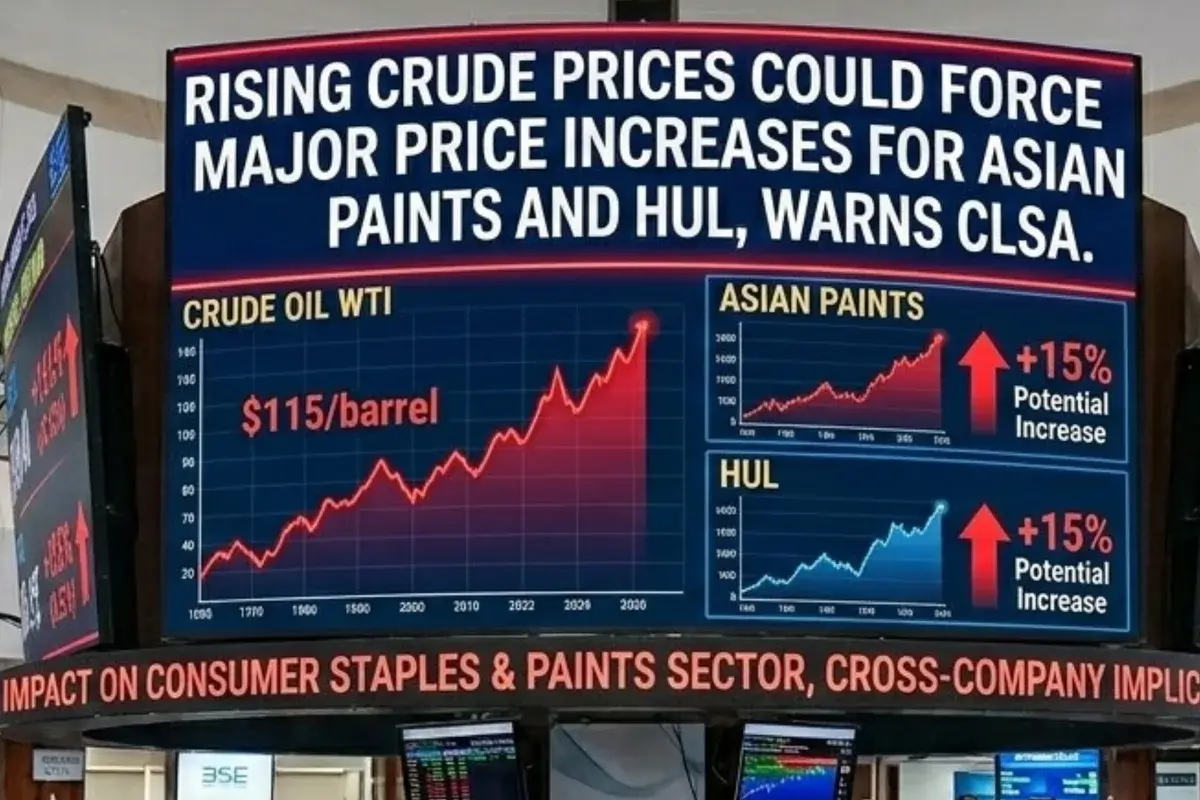
Surging crude oil prices could force major price increases for Indian giants Asian Paints and HUL, warns CLSA.

Gold prices on MCX soar to ₹1.64 lakh in March 2026, driven by intense US-Iran tensions. FinScann analyzes safe-haven demand and future outlook for...

Silver prices soar over 3% in March 2026 as Middle East tensions escalate and a weaker US dollar fuels safe-haven demand.

In-depth crude oil analysis for March 4, 2026. Explore Brent and WTI price forecasts, geopolitical risks, OPEC dynamics, inventory trends, technical...