Loading market data...
FinScann's latest analysis on the February 2026 MSCI rebalancing reveals potential inflows for Aditya Birla Capital, L&T Finance, and AU Small Finance Bank, despite India's overall net outflow. Understand the impact on your portfolio.
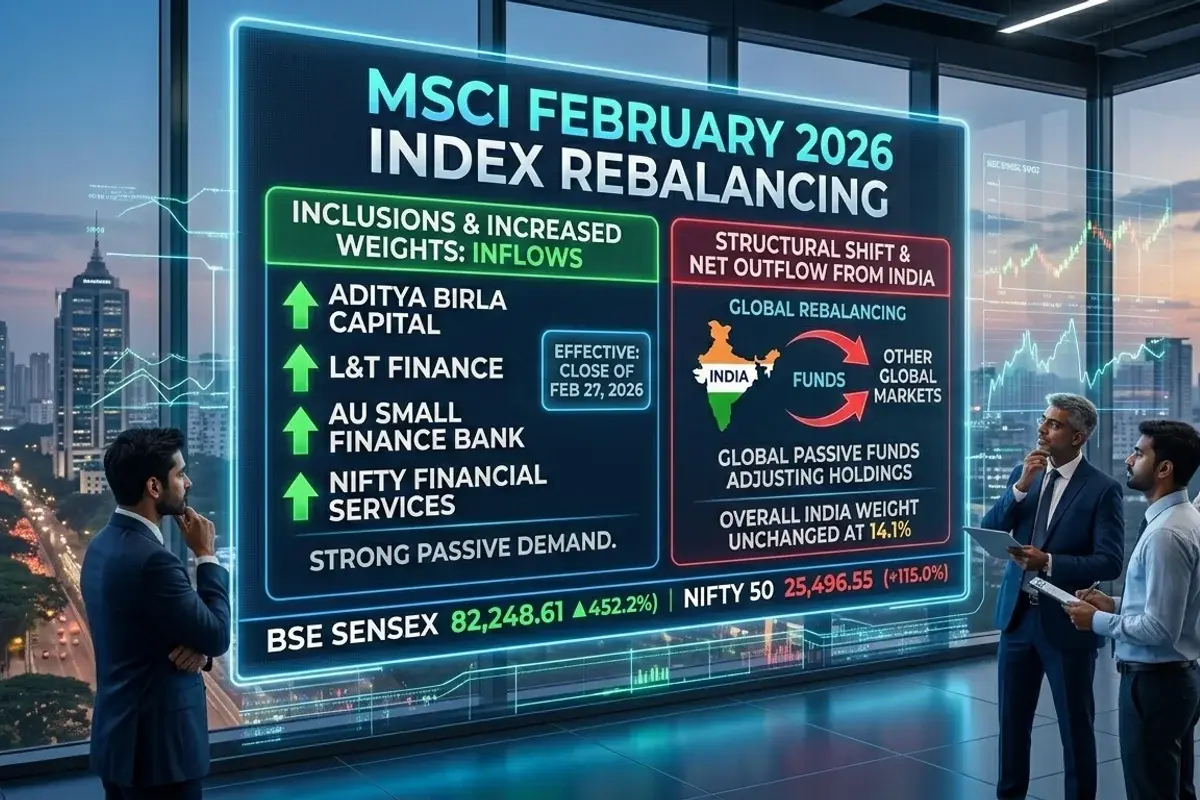
The much-anticipated MSCI February 2026 index rebalancing has delivered a mixed bag for the Indian equity market, with global index provider MSCI announcing a structural shift that will see an overall net outflow from India despite strategic inclusions and increased weightages for specific high-performing stocks. While India's overall weight in the MSCI Standard Index remains unchanged at 14.1%, the composition within the index has seen notable adjustments. This crucial rejig, effective from the close of February 27, 2026, is poised to trigger significant rebalancing of global portfolios, with passive funds adjusting their holdings in response to these rule-based changes. Investors are keenly observing how these shifts will impact individual stock performance and broader market sentiment, especially for financial sector stalwarts like Aditya Birla Capital Ltd., L&T Finance Ltd., and AU Small Finance Bank Ltd., which are set to experience substantial passive inflows.
The Catalyst
The MSCI index rejig is a periodic review that occurs four times a year – in February, May, August, and November – to ensure that the indices accurately reflect market dynamics and remain investable benchmarks for global investors. These quarterly reviews evaluate listed companies based on parameters such as market capitalization, liquidity, trading volumes, and free float. The current February 2026 review has led to a structural realignment, where additions prompt index-linked ETFs and passive funds to buy the stock, while deletions force selling. This rebalancing is not based on sentiment but on a strictly quantitative process following the MSCI Global Investable Market Indexes (GIMI) Methodology.
Despite the inclusion of two Indian stocks in the MSCI Global Standard Index, Aditya Birla Capital Ltd. and L&T Finance Ltd., and a weight increase for AU Small Finance Bank Ltd., India's overall position in the MSCI Emerging Markets Index has reportedly slipped to fourth place, with its weight moderating to under 14%. This is a notable shift from its peak of nearly 21% in September 2024. The decline is attributed to a combination of cyclical and structural factors, including strong rallies in North Asian markets driven by AI and semiconductor demand, China's stimulus measures, and some valuation recalibrations in India.
Financial Forensics
The February 2026 MSCI rejig brings significant capital movement expectations for the financial services sector. According to estimates by brokerage firm Nuvama Alternative & Quantitative Research, the three companies in focus are poised for substantial passive inflows:
Here's a comparison of the expected passive fund flows:
| Company | MSCI Rejig Action | Estimated Passive Inflow (USD) | Estimated Passive Inflow (₹ Billion) |
|---|---|---|---|
| Aditya Birla Capital Ltd. | Inclusion | ~$257 million | ~₹21.37 Billion (approx) |
| L&T Finance Ltd. | Inclusion | ~$238 million | ~₹19.79 Billion (approx) |
| AU Small Finance Bank Ltd. | Weight Increase | ~$172 million | ~₹14.30 Billion (approx) |
| IRCTC (for comparison) | Exclusion | ~$142 million outflow | ~₹11.80 Billion outflow (approx) |
Note: Rupee conversion is approximate based on current rates for illustrative purposes.
Market Impact
The inclusions and weight adjustments for Aditya Birla Capital, L&T Finance, and AU Small Finance Bank are expected to create a positive short-term impact on their respective share prices as passive funds tracking the MSCI indices are mandated to buy these stocks by the close of February 27, 2026. This forced buying activity often leads to increased trading volumes and price volatility around the adjustment date. For the broader Indian market, despite the net increase in the number of Indian companies in the MSCI Global Standard Index from 164 to 165, India's overall weight in the MSCI Emerging Markets Index has slightly reduced. This moderation in India's weight could trigger marginal passive outflows from ETFs and index-tracking funds benchmarked to MSCI EM. However, analysts remain optimistic about India's long-term structural growth story and robust earnings outlook, which continues to attract active investor interest. The financial services sector, in particular, is witnessing a significant vote of confidence from global institutional investors.
Key Takeaways
For investors, these MSCI rejig insights are crucial:
Moat Analysis
A "moat" refers to a sustainable competitive advantage that protects a company's long-term profits and market share. An "Investment Play" is the strategic rationale behind investing in a particular company.
FinScann Verdict
The February 2026 MSCI rejig undeniably signals a period of strategic recalibration for the Indian market within global passive portfolios. While the overall picture suggests a subtle shift in India's weight, the individual stories of Aditya Birla Capital, L&T Finance, and AU Small Finance Bank stand out as strong contenders for positive momentum. FinScann analysis indicates these companies are well-positioned to capitalize on the incoming passive funds, reinforcing their growth trajectories in the dynamic Indian financial landscape. Investors with a long-term perspective should consider these developments carefully, integrating them into their comprehensive portfolio strategies.
Q: What is the MSCI rebalancing and why is it important? A: The MSCI rebalancing is a periodic review by Morgan Stanley Capital International (MSCI) of its global stock indices, typically occurring quarterly in February, May, August, and November. It's crucial because many global passive funds and ETFs track these indices, meaning they are obligated to buy or sell stocks based on their inclusion, exclusion, or weight changes in the index. This leads to significant capital flows and can impact stock prices, market liquidity, and overall investor sentiment.
Q: How does the February 2026 MSCI rejig specifically impact India? A: The February 2026 MSCI rejig has resulted in two new Indian companies, Aditya Birla Capital Ltd. and L&T Finance Ltd., being added to the MSCI Global Standard Index, and AU Small Finance Bank Ltd. seeing an increase in its index weight due to a float adjustment. However, despite these additions, India's overall weight in the MSCI Emerging Markets Index has reportedly slipped below 14%, impacting its ranking. This indicates a slight net outflow from India at the broader index level, even as specific stocks benefit from inflows.
Q: Which other Indian stocks might see changes in MSCI weight or inclusion/exclusion in this review? A: While Aditya Birla Capital and L&T Finance were added to the Global Standard Index and AU Small Finance Bank saw a weight increase, Indian Railway Catering and Tourism Corporation (IRCTC) was notably removed, leading to expected outflows. The MSCI Smallcap Index also underwent significant adjustments, with seven additions and 34 deletions from India, reducing the total count of Indian stocks in this index to 480 from 508.
Q: When do the MSCI changes take effect? A: All changes announced as part of the MSCI February 2026 Index Review will be implemented as of the close of February 27, 2026. This means passive funds and other index-tracking investments will adjust their portfolios to reflect the new index composition at the end of this trading day.
Q: What factors typically drive a company's inclusion or exclusion from MSCI indices? A: MSCI uses a systematic, rules-based methodology to determine index constituents. Key factors include a company's full market capitalization, its free-float market capitalization (shares available for public trading), and its liquidity (average daily turnover). Companies must meet high thresholds in these areas to be considered for inclusion, particularly when moving into a Global Standard Index. Changes can also occur due to corporate actions like mergers, acquisitions, or significant changes in share structure that affect free float.
Disclaimer: For information only; not investment advice. Stock market investments carry risks. Please consult a SEBI-registered advisor before investing. FinScann assumes no liability for decisions made based on this report.

Financial journalist specializing in market analysis, stock research, and investment trends. Dedicated to providing accurate, timely insights for informed decision-making.
Credentials: Experienced financial journalist with expertise in equity markets and economic analysis
The information provided in this article is for educational and informational purposes only and should not be construed as financial, investment, or legal advice. Finscann does not provide personalized investment recommendations.
For detailed terms and conditions, please read our Disclaimer and Terms of Service.
A ₹590 crore fraud at IDFC FIRST Bank’s Chandigarh branch has triggered arrests, a 20% stock crash, and Haryana government de-empanelment.

IndiGo reports 11% growth in cargo volumes in 2025, driven by expanded belly capacity and three new freighters.

Hyundai Motor Co. invests $6.3 billion (₹52,500 Cr) in AI data centers, robot factories, and hydrogen plants in South Korea.

Vesuvius India Limited reports FY2025 revenue of ₹2,104 crore with net profit at ₹264 crore and recommends ₹1.50 dividend.

Tata Steel invests $264 million (₹2,401.50 Cr) in its T Steel Holdings subsidiary. FinScann analyzes the strategic move and its impact on Tata Steel...