Loading market data...
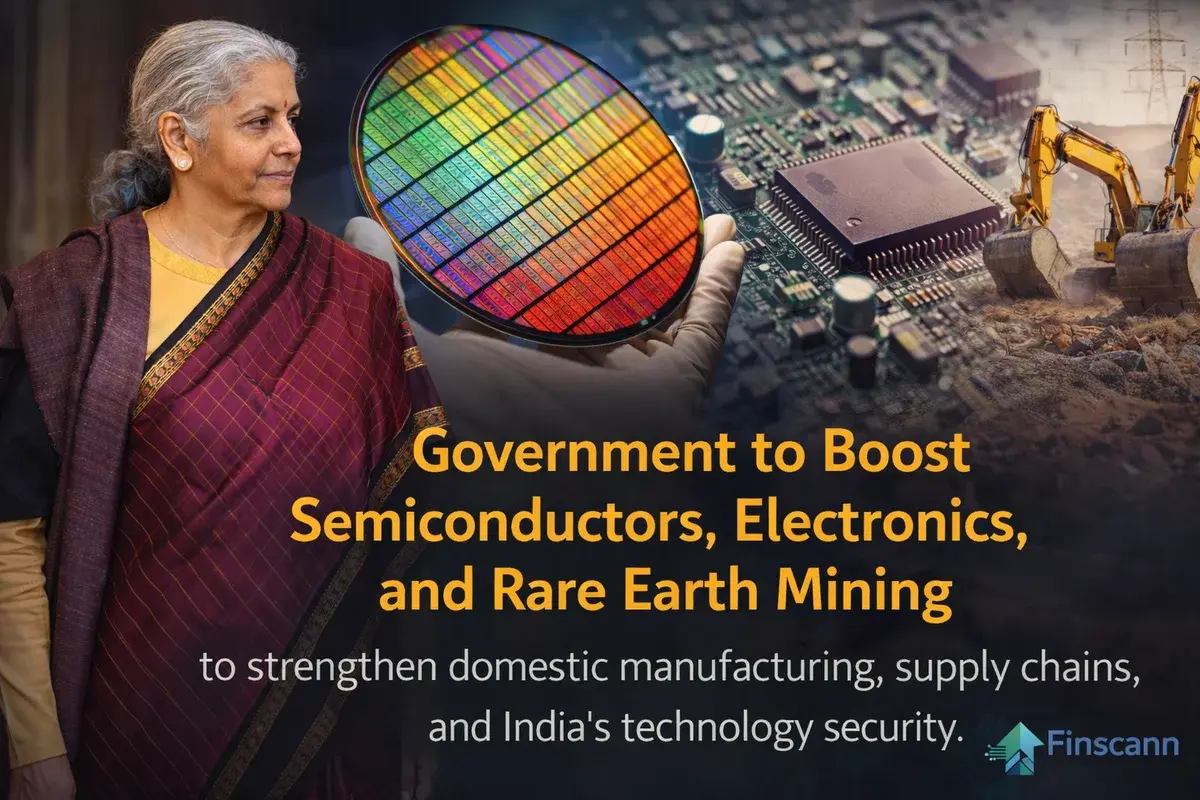
Union Budget 2026 LIVE: Semiconductor and rare earth ecosystems took centre stage as Finance Minister Nirmala Sitharaman presented her historic ninth Union Budget, signalling a decisive push towards technology-led self-reliance and strategic manufacturing.
Semiconductors Get a Major Policy Boost
In a key announcement for the technology sector, the Finance Minister said the India Semiconductor Mission (ISM) will be expanded through the launch of ISM 2.0, aimed at accelerating chip fabrication, advanced packaging, and design capabilities.
The government also raised the outlay for electronics component manufacturing to ₹40,000 crore, strengthening domestic supply chains and reducing reliance on imports. Semiconductor companies, electronics manufacturers, and ancillary suppliers are expected to benefit from the expanded incentives.
** Rare Earth Corridors to Strengthen Strategic Supply Chains**
To support clean energy, electronics, and defence manufacturing, the Budget proposed the creation of dedicated rare earth corridors in mineral-rich states including Odisha, Kerala, Andhra Pradesh, and Tamil Nadu.
The move is aimed at securing access to critical minerals amid global supply disruptions and growing geopolitical competition for rare earth resources.
** Biopharma Shakti Announced with ₹10,000 Crore Outlay**
Beyond semiconductors, Sitharaman announced Biopharma Shakti, a ₹10,000 crore initiative to build a biopharma-focused innovation network. The programme will include three new specialised institutes, supporting research, manufacturing, and global competitiveness in pharmaceuticals and biotechnology.
** Cabinet Approval and Economic Context**
The Union Cabinet, chaired by Narendra Modi, approved the Budget ahead of its presentation in Parliament.
Despite global trade pressures, including steep tariffs imposed by the US, India’s economy has remained resilient. GDP growth is projected at 7.4% for the year ending March 31, supported by infrastructure spending and tax measures that have boosted consumption.
** Economic Survey Sets the Tone**
Earlier this week, Sitharaman tabled the Economic Survey 2025–26, the government’s official annual report card on the economy. The Survey highlighted steady growth, improving demand conditions, and the need for continued reforms to sustain long-term expansion.
** Why This Matters**
With semiconductors, rare earths, and advanced manufacturing now firmly embedded in Budget 2026, the government has signalled that technology sovereignty and supply-chain security will be central to India’s economic strategy in the years ahead.

Financial journalist specializing in market analysis, stock research, and investment trends. Dedicated to providing accurate, timely insights for informed decision-making.
Credentials: Experienced financial journalist with expertise in equity markets and economic analysis
The information provided in this article is for educational and informational purposes only and should not be construed as financial, investment, or legal advice. Finscann does not provide personalized investment recommendations.
For detailed terms and conditions, please read our Disclaimer and Terms of Service.
India's benchmark indices Sensex and Nifty staged a robust recovery in March 2026, gaining significantly despite ongoing geopolitical tensions.

Geopolitical tensions surrounding the US-Iran conflict led FIIs to dump ₹12,000 crore from Indian shares.

Indian refinery stocks, including Reliance, MRPL, and CPCL, surge up to 5% after China reportedly suspends diesel and gasoline exports amidst...
Indian markets surged in March 2026, with Sensex and Nifty rebounding on de-escalation hopes in the Middle East.

Morgan Stanley cuts 2,500 jobs across investment banking, wealth management, and trading. Despite strong financials, this strategic move signals a...