Loading market data...
Indian refinery stocks, including Reliance, MRPL, and CPCL, surge up to 5% after China reportedly suspends diesel and gasoline exports amidst escalating Middle East tensions.

Indian refinery stocks witnessed a significant rally on Thursday, March 5, 2026, with major players like Reliance Industries, Mangalore Refinery and Petrochemicals (MRPL), and Chennai Petroleum Corporation (CPCL) seeing their share prices jump by up to 5.72%. This sharp uptick was primarily triggered by reports indicating that China, a key global supplier, plans to suspend exports of diesel and gasoline. The development underscores the fragile global energy supply chain, intensified by geopolitical tensions in the Middle East, and points to potentially tightened regional markets, offering a near-term tailwind for Indian refining giants.
The news has immediately reshaped market expectations for refined product availability, positioning Indian refiners in a potentially advantageous spot. As global crude flows face disruptions, and a major exporter steps back, the capacity and operational efficiency of Indian oil marketing companies and refiners come into sharper focus. Investors are closely monitoring the evolving dynamics, recognizing the potential for higher refining margins and enhanced profitability for domestic players in the immediate future.
The Catalyst: China's Export Suspension
The catalyst for the sudden surge in Indian refinery stocks stems from a Bloomberg report detailing China's directive to its largest oil refiners. The National Development and Reform Commission (NDRC), China’s principal economic planning body, has reportedly issued verbal instructions to refinery executives to immediately halt refined fuel exports. This directive, communicated to major players such as PetroChina, Sinopec, CNOOC, Sinochem Group, and Zhejiang Petrochemical, also includes a mandate to cease signing new export contracts and to negotiate the cancellation of existing agreements. The move, however, excludes jet and bunker fuel held in bonded storage, as well as supplies destined for Hong Kong and Macau.
This abrupt policy shift by one of the world's largest refined product exporters is a direct response to the escalating conflict in the Middle East, which has disrupted the consistent arrival of crude oil from one of the world's most critical producing regions. Such a measure by China is expected to significantly reduce the global supply of diesel and gasoline, inevitably leading to tighter markets and potentially higher prices for these refined products. For Indian refiners, who largely cater to domestic demand while also exporting, this could translate into better realizations on their refined product sales, thereby boosting their profitability.
| Metric | Details |
|---|---|
| Trigger Event | China's reported suspension of diesel & gasoline exports |
| Primary Reason | Escalating Middle East conflict disrupting crude supply |
| Affected Products | Diesel, Gasoline (excluding jet/bunker in bonded storage, HK/Macau supplies) |
| Impacted Chinese Firms | PetroChina, Sinopec, CNOOC, Sinochem Group, Zhejiang Petrochemical |
| Immediate Effect | Reduced global supply of refined fuels, potential for tightened regional markets, higher refining margins |
Financial Forensics: Decoding the Refinery Rally
The financial markets reacted swiftly to the news, reflecting investor optimism regarding the potential upside for Indian refiners. Reliance Industries' share price jumped nearly 3%, demonstrating its significant market capitalization and broad investor interest. Similarly, Chennai Petroleum Corporation's shares rallied 5.4%, and Mangalore Refinery and Petrochemicals (MRPL) stock surged as much as 5.72%. Even public sector undertakings (PSUs) in the oil sector saw considerable gains: Indian Oil Corporation (IOC) shares climbed 2.87%, Hindustan Petroleum Corporation Ltd (HPCL) gained 2.37%, and Bharat Petroleum Corporation Ltd (BPCL) rose 1.37%.
Beyond the immediate market sentiment, a crucial factor bolstering the rally is the sharp rise in Singapore Gross Refining Margins (GRMs). Independent markets analyst and wealth advisor Avinash Gorakshkar highlighted that Singapore GRMs are currently hovering around $27 per barrel. This metric is a key indicator of refiner profitability, representing the difference between the total value of petroleum products produced by an oil refinery and the cost of crude oil. Higher GRMs directly translate to better margins for refiners, making their operations more lucrative. Furthermore, LSEG pricing data indicated that diesel processing margins were nearing three-year highs at approximately $49 per barrel on Thursday, with jet fuel cracks trading above $55 per barrel. These robust margins underscore the strong underlying profitability drivers for refiners in the current environment.
| Refining Metric | Data (March 5, 2026) |
|---|---|
| Singapore GRMs | Approximately $27 per barrel |
| Diesel Processing Margins | Near three-year highs, approximately $49 per barrel |
| Jet Fuel Cracks | Trading above $55 per barrel |
| Implication | Strong profitability for refiners, driven by robust demand and tightening supplies |
Market Impact: A Boost for Indian Refiners
The reported suspension of Chinese fuel exports could have a substantial, albeit potentially short-term, positive impact on Indian refiners. As one of Asia's largest sources of refined product supply, a reduction from China is expected to further tighten the regional market, driving refining margins even higher. This scenario presents a lucrative opportunity for Indian oil marketing companies, which possess significant refining capacities. India, being a major importer of crude and an exporter of refined products, stands to gain from improved realizations on its exports and potentially stable domestic prices due to reduced competitive pressure.
The geopolitical instability in the Middle East, which is a primary reason for China's reported decision, also raises questions about India's energy security and strategic responses. While no official statement has been made, analysts suggest that India might consider similar measures to safeguard its domestic fuel supply, though such decisions would hinge on commercial interests and the compliance of refiners. This dynamic could create a more favorable operating environment for Indian Oil Corporation, Hindustan Petroleum Corporation Ltd, and Bharat Petroleum Corporation Ltd, who play a dual role of refining and marketing within the country.
Key Takeaways for Investors
FinScann Verdict
The reported decision by China to halt fuel exports marks a pivotal moment for the global and regional refined products market. For Indian refiners, this development, coupled with already strong GRMs, paints a near-term optimistic picture, potentially leading to enhanced profitability. While geopolitical risks remain, the current environment offers a compelling investment play for those looking at the energy sector, particularly in refining.
Q: What triggered the recent rally in Indian refinery stocks? A: The rally was triggered by reports that China plans to suspend exports of diesel and gasoline due to disruptions in crude oil supply caused by the escalating Middle East conflict. This is expected to tighten global fuel markets.
Q: How does China's reported decision impact global fuel markets? A: As one of Asia's largest refined product suppliers, China's suspension of exports will likely lead to a significant reduction in global diesel and gasoline availability, tightening the regional market and driving refining margins higher.
Q: What are Gross Refining Margins (GRMs) and why are they important? A: Gross Refining Margins (GRMs) represent the difference between the total value of petroleum products produced by a refinery and the cost of crude oil processed. They are a crucial indicator of a refiner's profitability; higher GRMs mean better earnings.
Q: Should Indian investors consider refinery stocks now? A: FinScann analysis suggests that the current market dynamics, driven by China's reported export halt and strong GRMs, present a potentially favorable environment for Indian refiners. However, investors should conduct thorough due diligence, consider individual company fundamentals, and consult a SEBI-registered advisor before making investment decisions, as market conditions can change rapidly.
Q: Are there any risks associated with this rally? A: Yes, potential risks include a swift resolution to the Middle East conflict, a reversal of China's export policy, or a significant drop in crude oil prices. Moreover, any potential intervention by the Indian government to control domestic fuel prices could impact refiners' realizations.
Disclaimer: For information only; not investment advice. Stock market investments carry risks. Please consult a SEBI-registered advisor before investing. FinScann assumes no liability for decisions made based on this report.

Financial journalist specializing in market analysis, stock research, and investment trends. Dedicated to providing accurate, timely insights for informed decision-making.
Credentials: Experienced financial journalist with expertise in equity markets and economic analysis
The information provided in this article is for educational and informational purposes only and should not be construed as financial, investment, or legal advice. Finscann does not provide personalized investment recommendations.
For detailed terms and conditions, please read our Disclaimer and Terms of Service.
Indian markets surged in March 2026, with Sensex and Nifty rebounding on de-escalation hopes in the Middle East.
Morgan Stanley cuts 2,500 jobs across investment banking, wealth management, and trading. Despite strong financials, this strategic move signals a...
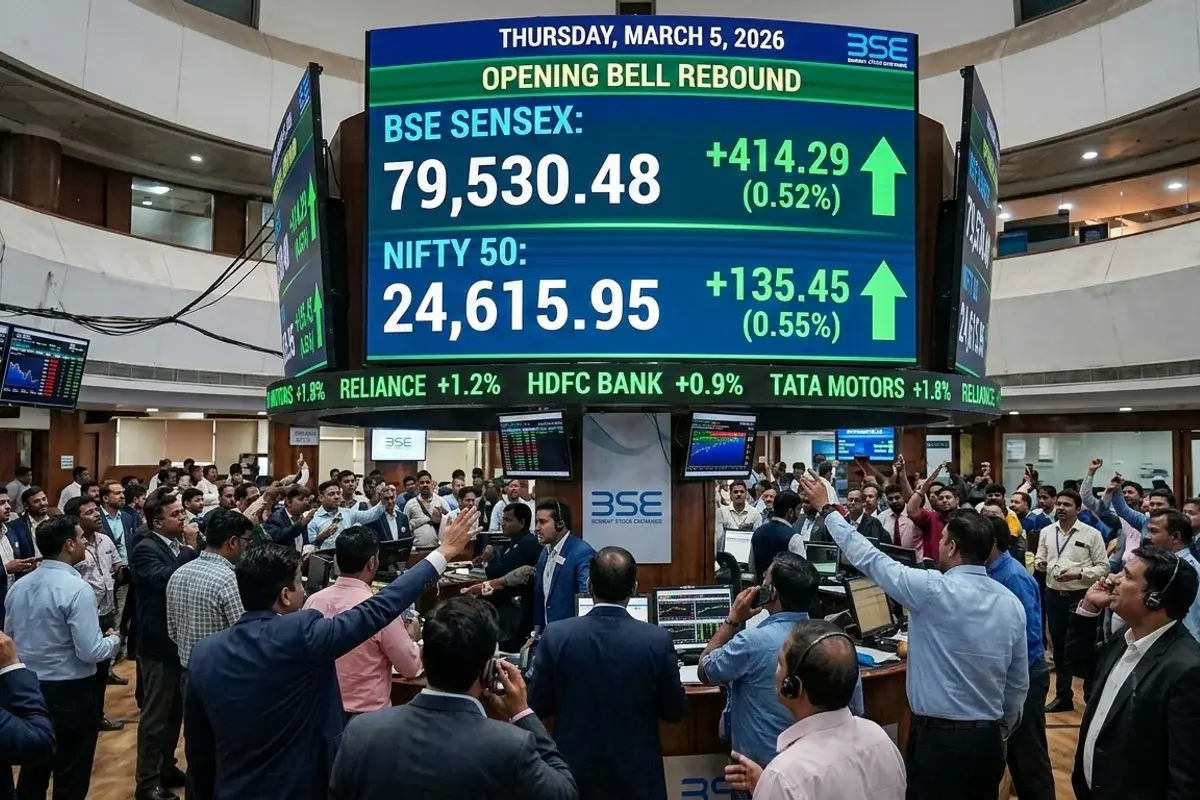
Indian stock markets witnessed a strong rebound on March 5, 2026, with Nifty 50 and Sensex surging.
Indian investors are closely monitoring a diverse set of companies as the market opens on Thursday, March 5, 2026, with key developments poised to...

Escalating West Asia tensions send Indian crude-linked sectors plummeting. FinScann analyzes the severe impact on refiners, paint, and rubber stocks.