Loading market data...
RBI grants approval to SBI Mutual Fund to acquire up to 9.99% stake in Bandhan Bank under the Banking Regulation Act. Explore detailed analysis of regulatory conditions, ownership limits, banking sector impact, and investor outlook.
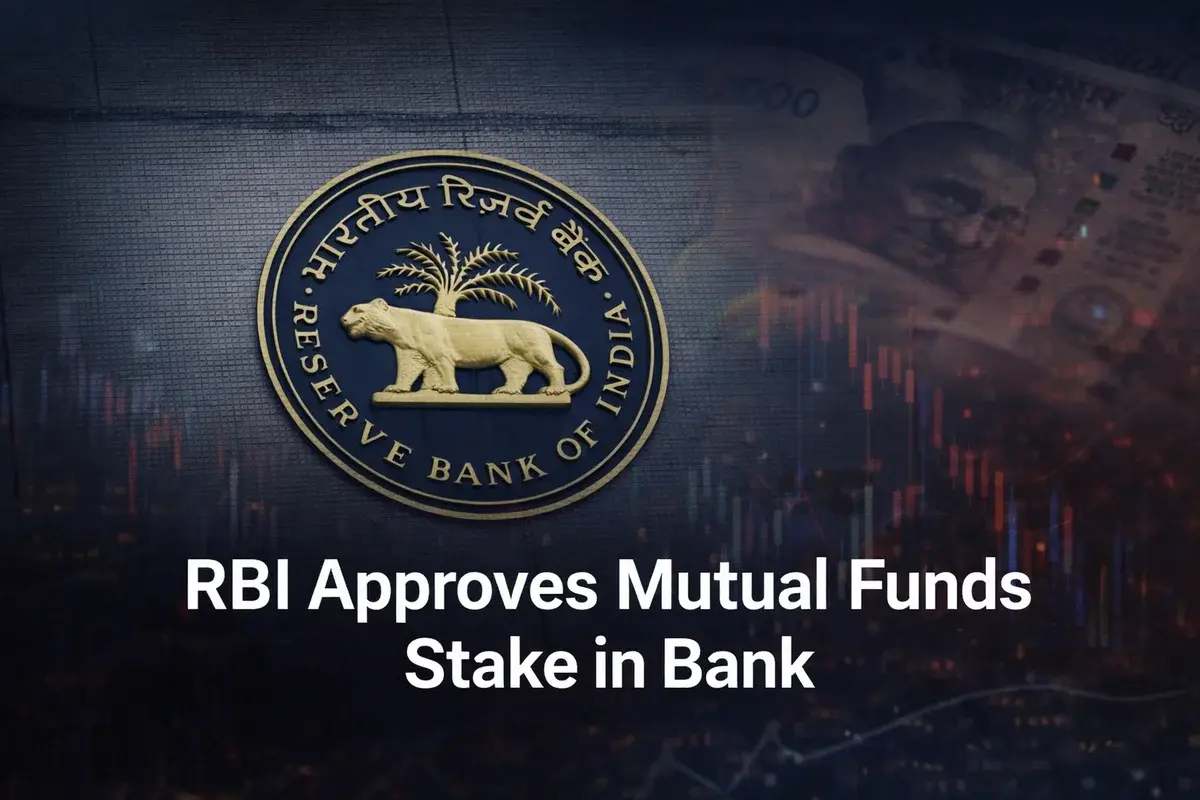
The Reserve Bank of India has approved SBI Mutual Fund to acquire up to 9.99% stake in Bandhan Bank Ltd., subject to strict compliance under the Banking Regulation Act and RBI’s 2025 shareholding directions. The approval is time-bound to one year and capped at 9.99% voting rights. The development signals growing institutional confidence in private sector banking consolidation amid tightening regulatory oversight and evolving capital discipline in India’s financial sector.
The Reserve Bank of India has formally permitted SBI Mutual Fund to acquire an aggregate holding of up to 9.99% in Bandhan Bank Ltd.. The approval, conveyed via letter dated February 25, 2026, enables the fund house to accumulate shares representing up to 9.99% of the paid-up share capital or voting rights of the lender.
This is not a routine secondary market accumulation. Any acquisition beyond 5% in a banking entity requires explicit regulatory approval under the Banking Regulation Act, 1949 and the Reserve Bank of India (Commercial Banks’ Acquisition and Holding of Shares or Voting Rights) Directions, 2025.
The decision reflects RBI’s calibrated approach toward ownership concentration in scheduled commercial banks.
| Parameter | Details |
|---|---|
| Maximum Approved Stake | 9.99% |
| Approval Date | February 25, 2026 |
| Completion Timeline | Within 1 Year |
| Regulatory Framework | Banking Regulation Act, 1949 |
| Additional Compliance | FEMA, SEBI regulations |
| Holding Threshold Clause | Fresh approval required if stake falls below 5% and re-crosses 5% |
The RBI has imposed a strict timeline: if SBI Mutual Fund fails to complete the acquisition within one year, the approval automatically lapses. Additionally, the fund’s holding cannot exceed 9.99% at any time.
If the aggregate stake drops below 5%, prior RBI approval would again be required to increase it back above that threshold.
This layered compliance structure ensures regulatory oversight over significant shareholding movements in banking institutions.
| Metric | FY25E Estimate |
|---|---|
| Total Advances | ₹1.3–1.4 lakh crore |
| Deposits | ₹1.5 lakh crore+ |
| Net Interest Margin | ~6% range (historical strength) |
| Gross NPA | Moderating post-microfinance stress |
| Capital Adequacy Ratio | Comfortable above regulatory norms |
| Market Position | Strong microfinance & retail presence |
Bandhan Bank Ltd. has evolved from a microfinance-focused lender into a diversified retail banking franchise. While it faced asset quality headwinds in recent years due to microfinance portfolio stress, capital buffers and improving collection efficiencies have stabilized performance.
The entry of a large domestic institutional investor like SBI Mutual Fund may enhance investor perception around governance stability and long-term growth prospects.
| Metric | SBI Mutual Fund Profile |
|---|---|
| AUM | Among India’s largest fund houses |
| Parentage | State Bank of India Group |
| Investment Style | Diversified, institutional-grade |
| Banking Exposure | Significant across PSU & private lenders |
As one of India’s largest asset managers, SBI Mutual Fund manages substantial equity exposure across financial services.
Increasing stake in Bandhan Bank could indicate confidence in:
Improving asset quality Retail deposit traction Margin resilience Valuation comfort
With private banking valuations having undergone a partial reset amid broader market volatility, selective accumulation reflects strategic capital deployment rather than speculative positioning.
India’s banking sector has entered a new phase characterized by:
Moderating credit growth Normalization of net interest margins Stable deposit mobilization Tighter regulatory supervision
| Segment | Momentum | Capital Flow Sentiment |
|---|---|---|
| PSU Banks | Stable | Value-driven flows |
| Large Private Banks | Resilient | Defensive allocation |
| Mid-Sized Banks | Selective | Earnings-driven |
| Microfinance-Linked Banks | Recovering | Cautiously constructive |
Bandhan Bank falls within the recovering microfinance-linked segment, where asset quality trends are closely monitored.
The RBI approval does not automatically imply immediate stake acquisition. It provides a regulatory window for SBI Mutual Fund to accumulate shares over a 12-month period.
A near-10% institutional holding can:
Improve liquidity perception Enhance governance signaling Support valuation rerating Stabilize shareholder structure
However, the stake cap ensures no single domestic fund house exercises outsized influence.
The RBI’s shareholding directions introduced in November 2025 tightened disclosure norms and approval thresholds for significant stake acquisitions in banks.
This move aligns with global best practices in maintaining diversified ownership structures in financial institutions.
Ownership concentration risks can influence governance and systemic stability, hence the RBI’s structured approval framework.
Short-term market impact typically includes:
Increased trading volumes Speculative accumulation Sentiment-driven price movement
Long-term impact depends on earnings trajectory, not ownership changes alone.
Bandhan Bank’s valuation multiple remains sensitive to:
Asset quality stabilization Return on equity recovery Deposit franchise expansion Cost-to-income optimization
“Institutional participation at scale often signals confidence in earnings normalization. However, ownership approvals do not replace fundamental improvement in asset quality and capital efficiency,” says a Mumbai-based banking analyst.
The comment highlights the distinction between sentiment uplift and structural performance delivery.
For long-term investors, this approval indicates institutional confidence but does not guarantee price appreciation without sustained operational performance.
Short-term traders may observe momentum-driven price action during accumulation phases.
Key metrics to monitor include:
Net interest margin trends
Gross and net NPA movement
Credit growth trajectory
Capital adequacy buffer
Retail investors tracking Bandhan Bank via platforms such as Zerodha, Groww, Upstox, and Angel One should evaluate the development within the broader banking cycle rather than in isolation.
The RBI’s greenlight marks a significant governance milestone, but earnings discipline and asset quality recovery will ultimately determine shareholder returns.
⚠️ DISCLAIMER: We Are Not Financial Advisors

Financial journalist specializing in market analysis, stock research, and investment trends. Dedicated to providing accurate, timely insights for informed decision-making.
Credentials: Experienced financial journalist with expertise in equity markets and economic analysis
The information provided in this article is for educational and informational purposes only and should not be construed as financial, investment, or legal advice. Finscann does not provide personalized investment recommendations.
For detailed terms and conditions, please read our Disclaimer and Terms of Service.
India's benchmark indices Sensex and Nifty staged a robust recovery in March 2026, gaining significantly despite ongoing geopolitical tensions.

Geopolitical tensions surrounding the US-Iran conflict led FIIs to dump ₹12,000 crore from Indian shares.

Indian refinery stocks, including Reliance, MRPL, and CPCL, surge up to 5% after China reportedly suspends diesel and gasoline exports amidst...
Indian markets surged in March 2026, with Sensex and Nifty rebounding on de-escalation hopes in the Middle East.
Morgan Stanley cuts 2,500 jobs across investment banking, wealth management, and trading. Despite strong financials, this strategic move signals a...