Loading market data...
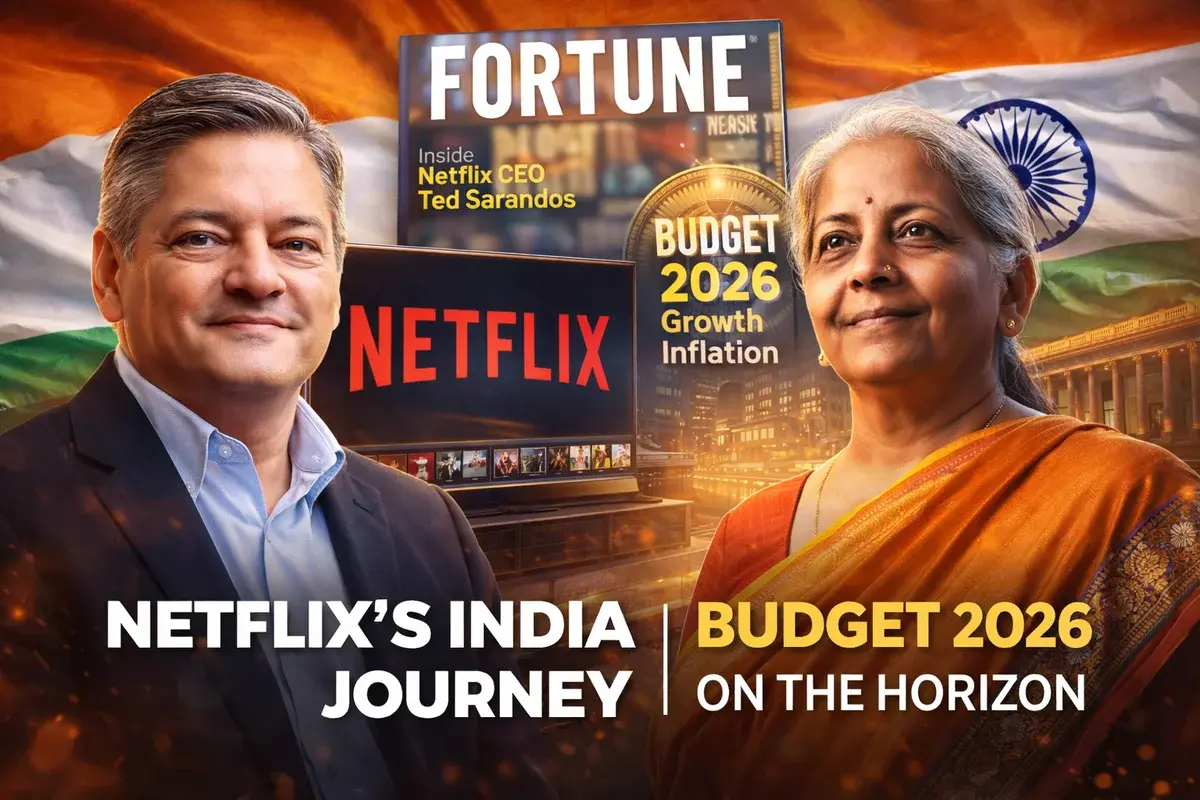
Netflix’s 10-Year India Journey Meets Budget 2026: How Premium Content, Pricing Strategy, and Economic Policy Are Shaping the Entertainment Economy
Introduction: When Entertainment Strategy Meets Economic Policy
India’s media and entertainment landscape is undergoing a profound transformation. Over the past decade, Netflix’s journey in India has emerged as one of the most closely watched case studies in global streaming expansion. From an experimental launch to becoming a mainstream premium platform, Netflix has demonstrated that high-quality content combined with smart pricing can unlock scale even in one of the world’s most price-sensitive markets.
At the same time, India’s broader economic environment is entering a critical phase. With Budget 2026 approaching, expectations of strong economic growth and easing inflation are shaping sentiment across industries—including digital entertainment. The intersection of streaming economics and fiscal policy is now more relevant than ever.
The latest edition of Fortune India brings these narratives together through an exclusive interview with Netflix CEO Ted Sarandos and a broader examination of India’s economic outlook under Finance Minister Nirmala Sitharaman.
This article takes a deep, structured, and SEO-rich dive into Netflix’s decade-long India journey, the evolving competitive landscape, the role of pricing and content, and how Budget 2026 could influence the future of the entertainment sector.
Netflix in India: A Decade of Strategic Evolution
When Netflix entered India ten years ago, the market was vastly different.
• Streaming was still nascent • Data costs were high • Local content dominated viewing habits • Subscription fatigue was a real concern
Yet, Netflix chose a long-term play rather than chasing immediate scale.
Phase One: Entry and Experimentation
Netflix’s initial years in India were marked by experimentation rather than aggressive expansion.
Key characteristics of this phase included:
• Focus on urban, English-speaking audiences • Premium positioning compared to local platforms • Limited local-language content • High subscription prices relative to competitors
This phase helped Netflix understand Indian consumer psychology, viewing patterns, and pricing sensitivity.
Phase Two: Localization and Content Adaptation
The turning point came when Netflix shifted its strategy toward deep localization.
Key moves included:
• Heavy investment in Indian originals • Expansion into Hindi, Tamil, Telugu, Malayalam, and regional languages • Collaboration with Indian creators and production houses • Focus on culturally resonant storytelling
This phase marked Netflix’s transition from a foreign streaming service to a locally embedded entertainment brand.
Phase Three: Pricing Innovation Without Diluting Premium Identity
One of Netflix’s most critical achievements in India has been balancing premium content with competitive pricing.
Instead of slashing prices across the board, Netflix adopted a tiered pricing model:
| Subscription Element | Strategic Purpose |
|---|---|
| Mobile-only plans | Entry point for price-sensitive users |
| Multi-device plans | Retain premium subscribers |
| Flexible pricing | Reduce churn |
| Value-driven bundling | Compete with rivals |
This approach allowed Netflix to expand its subscriber base without undermining its brand positioning.
Ted Sarandos’ Perspective: Content First, Market Second
In the Fortune India interview, CEO Ted Sarandos reinforces a philosophy Netflix has followed globally:
“Great stories travel. The key is making them locally meaningful.”
Sarandos highlights that Netflix’s India strategy was never about copying global formulas. Instead, it focused on:
• Empowering Indian storytellers • Backing creative risk-taking • Investing patiently in market development
This approach helped Netflix survive intense competition and build long-term trust with Indian audiences.
The Competitive Streaming Landscape in India
India is one of the most competitive streaming markets globally.
Major players include:
• Netflix • Amazon Prime Video • Disney+ Hotstar • JioCinema • Sony LIV • Zee5
Each platform has adopted a distinct strategy.
| Platform | Core Strength |
|---|---|
| Netflix | Premium originals |
| Amazon Prime Video | Bundled value |
| Disney+ Hotstar | Sports + mass content |
| JioCinema | Free / ad-supported reach |
| Sony LIV | Regional + sports |
| Zee5 | Broad language coverage |
Netflix’s edge lies in content quality, global IP, and storytelling consistency, rather than volume alone.
Why Netflix’s India Model Matters Globally
Netflix’s India playbook is now influencing its strategy in other emerging markets.
Key lessons include:
• Pricing flexibility beats uniform global pricing • Local content is not optional—it’s foundational • Market patience delivers compounding returns • Brand trust matters more than short-term subscriber spikes
India has effectively become a testing ground for Netflix’s future growth markets.
Budget 2026: Why the Entertainment Sector Is Watching Closely
As Netflix celebrates its decade in India, the macroeconomic backdrop is equally important.
Finance Minister Nirmala Sitharaman is preparing Budget 2026 amid:
• Rising economic growth • Cooling inflation • Improving fiscal stability • Expanding digital economy
The entertainment and media sector stands to be directly influenced by policy signals.
How Budget 2026 Could Impact Streaming Platforms
Several budget-related factors could shape the streaming ecosystem.
| Policy Area | Potential Impact |
|---|---|
| Taxation | Subscription affordability |
| Digital infrastructure | Streaming reach |
| Data costs | User engagement |
| Content regulation | Platform compliance |
| FDI norms | Investment inflows |
Even subtle changes in taxation or compliance can influence pricing strategies and content investment decisions.
Economic Growth and Consumer Spending
With inflation easing and growth stabilizing, consumer discretionary spending is expected to improve.
This is critical for streaming platforms because:
• Subscriptions are discretionary expenses • Retention depends on perceived value • Economic confidence boosts content consumption
Netflix could benefit from higher willingness to pay among Indian households.
Streaming Industry Trends in India
The Indian streaming industry continues to expand rapidly due to structural drivers.
Key growth drivers include:
• Affordable smartphones • Low-cost mobile data • Rising regional content demand • Youth-driven consumption • Smart TV penetration
| Trend | Implication |
|---|---|
| Regional storytelling | Broader audience base |
| Shorter content formats | New experimentation |
| Ad-supported tiers | Monetization diversification |
| AI-driven recommendations | Higher engagement |
Netflix’s ability to adapt to these trends will define its next decade.
Regulatory Environment: A Balancing Act
While growth is strong, regulatory scrutiny is increasing.
Areas under focus include:
• Content classification • Consumer protection • Digital taxation • Platform accountability
Netflix’s global compliance experience gives it an advantage in navigating evolving frameworks.
Business Impact: What This Means for Netflix and the Industry
Netflix’s strong positioning in India has several implications.
For Netflix:
• Improved subscriber growth • Stronger pricing power • Higher local content ROI • Long-term market leadership
For the industry:
• Higher content quality benchmarks • Increased creator opportunities • Greater competition on storytelling • Shift from scale-only to value-driven models
Market Context: Why Investors Are Paying Attention
The convergence of strong corporate strategy and favorable macro conditions is drawing investor interest.
Streaming platforms are increasingly seen as:
• Long-term consumption plays • Data-driven entertainment businesses • Intellectual property engines
Budget 2026 could further influence investor sentiment toward digital-first companies.
Industry Context: Entertainment as an Economic Contributor
The media and entertainment sector is no longer peripheral.
It contributes to:
• Employment generation • Digital exports • Cultural soft power • Startup ecosystems
Netflix’s India journey illustrates how global platforms can integrate into national economic narratives.
Frequently Asked Questions
Why has Netflix succeeded in India despite intense competition Because it focused on premium content, local storytelling, and flexible pricing rather than chasing mass scale.
How important is Budget 2026 for the streaming industry Budget policies can influence taxation, compliance costs, and consumer spending, all of which affect platform economics.
Is Netflix profitable in India Netflix prioritizes long-term value creation over short-term profitability, with India viewed as a strategic growth market.
Will competition affect Netflix’s growth Competition is intense, but Netflix’s differentiation lies in content quality and global-local integration.
Looking Ahead: The Next Phase for Netflix and Indian Entertainment
As Netflix enters its second decade in India, the focus will likely shift toward:
• Deeper regional penetration • New content formats • Strategic partnerships • Sustainable monetization models
Simultaneously, Budget 2026 could act as a catalyst by reinforcing economic confidence and digital growth.
Conclusion: A Decade That Redefined Streaming in India
Netflix’s ten-year journey in India is a story of patience, adaptation, and strategic clarity. By blending premium content with thoughtful pricing and local relevance, Netflix has carved out a durable position in one of the world’s most complex entertainment markets.
As India prepares for Budget 2026 under Finance Minister Nirmala Sitharaman, the alignment of economic stability and digital consumption growth could shape the next chapter of the streaming revolution.
For Netflix, the next decade may not just be about growth—but about leadership in a maturing, value-driven entertainment economy.

Financial journalist specializing in market analysis, stock research, and investment trends. Dedicated to providing accurate, timely insights for informed decision-making.
Credentials: Experienced financial journalist with expertise in equity markets and economic analysis
The information provided in this article is for educational and informational purposes only and should not be construed as financial, investment, or legal advice. Finscann does not provide personalized investment recommendations.
For detailed terms and conditions, please read our Disclaimer and Terms of Service.

India's benchmark indices Sensex and Nifty staged a robust recovery in March 2026, gaining significantly despite ongoing geopolitical tensions.

Geopolitical tensions surrounding the US-Iran conflict led FIIs to dump ₹12,000 crore from Indian shares.

Indian refinery stocks, including Reliance, MRPL, and CPCL, surge up to 5% after China reportedly suspends diesel and gasoline exports amidst...

Indian markets surged in March 2026, with Sensex and Nifty rebounding on de-escalation hopes in the Middle East.

Morgan Stanley cuts 2,500 jobs across investment banking, wealth management, and trading. Despite strong financials, this strategic move signals a...