Loading market data...
Surging crude oil prices could force major price increases for Indian giants Asian Paints and HUL, warns CLSA. FinScann analyzes the market impact & investor outlook.
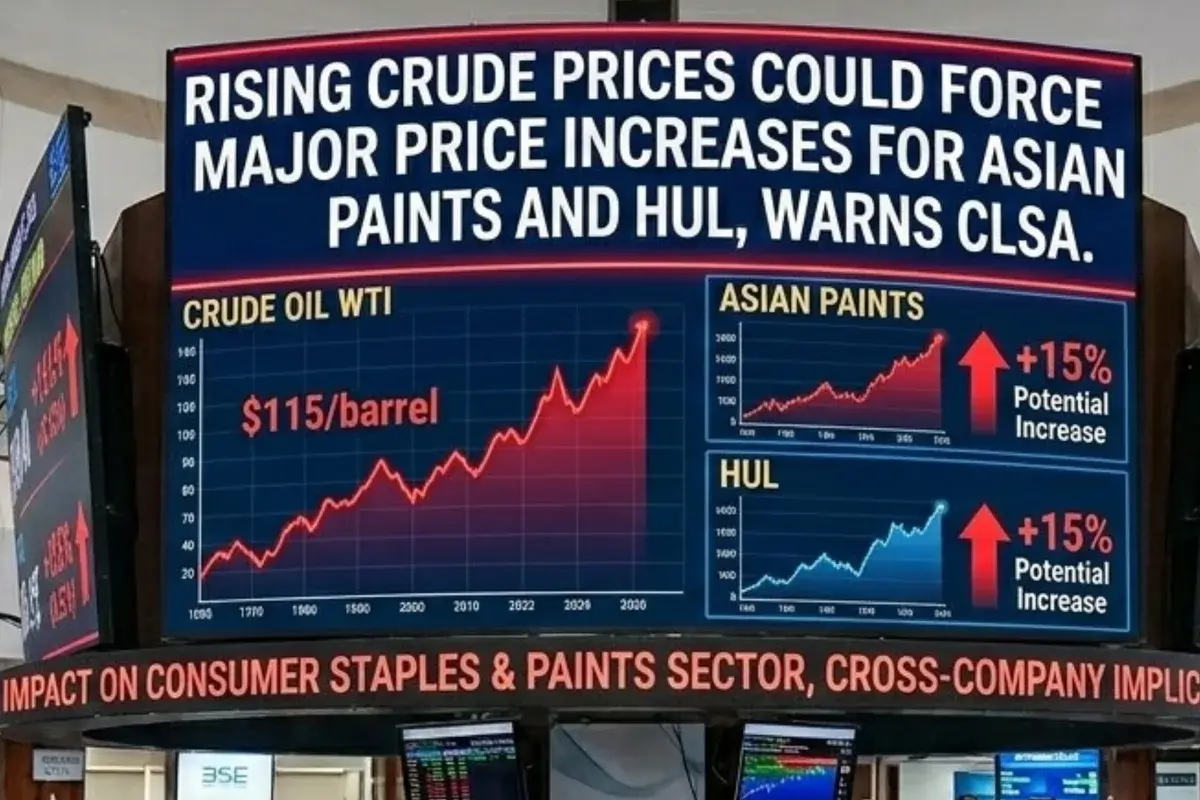
Indian consumer and paint sectors are on high alert as escalating global crude oil prices threaten to significantly impact the profitability of industry stalwarts Asian Paints and Hindustan Unilever Ltd (HUL), according to a recent warning from global brokerage CLSA. This surge in commodity costs could compel these companies to implement substantial price increases for their products, directly affecting millions of Indian consumers and raising broader inflationary concerns. The development follows a period of heightened geopolitical tensions, which have pushed crude benchmarks to multi-month highs, creating a challenging environment for companies heavily reliant on petroleum-linked raw materials.
The Catalyst
The primary driver behind this looming crisis is the sharp and sustained rally in international crude oil prices. As of early March 2026, Brent crude oil is trading around ₹7,076 per barrel, reflecting a significant increase. The Indian basket of crude oil has also seen elevated levels, making India, which imports approximately 85% of its crude requirements, particularly vulnerable to global price fluctuations. Recent geopolitical developments, including escalating tensions in the Middle East, have been a major factor, with reports indicating WTI crude surging above $75 per barrel and Brent crude above $77 per barrel due to concerns over supply disruptions, particularly around the Strait of Hormuz. This volatility translates directly into higher input costs for a wide array of industries, with paint and Fast-Moving Consumer Goods (FMCG) sectors being among the most susceptible.
Financial Forensics
The financial impact on Asian Paints and HUL stems from their significant dependence on crude oil derivatives as key raw materials.
Asian Paints: For paint manufacturers, crude oil derivatives constitute a substantial portion of their raw material costs, ranging from 50% to over 60%. Key derivatives include titanium dioxide, emulsions, solvents, resins, and binders. A rise in crude oil prices directly inflates the cost of these inputs, putting immense pressure on gross and operating margins. Historically, a $1 increase in crude oil prices can dent the EBITDA margin of paint companies by 0.2% to 0.3%. Companies like Asian Paints have previously faced an almost double-digit increase in raw material prices due to crude price volatility. While Asian Paints is India's largest paint company with a strong market share, its reliance on imported crude derivatives means it cannot escape these cost pressures.
Hindustan Unilever Ltd (HUL): For FMCG giants like HUL, petroleum derivatives account for an estimated 20-25% of their total input costs. Critical crude-linked raw materials for HUL include Linear Alkyl Benzene (LAB), a primary ingredient in detergents that can comprise over half of their raw material costs. Additionally, High-Density Polyethylene (HDPE), a crude derivative, is extensively used for packaging across various consumer goods like soaps, shampoos, and toothpaste. Beyond direct product inputs, rising crude oil prices also lead to increased freight and logistics costs, further squeezing margins across the supply chain. HUL has, in the past, initiated price hikes in response to commodity inflation, including in skin cleansing and tea products due to high crude palm oil and tea prices. The company has often absorbed some cost increases but typically passes them on to consumers if the pressure is sustained.
The table below illustrates the estimated impact of crude price sensitivity on these two consumer behemoths:
Impact of Crude Oil Price Fluctuations: Asian Paints vs. HUL
| Company | Primary Crude-Linked Inputs | Approx. Raw Material Cost Link to Crude | Potential Impact on Margins (Rising Crude) |
|---|---|---|---|
| Asian Paints | Titanium Dioxide, Emulsions, Solvents, Resins, Binders | 50-60% | Significant erosion, often leading to price hikes |
| Hindustan Unilever Ltd. | Linear Alkyl Benzene (LAB), HDPE for packaging, Crude Palm Oil | 20-25% (overall FMCG) | Margin pressure, increased freight costs, eventual price hikes |
| Source: FinScann Analysis, derived from industry reports and company disclosures. |
Market Impact
The broader Indian equity market has already reacted to the volatile crude oil landscape. During periods of sharp crude price increases, stocks of paint companies, including Asian Paints, Berger Paints, and Indigo Paints, have historically seen declines, sometimes by as much as 5-6% in a single day, hitting multi-month or 52-week lows. The Nifty 50 and Sensex have also experienced downturns, with oil-sensitive sectors facing significant pressure.
For investors, this scenario presents a dual challenge: potential margin compression for these companies and a possible slowdown in consumer demand if price increases are too steep. While HUL is a Nifty 50 constituent, and Asian Paints is a market leader, their sensitivity to crude oil cannot be overlooked. Elevated crude prices also contribute to overall inflation, which can prompt the Reserve Bank of India (RBI) to maintain a hawkish stance on interest rates, further impacting market sentiment and economic growth.
Key Takeaways
FinScann Verdict
FinScann analysis indicates that the current surge in crude oil prices presents a significant headwind for both Asian Paints and Hindustan Unilever Ltd. While both companies possess strong brand equity and market leadership, their ability to fully pass on increased costs without impacting demand will be critical. We anticipate a period of margin pressure followed by strategic price adjustments, making judicious portfolio allocation and a close watch on commodity trends paramount for investors.
Q: How do rising crude oil prices affect paint manufacturers like Asian Paints? A: Rising crude oil prices significantly impact paint manufacturers because petroleum derivatives, such as titanium dioxide, emulsions, solvents, resins, and binders, constitute 50-60% of their raw material costs. Higher crude prices directly inflate these input costs, leading to margin erosion and often necessitating price hikes to maintain profitability.
Q: What is the primary impact of crude oil on FMCG companies such as HUL? A: For FMCG companies like HUL, crude oil primarily impacts raw material costs for products like detergents (e.g., Linear Alkyl Benzene or LAB) and packaging materials (e.g., HDPE). Petroleum derivatives can make up 20-25% of their input costs. Additionally, higher fuel prices stemming from crude oil increases lead to elevated freight and logistics expenses, further squeezing margins.
Q: Will Indian consumers see higher prices for paints and daily essentials soon? A: Yes, it is highly probable that Indian consumers will face higher prices for paints and daily essentials. With major players like Asian Paints and HUL experiencing increased raw material and operational costs due to rising crude oil prices, they are likely to pass on these costs to consumers through price increases to protect their profit margins.
Q: How can investors gauge the risk of crude price volatility on their portfolio? A: Investors should monitor global crude oil benchmarks (e.g., Brent, WTI), geopolitical developments affecting oil supply, and corporate earnings reports for commentary on raw material costs and pricing strategies. For companies like Asian Paints and HUL, understanding their raw material basket's dependency on crude derivatives and their historical ability to absorb or pass on costs can help assess risk. Diversifying portfolios and considering companies with lower crude oil sensitivity or stronger pricing power can also mitigate risk.
Disclaimer: For information only; not investment advice. Stock market investments carry risks. Please consult a SEBI-registered advisor before investing. FinScann assumes no liability for decisions made based on this report.

Financial journalist specializing in market analysis, stock research, and investment trends. Dedicated to providing accurate, timely insights for informed decision-making.
Credentials: Experienced financial journalist with expertise in equity markets and economic analysis
The information provided in this article is for educational and informational purposes only and should not be construed as financial, investment, or legal advice. Finscann does not provide personalized investment recommendations.
For detailed terms and conditions, please read our Disclaimer and Terms of Service.

Gold prices on MCX soar to ₹1.64 lakh in March 2026, driven by intense US-Iran tensions. FinScann analyzes safe-haven demand and future outlook for...

Silver prices soar over 3% in March 2026 as Middle East tensions escalate and a weaker US dollar fuels safe-haven demand.
In-depth crude oil analysis for March 4, 2026. Explore Brent and WTI price forecasts, geopolitical risks, OPEC dynamics, inventory trends, technical...

Gold futures drop 3% and silver crashes 6% on MCX as US dollar strength outweighs geopolitical tensions.
Gold prices soared in March 2026, with COMEX reaching $5,400/oz and MCX over ₹1,67,900/10g, driven by escalating Iran war tensions.