Loading market data...
The Indian stock market is flashing caution signals as rising volatility, sustained FII selling, stretched valuations in select segments, and global macro uncertainty fuel fears of a possible correction. While crash narratives are gaining traction, history shows that markets rarely collapse without a liquidity or systemic trigger. This analysis breaks down technical signals, FII behaviour, past crash patterns, and current macro conditions to assess whether India is truly headed for a crash — or merely entering a volatile consolidation phase that demands discipline, not panic.
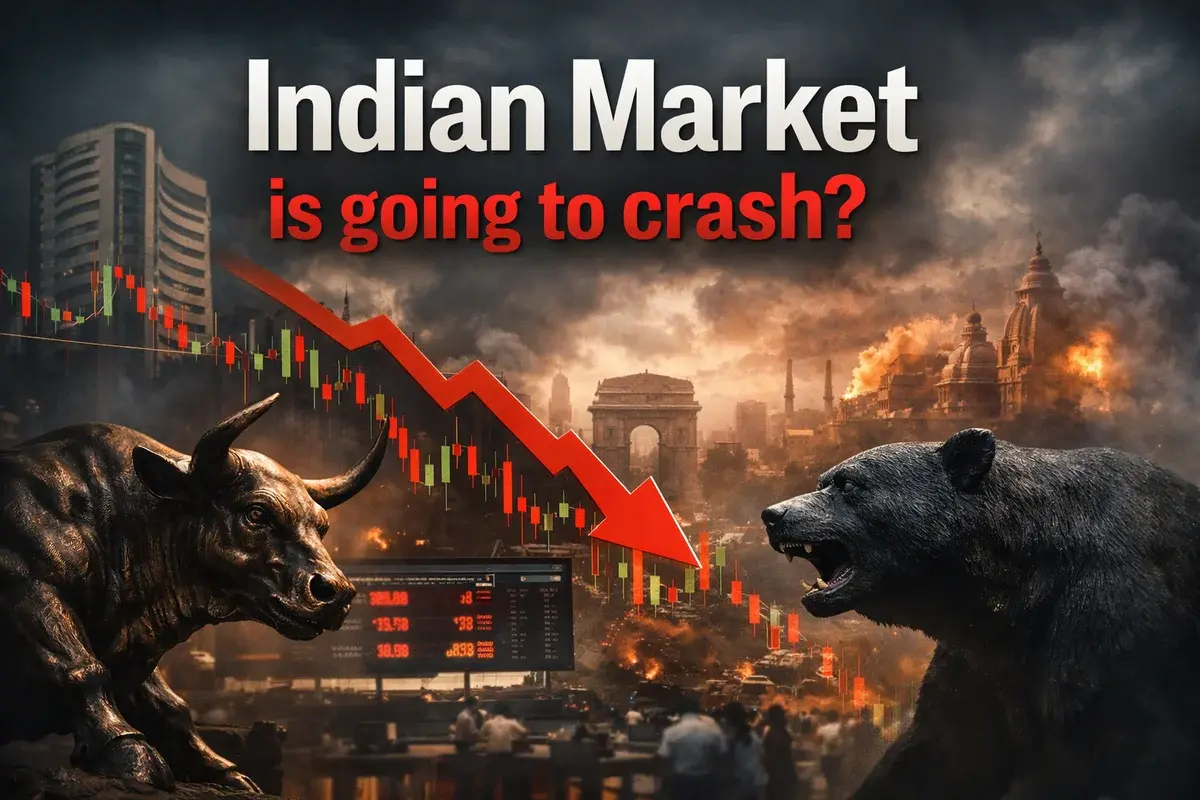
The question many investors are quietly asking — and some are already acting on — is unsettling: Is the Indian stock market heading towards a crash? With rising volatility, persistent foreign investor selling, stretched valuations in pockets of the market, and growing global uncertainty, fears of a sharp correction are no longer limited to pessimists. They are now part of mainstream market conversations.
But before panic takes over portfolios, it is critical to separate signals from noise.
Why Crash Fears Are Growing Right Now
Several developments have triggered renewed anxiety across Dalal Street.
Foreign institutional investors (FIIs) continue to remain net sellers. Sustained FII outflows often pressure headline indices, especially when domestic liquidity alone struggles to absorb supply. Historically, prolonged FII selling phases have coincided with either sharp corrections or long consolidation periods.
Global macro risks are rising. Geopolitical tensions, particularly in energy-sensitive regions, have kept crude oil prices volatile. For a net oil-importing economy like India, elevated crude prices directly impact inflation, fiscal balances, and corporate margins — all of which influence equity valuations.
Valuation fatigue is becoming visible. Select sectors, midcaps, and smallcaps are trading significantly above long-term averages. When earnings growth fails to justify price momentum, markets tend to correct not because of bad news, but because expectations were too optimistic.
Volatility indicators, although cooling from recent peaks, remain elevated compared to long-term lows. A rising or unstable volatility environment typically reflects investor nervousness rather than confidence.
Technical Signals Adding to the Nervousness
From a technical perspective, markets are showing hesitation.
Major indices are struggling to decisively break higher resistance zones, while rallies are increasingly being sold into. Market breadth — the ratio of advancing stocks to declining stocks — has weakened intermittently, indicating selective participation rather than broad-based strength.
Historically, such behaviour has preceded either sharp corrections or time-consuming sideways phases that frustrate both bulls and bears.
But Here’s the Other Side of the Story
Despite the noise, calling an outright market crash at this stage may be premature.
India’s domestic macro fundamentals remain relatively stable. Economic growth continues to outpace many global peers, corporate balance sheets are stronger than in previous cycles, and the banking system is far healthier compared to past crisis periods.
Domestic institutional investors (DIIs) and retail participation continue to provide a cushion against extreme downside moves. Unlike past crashes driven by leverage or systemic financial stress, the current environment reflects caution — not panic.
Additionally, sustained policy focus on infrastructure, manufacturing, defence, and capital expenditure provides medium-to-long-term earnings visibility for several sectors.
Bull vs Bear Checklist: Is the Market Headed for a Crash or Just a Pause?
Bull Case — Why the Market May Hold or Recover
Strong domestic participation through SIPs, DIIs, and retail investors acting as a shock absorber
Healthy banking system with low NPAs, strong credit growth, and solid capital adequacy
Government capex push supporting infrastructure, manufacturing, railways, defence, and energy transition
India’s economic growth premium attracting long-term global capital
Earnings resilience in large-cap companies preventing panic selling
No visible systemic leverage or credit freeze unlike 2008 or 2020
India VIX elevated but not in panic territory
Bear Case — Why Correction or Crash Fears Are Rising
Sustained FII outflows historically preceding corrections or long consolidations
Valuation excess in select midcap and smallcap segments
Rising global macro and geopolitical risks
Narrow market breadth indicating rally exhaustion
Event risks including Budget announcements and global policy shifts
Complacency risk after sharp rallies without earnings upgrades
Historical Market Crashes: What Actually Happened in the Past
Major Indian Market Crashes & Corrections (Nifty)
| Event / Crisis | Period | Nifty Peak | Nifty Low | Approx Fall |
|---|---|---|---|---|
| Harshad Mehta Scam | 1992 | ~4,546 | ~2,600 | ~43% |
| Asian Financial Crisis | 1997–98 | ~1,800 | ~950 | ~47% |
| Dot-com Bust | 2000–01 | ~1,800 | ~850 | ~53% |
| Global Financial Crisis | 2008–09 | ~6,357 | ~2,252 | ~65% |
| Eurozone Debt Crisis | 2011 | ~6,338 | ~4,531 | ~28% |
| Demonetisation | 2016 | ~8,968 | ~7,900 | ~12% |
| COVID-19 Crash | Feb–Mar 2020 | ~12,430 | ~7,511 | ~40% |
| Global Rate Shock | 2022 | ~18,604 | ~15,183 | ~18% |
Sensex: All-Time Highs vs Crash Lows
| Crisis | Sensex Peak | Sensex Low | Fall |
|---|---|---|---|
| Global Financial Crisis 2008 | ~21,206 | ~8,160 | ~62% |
| Eurozone Crisis 2011 | ~20,664 | ~15,135 | ~27% |
| COVID-19 Crash 2020 | ~42,273 | ~25,638 | ~39% |
| Rate Tightening Phase 2022 | ~62,245 | ~50,921 | ~18% |
Sectoral Behaviour During Market Crashes
| Index | Typical Behaviour |
|---|---|
| Bank Nifty | Falls more than Nifty during stress but recovers faster |
| Midcap Index | Falls 1.5–2× more than Nifty |
| Smallcap Index | Suffers deepest drawdowns (50–70% in severe crashes) |
| IT Index | Sensitive to global cycles and currency |
| FMCG Index | Defensive, usually falls less |
| Metal Index | Highly cyclical, sharp collapses during global slowdowns |
What FIIs Did Before Each Major Market Crash (A Crucial Pattern Investors Miss)
One of the most consistent yet underappreciated warning signals before major Indian market corrections has been Foreign Institutional Investor (FII) behaviour. FIIs rarely panic at market bottoms. Instead, they usually reduce exposure well before crashes become obvious to the broader market.
FII Behaviour Ahead of Major Indian Market Crashes
| Market Event | FII Behaviour Before the Fall | Key Insight |
|---|---|---|
| Harshad Mehta Scam (1992) | FIIs reduced exposure months earlier | Early valuation and governance concerns |
| Asian Financial Crisis (1997–98) | Steady exit from emerging markets | Currency and external debt stress |
| Dot-com Bust (2000–01) | Rotated out of overvalued tech stocks | Valuation disconnect |
| Global Financial Crisis (2008) | Heavy selling 6–8 months before crash | Early detection of credit stress |
| Eurozone Crisis (2011) | Aggressive selling during global risk-off | Macro risk dominated |
| Demonetisation (2016) | Mild caution, no panic selling | Event-driven correction |
| COVID-19 Crash (2020) | Sharp selling weeks before lockdowns | Global de-risking |
| Rate Shock (2022) | Sustained selling amid liquidity tightening | Dollar strength & rate hikes |
The Repeating FII Pattern (Very Important)
Across cycles, FIIs tend to follow a three-step pattern:
Distribution Phase: Gradual selling while markets hover near highs
Acceleration Phase: Faster exits as global risks intensify
Re-entry Phase: Buying resumes only after valuations reset and fear peaks
By the time FIIs return aggressively, the worst damage is usually already done.
What FII Behaviour Is Signalling Right Now
FIIs are selectively selling, not panic dumping
Selling is concentrated in overvalued pockets, not across the market
Domestic flows are currently absorbing foreign selling
Historically, this aligns more with correction or consolidation, not an immediate crash
However, history also shows that prolonged FII selling combined with a global shock can quickly change market dynamics.
Key Insight From History
Every crash feels obvious only in hindsight
Markets usually correct first and explain later
Crashes occur when valuation + leverage + liquidity shock align
Corrections happen when expectations outrun earnings
Right now, India shows valuation stress and global risk — but not systemic leverage collapse.
So… Crash or Correction?
Crash probability: Low to moderate (unless a major global shock hits)
Correction / consolidation probability: High
Volatility probability: Very high
Investor Playbook (Neutral & Practical)
Avoid excessive leverage
Do not chase momentum blindly
Focus on quality balance sheets
Use corrections to rebalance, not panic
Keep cash ready — not fear
Final Verdict
The Indian market is not screaming “crash” yet, but it is flashing caution. History shows that ignoring warning signs is dangerous — but so is exiting entirely during uncertainty.
The smartest investors prepare, not predict.
Disclaimer
This content is for educational and informational purposes only and should not be considered investment advice. Market investments are subject to risk. Past performance does not guarantee future results. Please consult a certified financial advisor before making investment decisions.

Financial journalist specializing in market analysis, stock research, and investment trends. Dedicated to providing accurate, timely insights for informed decision-making.
Credentials: Experienced financial journalist with expertise in equity markets and economic analysis
The information provided in this article is for educational and informational purposes only and should not be construed as financial, investment, or legal advice. Finscann does not provide personalized investment recommendations.
For detailed terms and conditions, please read our Disclaimer and Terms of Service.
India's benchmark indices Sensex and Nifty staged a robust recovery in March 2026, gaining significantly despite ongoing geopolitical tensions.

Geopolitical tensions surrounding the US-Iran conflict led FIIs to dump ₹12,000 crore from Indian shares.

Indian refinery stocks, including Reliance, MRPL, and CPCL, surge up to 5% after China reportedly suspends diesel and gasoline exports amidst...
Indian markets surged in March 2026, with Sensex and Nifty rebounding on de-escalation hopes in the Middle East.

Morgan Stanley cuts 2,500 jobs across investment banking, wealth management, and trading. Despite strong financials, this strategic move signals a...