Loading market data...
India’s Earth Corridors initiative marks a strategic shift to secure critical mineral sands such as monazite and rare earths for clean mobility and electronics. Backed by a ₹7,280 crore REPM investment, the plan targets 6,000 MTPA domestic capacity for EV motors and wind turbines, reducing China’s supply-chain dominance. By integrating mining, processing, manufacturing, and logistics, Earth Corridors aim to strengthen India’s clean-tech sovereignty, boost jobs, and build long-term industrial resilience.
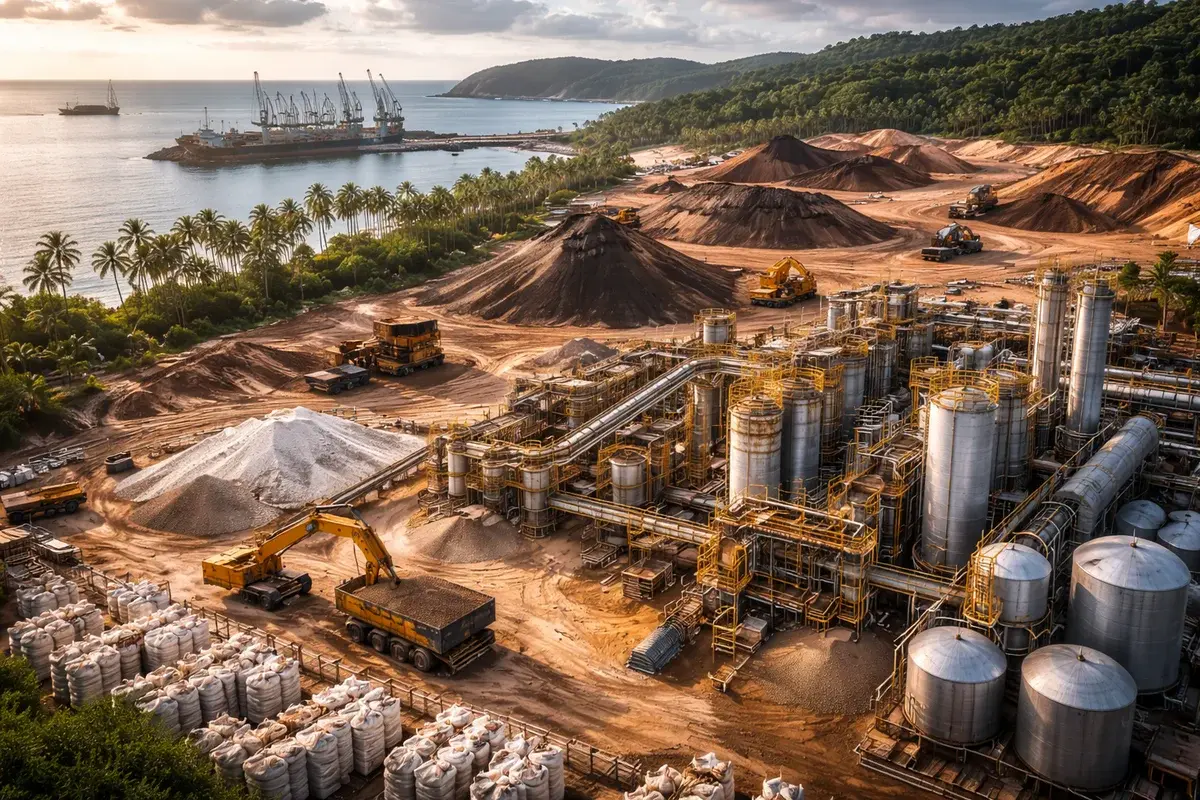
India’s drive for strategic autonomy in clean mobility and electronics has a new spine: Earth Corridors — regional mining + processing routes designed to secure domestic supplies of critical mineral sands, notably monazite and rare earth-bearing heavy minerals. Coupled with the government’s REPM investment of ₹7,280 crore, the plan targets a domestic capacity of 6,000 MTPA for components used in EV motors and wind turbines, aiming to slash China’s nearly 80% dominance in the supply chain and position India as a global clean-tech manufacturing hub.
This is not merely a resource policy. It is a full-spectrum industrial strategy connecting mining, downstream processing, advanced manufacturing, export logistics, and skill ecosystems — corridor by corridor.
Why Earth Corridors Matter Now
• Critical supply vulnerability: Rare earth refining and magnet manufacturing remain highly concentrated, creating geopolitical and commercial risks • Exploding clean-tech demand: EVs, renewable energy, and electronics require permanent magnets and rare-earth components • REPM as catalyst: The ₹7,280 crore scheme de-risks private investment by enabling domestic processing and component capacity • Value-chain capture: Transitioning from raw sand to finished motors keeps value, IP, and employment within India
Corridor Strategy: Where and What
The proposal focuses on regionally integrated corridors across mineral-rich coastal states with port access and industrial depth:
| Corridor (Proposed) | Focus | Strategic Advantage |
|---|---|---|
| Odisha Corridor | Monazite extraction, mineral separation | Heavy mineral sands, Paradip port access |
| Kerala Corridor | Regulated monazite mining, separation | Historic reserves, skilled workforce |
| Andhra Pradesh Corridor | Processing + EV component manufacturing | Visakhapatnam port, industrial clusters |
| Tamil Nadu Corridor | Magnet & motor assembly, exports | Auto & electronics ecosystem |
Each corridor links coastal mining zones with processing parks and manufacturing hubs within 200–400 km to minimize logistics costs and speed up scale-up.
The REPM Scheme: What It Delivers
• Total allocation: ₹7,280 crore • Target capacity: 6,000 MTPA • Instruments: Capex grants, concessional financing, tax incentives, R&D support • Private participation: Government funding lowers first-mover risk, crowding in private capital
REPM works as both a supply accelerator and a demand signal, attracting EV OEMs, magnet manufacturers, and global partners seeking alternatives to China-centric supply chains.
Economic and Strategic Impact
Environmental and Social Safeguards
For sustainable execution, corridors must include:
• Radiation safety protocols for monazite handling • Coastal ecology protection and rehabilitation • Community employment and revenue-sharing models • Transparent sourcing and traceability standards
Green industrialization without safeguards risks long-term setbacks.
Who Benefits and What to Watch
• Beneficiaries: Magnet makers, EV motor OEMs, specialty chemical firms, EPC players, port operators
• Watchlist sectors: Rare-earth processing, advanced materials, recycling, logistics infrastructure
Key Challenges Ahead
• Technological complexity of rare-earth refining • Coastal mining permissions and regulatory clarity • Multi-year capital commitment needs • Skilled workforce development
Execution discipline will decide success.
Frequently Asked Questions
What is monazite?
A heavy mineral sand rich in rare earth elements essential for EVs and wind turbines.
Why is REPM critical?
It enables India to build processing and manufacturing capacity instead of importing finished components.
How does this reduce dependence on China?
By domesticizing refining and manufacturing, India competes globally and secures supply chains.
Are environmental risks involved?
Yes, which is why strict safeguards are essential.
Bottom Line
Earth Corridors combined with the REPM scheme provide India a realistic pathway to secure critical minerals, build advanced manufacturing capacity, and strengthen clean-tech sovereignty. If executed with environmental discipline and policy consistency, this initiative could redefine India’s position in the global green economy.
Disclaimer: This article is for informational purposes only and does not constitute financial or investment advice. Policy details, corridor alignments, and timelines are subject to official government notifications.

Financial journalist specializing in market analysis, stock research, and investment trends. Dedicated to providing accurate, timely insights for informed decision-making.
Credentials: Experienced financial journalist with expertise in equity markets and economic analysis
The information provided in this article is for educational and informational purposes only and should not be construed as financial, investment, or legal advice. Finscann does not provide personalized investment recommendations.
For detailed terms and conditions, please read our Disclaimer and Terms of Service.
India's benchmark indices Sensex and Nifty staged a robust recovery in March 2026, gaining significantly despite ongoing geopolitical tensions.

Geopolitical tensions surrounding the US-Iran conflict led FIIs to dump ₹12,000 crore from Indian shares.

Indian refinery stocks, including Reliance, MRPL, and CPCL, surge up to 5% after China reportedly suspends diesel and gasoline exports amidst...
Indian markets surged in March 2026, with Sensex and Nifty rebounding on de-escalation hopes in the Middle East.

Morgan Stanley cuts 2,500 jobs across investment banking, wealth management, and trading. Despite strong financials, this strategic move signals a...