Loading market data...
San Francisco-based Kana secures $15 million in seed funding led by Mayfield to launch configurable AI agents for end-to-end marketing workflows. Deep analysis of product strategy, synthetic data use, competitive landscape, and martech market outlook.
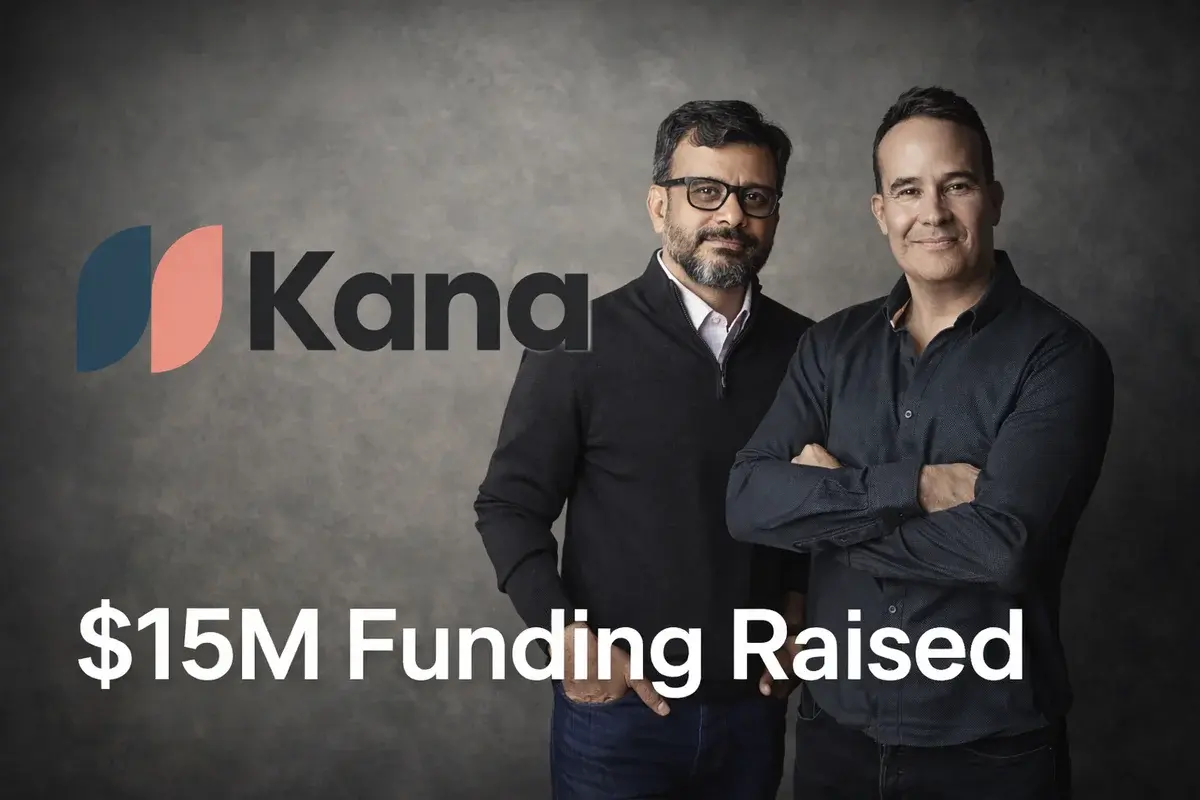
San Francisco-based Kana has raised $15 million in a seed round led by Mayfield, emerging from stealth with a platform built around configurable AI agents for marketing workflows. Founded by martech veterans Tom Chavez and Vivek Vaidya, the company is betting that autonomous, adaptable AI systems—not isolated tools—will define the next generation of enterprise marketing infrastructure. The funding will be deployed across engineering, product, and go-to-market expansion as Kana positions itself at the center of a rapidly evolving AI-driven marketing stack.
Enterprise marketing software is undergoing structural reinvention. Over the past two years, generative AI tools have flooded the market, offering content generation, campaign suggestions, and automation add-ons. Yet most platforms remain fragmented, handling isolated tasks rather than orchestrating full workflows.
Kana is entering this environment with a different thesis. Instead of positioning itself as another AI assistant, the company is building configurable AI agents designed to operate across planning, execution, optimization, and reporting. In a climate where marketing teams face budget constraints but higher performance expectations, workflow autonomy is emerging as a key differentiator.
The $15 million seed round led by Mayfield signals investor conviction that AI agents, rather than feature-level automation, may represent the next durable moat in marketing technology.
The seed round was led by Mayfield, with managing partner Navin Chadha joining Kana’s board. Mayfield’s participation adds institutional credibility and signals a long-term platform-building strategy rather than a rapid-flip startup approach.
The capital will be allocated toward:
In today’s venture capital trends environment, where investors increasingly prioritize sustainable product differentiation and technical defensibility over rapid user acquisition, Kana’s structured expansion approach aligns with a capital discipline narrative.
Kana describes its system as a network of loosely coupled AI agents that can integrate into existing marketing stacks without requiring a complete infrastructure rebuild. This is a crucial positioning move in an enterprise landscape where marketing teams already rely on multiple SaaS platforms.
The agents are designed to operate across:
• Data analysis and audience segmentation • Campaign planning and execution • Media allocation and performance optimization • Customer engagement workflows • Chatbot refinement and conversational optimization
Unlike generative tools that assist only during content creation, Kana’s system aims to remain active throughout a campaign lifecycle.
For example, when a marketer uploads a media brief, the platform’s agents can:
This always-on operational model reflects a shift from augmentation to delegation in enterprise AI systems.
One of Kana’s more differentiated claims lies in its use of synthetic data to complement external datasets. In an era marked by privacy regulations and diminishing third-party cookie reliability, synthetic augmentation may provide strategic flexibility.
By generating modeled datasets to fill research gaps, Kana positions itself as reducing reliance on volatile third-party data markets. The strategic benefits include:
However, synthetic data accuracy and regulatory oversight remain potential risk variables.
Kana’s leadership team is not new to marketing technology cycles. CEO Tom Chavez and CTO Vivek Vaidya bring more than 25 years of combined martech experience.
Their previous ventures include:
• Rapt, acquired by Microsoft in 2008 • Krux, sold to Salesforce in 2016 • super{set}, a startup studio that incubated Kana
The founders’ acquisition history strengthens investor confidence, especially in a funding climate where execution risk is heavily scrutinized.
“Markets are rewarding experienced operators who understand enterprise buying cycles and can navigate integration complexity,” says a Silicon Valley-based venture investor tracking AI infrastructure startups.
Kana is entering a crowded space where large incumbents like Adobe, Salesforce, and HubSpot are embedding AI features into their ecosystems. Smaller startups are also racing to deploy AI-driven campaign tools.
Kana’s stated differentiation lies in configurability. Rather than building bespoke systems for each client, the company emphasizes rapid deployment and adaptive configuration.
Strategic pillars include:
The competitive challenge will be proving that adaptability can scale without eroding margins.
As a seed-stage company, Kana has not disclosed revenue figures. However, in assessing early-stage AI infrastructure startups, investors typically evaluate:
• Product-market fit validation
• Enterprise contract pipeline
• Customer acquisition cost
• Recurring revenue potential
• Infrastructure burn rate
The $15 million capital raise provides operational runway, but sustained differentiation will determine long-term valuation multiples.
In an environment where startup funding in AI remains robust but selective, Kana’s success will hinge on converting product narrative into enterprise adoption.
The AI marketing automation sector is supported by structural tailwinds:
If Kana successfully embeds itself into enterprise stacks, switching costs could create defensible recurring revenue streams.
Despite promising positioning, risks remain:
Execution quality in the next 18–24 months will determine whether Kana evolves into a platform or remains a niche tool provider.
Kana’s $15 million seed round reflects continued conviction in AI-driven enterprise infrastructure. However, differentiation in marketing automation is increasingly measured not by features but by integration depth and measurable ROI.
For Venture Observers:
For Enterprise Buyers:
The next wave of martech will likely reward platforms capable of orchestrating AI agents across entire campaign lifecycles rather than enhancing isolated tasks.
Kana’s emergence from stealth underscores a broader transition in enterprise AI—from generative experimentation to operational automation. In a saturated marketing technology market, adaptability may become the true moat.
The question is not whether AI will dominate marketing workflows, but which platforms can orchestrate it without sacrificing control, compliance, and capital efficiency.
⚠️ DISCLAIMER: We Are Not Financial Advisors

Financial journalist specializing in market analysis, stock research, and investment trends. Dedicated to providing accurate, timely insights for informed decision-making.
Credentials: Experienced financial journalist with expertise in equity markets and economic analysis
The information provided in this article is for educational and informational purposes only and should not be construed as financial, investment, or legal advice. Finscann does not provide personalized investment recommendations.
For detailed terms and conditions, please read our Disclaimer and Terms of Service.

Info Edge, parent of Naukri.com, sets up ₹250 crore B8 Fund-I to invest in growth-stage tech companies.

Indian AI startups unveil real-world deployment solutions at the India AI Impact Summit, spanning voice AI for BFSI, radiology tools, industrial IoT,...

Indian agentic AI startup Gushwork secures $9 million in seed funding to expand engineering and scale AI-driven citation optimization for platforms...

Prayaan Capital secures ₹110 crore in Series A funding led by Peak XV Partners to build a technology-enabled MSME lending platform.

Comprehensive 2026 analysis of Gurugram’s top AI startups including revenue growth, funding rounds, valuation signals, enterprise adoption,...