Loading market data...
India’s AI startup ecosystem is witnessing strong investor momentum as companies like Sarvam AI, Krutrim, Yellow.ai, Mad Street Den, and Uniphore attract significant funding. Explore how these AI startups are shaping India’s artificial intelligence economy and global tech markets.
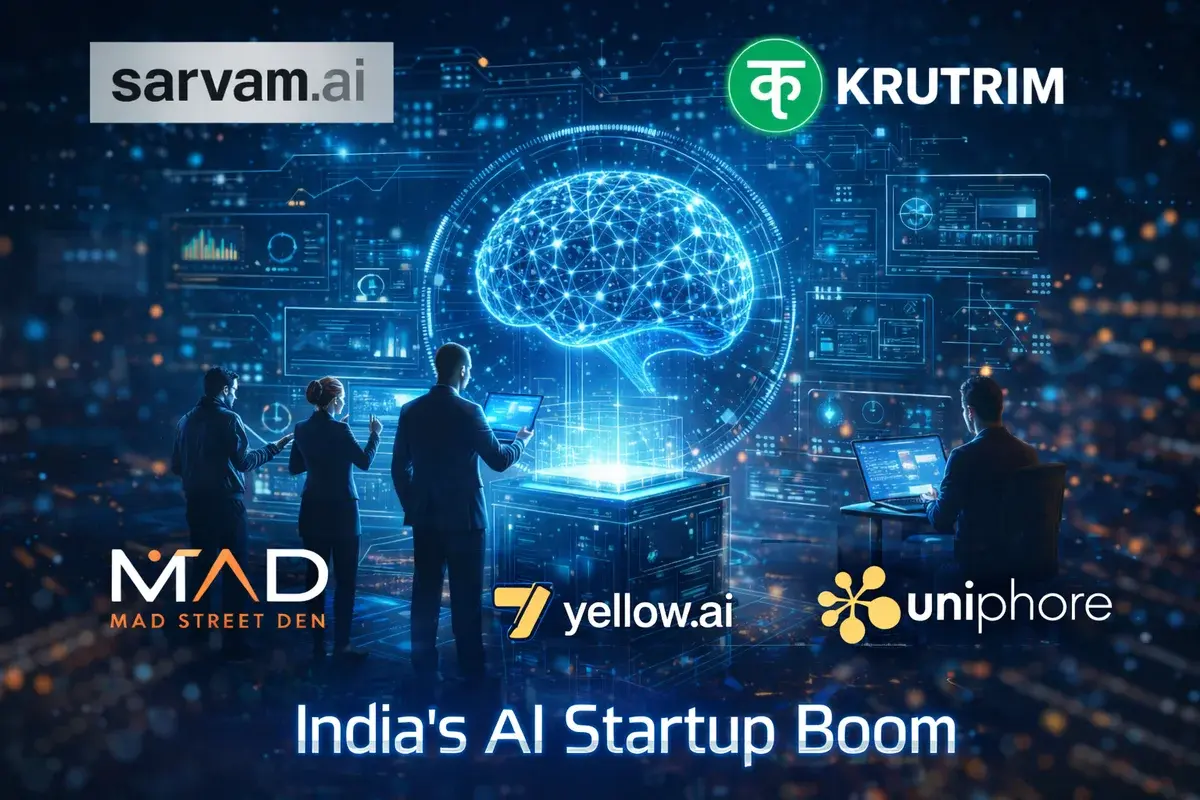
India’s artificial intelligence ecosystem is entering a pivotal phase as venture capital flows, enterprise adoption, and government policy converge to accelerate the country’s AI startup economy. Over the past two years, India has seen a wave of funding into generative AI, enterprise automation, and AI infrastructure companies, reflecting growing confidence among global investors in the country’s deep-tech capabilities. As global markets grapple with financial volatility and tightening capital conditions, India’s AI startups have continued attracting strategic capital, positioning themselves as long-term players in the global AI race.
| Indicator | Data |
|---|---|
| India AI Startup Count | ~1,700+ |
| AI Funding in India (2025 est.) | ~$1.4 Billion |
| Global AI Market Size Forecast | $1.8 Trillion by 2030 |
| Key Investor Regions | US, Singapore, Middle East |
The momentum reflects broader structural shifts in global markets. Institutional investors increasingly see AI infrastructure and enterprise automation platforms as long-term productivity engines capable of offsetting macroeconomic slowdowns. India’s large developer ecosystem, competitive cloud costs, and expanding digital economy are reinforcing its attractiveness as a global AI innovation hub.
One of the most closely watched companies in India’s AI ecosystem is Sarvam AI, a generative AI startup focused on building foundational large language models tailored for Indian languages and enterprise applications. Founded by former AI researchers and engineers, the company has attracted strong venture interest as demand for localized generative AI models continues rising across emerging markets.
| Metric | Data |
|---|---|
| Latest Funding Round | $41 Million |
| Lead Investors | Lightspeed Venture Partners |
| Focus Area | Indian Language LLMs |
| Enterprise Applications | Banking, Government, Customer Service |
Sarvam AI’s strategic relevance lies in the localization layer of artificial intelligence. While global models developed by companies such as OpenAI and Anthropic dominate English-language AI capabilities, India’s digital economy requires multilingual AI systems capable of processing dozens of regional languages. The company’s models are designed to support enterprise use cases ranging from automated customer support to government digital services.
Institutional investors see such localized AI infrastructure as a defensible moat in emerging markets. Enterprises operating across India’s diverse linguistic landscape increasingly require AI solutions optimized for local datasets. As a result, Sarvam AI could play a critical role in enabling the next phase of AI adoption across India’s financial services, telecom, and e-commerce sectors.
Another major entrant reshaping India’s AI ecosystem is Krutrim, the artificial intelligence company launched by mobility platform Ola. Positioned as India’s first AI unicorn, Krutrim aims to build a full AI computing stack including models, cloud infrastructure, and developer platforms.
| Metric | Data |
|---|---|
| Valuation | $1 Billion+ |
| Funding Raised | ~$50 Million |
| Founder | Bhavish Aggarwal |
| Focus | AI Cloud + Foundation Models |
Krutrim’s strategy reflects a broader shift in the global AI economy toward vertically integrated platforms. Instead of focusing solely on AI applications, the company is investing heavily in compute infrastructure, developer tools, and AI operating systems designed to support large-scale enterprise deployments.
The move comes at a time when global technology companies are racing to control AI infrastructure layers. With rising demand for AI compute capacity and increasing geopolitical tensions affecting semiconductor supply chains, building domestic AI infrastructure has become a strategic priority for many countries. Krutrim’s positioning aligns closely with India’s ambition to develop sovereign AI capabilities that reduce dependence on foreign platforms.
For investors, the company represents a high-risk, high-reward bet on India’s long-term AI leadership potential.
Enterprise automation platform Yellow.ai has emerged as one of India’s most globally recognized AI startups. The company specializes in conversational AI solutions that automate customer interactions for large enterprises across banking, e-commerce, telecommunications, and retail sectors.
| Metric | Data |
|---|---|
| Funding Raised | ~$102 Million |
| Key Investors | WestBridge Capital, Salesforce Ventures |
| Enterprise Clients | 1000+ globally |
| AI Focus | Conversational AI |
The company’s growth trajectory highlights the rising demand for AI-powered enterprise automation tools. Businesses across global markets are increasingly deploying conversational AI systems to reduce operational costs, improve customer response times, and enhance digital engagement.
From an investor perspective, conversational AI sits at the intersection of automation and customer experience transformation. As companies continue digitalizing operations in response to global economic uncertainty, platforms like Yellow.ai provide scalable tools capable of handling millions of customer interactions simultaneously.
With clients spanning multiple continents, Yellow.ai also represents India’s ability to build globally competitive AI software companies.
Retail AI platform Mad Street Den has positioned itself as a leader in computer vision and AI-driven retail analytics. Its flagship platform, Vue.ai, helps global retailers optimize product discovery, visual search, and merchandising through artificial intelligence.
| Metric | Data |
|---|---|
| Funding Raised | ~$50 Million |
| Key Technology | Computer Vision AI |
| Target Industry | Retail & Fashion |
| Global Retail Clients | Hundreds |
The rise of AI-powered retail intelligence comes at a time when e-commerce platforms face increasing competition and margin pressures. Retailers are investing heavily in AI technologies capable of improving product recommendations, visual search accuracy, and customer personalization.
Computer vision models developed by companies like Mad Street Den analyze product images, consumer browsing behavior, and inventory data to generate actionable insights for retailers. This technology significantly improves product discovery rates, which directly impacts revenue growth.
From a macroeconomic perspective, AI-driven retail analytics could become a crucial tool for companies navigating shifting consumer demand patterns amid global economic uncertainty.
Enterprise AI company Uniphore has built one of the world’s most advanced conversational automation platforms focused on voice intelligence and contact center automation. With major enterprise customers across financial services, telecommunications, and healthcare, the company has attracted significant global investment.
| Metric | Data |
|---|---|
| Total Funding | ~$610 Million |
| Valuation | ~$2.5 Billion |
| Core Technology | Conversational AI + Voice Intelligence |
| Global Offices | US, India, Europe |
Uniphore’s AI technology analyzes voice conversations in real time, extracting insights from customer interactions to automate workflows and enhance service quality. As enterprises increasingly rely on digital communication channels, AI platforms capable of interpreting voice and sentiment data are becoming essential operational tools.
The company’s rapid expansion reflects a broader trend in enterprise software markets where AI capabilities are becoming embedded across nearly every business function. For institutional investors, AI-driven enterprise automation represents one of the most scalable software investment themes of the decade.
The rise of these companies reflects a broader shift in global venture capital flows toward artificial intelligence infrastructure and enterprise automation technologies. Despite financial volatility in global markets and tightening liquidity conditions, AI remains one of the most resilient sectors attracting investment.
| Startup | Sector | Funding Raised | Valuation |
|---|---|---|---|
| Sarvam AI | Generative AI | $41M | Growing |
| Krutrim | AI Infrastructure | $50M | $1B+ |
| Yellow.ai | Conversational AI | $102M | ~$1B |
| Mad Street Den | Retail AI | $50M | Private |
| Uniphore | Voice AI | $610M | ~$2.5B |
The sustained flow of venture capital into India’s AI ecosystem highlights growing investor confidence in the country’s deep-tech innovation capacity. As global corporations accelerate AI adoption to improve productivity and reduce operational costs, startups building foundational AI platforms are expected to capture a significant share of future enterprise spending.
Looking ahead, the macroeconomic outlook for AI investment remains robust despite broader market uncertainty. Institutional investors increasingly view artificial intelligence as a structural technology wave comparable to the rise of cloud computing or mobile internet. For India, the convergence of engineering talent, digital infrastructure, and venture capital funding could position the country as one of the world’s most important AI innovation hubs over the next decade.
⚠️ Disclaimer: This article is for informational purposes only and does not constitute financial advice.

Financial journalist specializing in market analysis, stock research, and investment trends. Dedicated to providing accurate, timely insights for informed decision-making.
Credentials: Experienced financial journalist with expertise in equity markets and economic analysis
The information provided in this article is for educational and informational purposes only and should not be construed as financial, investment, or legal advice. Finscann does not provide personalized investment recommendations.
For detailed terms and conditions, please read our Disclaimer and Terms of Service.

Rozana, a New Delhi-based rural commerce startup, has raised ₹290 crore in a Series B funding round led by Bertelsmann India Investments with...

Skyroot Aerospace prepares for Vikram-1 launch, India's first private orbital rocket. FinScann analyzes its over ₹800 Cr funding, market impact, and...

TruDoc Healthcare raises $15M in Pre-Series B for virtual-first and at-home critical care expansion across the GCC.

Bengaluru is rapidly emerging as India’s artificial intelligence innovation hub, with startups building advanced AI platforms across healthcare,...
Evervault raises €21M in Series B funding led by Ribbit Capital to expand its data encryption platform, securing sensitive information for global...