Loading market data...
Rozana, a New Delhi-based rural commerce startup, has raised ₹290 crore in a Series B funding round led by Bertelsmann India Investments with participation from Fireside Ventures and other investors. The funding highlights growing investor confidence in India’s rural retail market as the company expands its network of women-led partners delivering groceries and essentials across more than 21,000 villages.
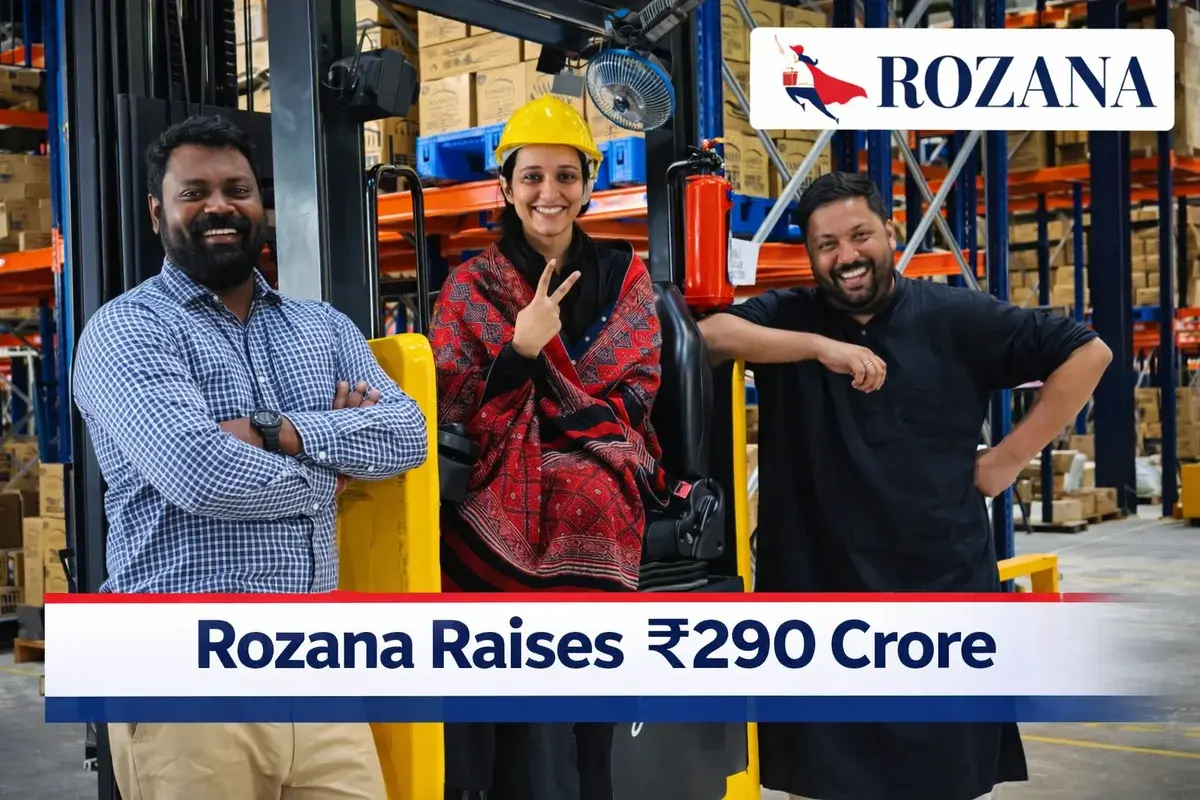
India’s rural commerce sector is attracting significant institutional capital as digital infrastructure and supply chain innovation unlock new consumer markets across the country. New Delhi-based startup Rozana announced on March 6, 2026 that it has raised ₹290 crore, approximately $35 million, in a Series B funding round aimed at expanding its rural retail network across northern India.
The round was led by Bertelsmann India Investments with participation from Fireside Ventures, Spark Growth Ventures, the family office associated with Bikaji Foods International, and FE Securities. The funding reflects a broader shift in investor attention toward the “Bharat” consumption story as startups begin building scalable commerce infrastructure across rural India.
Founded in 2021 by Ankur Dahiya, Adwait Vikram Singh, Mukesh Christopher, and Prithvi Pal Singh, Rozana operates a technology-driven distribution platform designed specifically for rural communities. The company connects local entrepreneurs and village-level partners to supply groceries and daily essentials to households that traditionally lack access to organized retail.
| Key Funding Metrics | Data |
|---|---|
| Series B Funding | ₹290 Crore |
| USD Equivalent | ~$35 Million |
| Funding Announcement | March 6, 2026 |
| Estimated Valuation | ~$200 Million |
| Previous Valuation (2024) | ~$85 Million |
| Revenue Growth Since Series A | 4× |
| Active Households Served | 1 Million+ |
| Villages Covered | 21,000 |
The latest funding round more than doubles the company’s valuation from roughly $85 million in 2024 to nearly $200 million, highlighting strong investor confidence in rural commerce as a long-term structural growth sector within India’s digital economy.
Unlike conventional e commerce platforms that focus on large cities and metropolitan logistics networks, Rozana has built a rural-first distribution model designed to function efficiently in villages and small towns.
The company’s platform enables local women entrepreneurs to act as community retail partners responsible for order aggregation, last mile delivery, and customer engagement within their villages. This decentralized model allows the company to overcome logistical barriers that have historically limited retail penetration across rural India.
| Operational Network | Data |
|---|---|
| Women Partner Network | 35,000+ |
| Villages Covered | 21,000 |
| Retail Experience Centers | 75 |
| Target Retail Centers | 200+ |
| States Served | Uttar Pradesh, Haryana |
| Planned Expansion | 2 to 3 additional states |
The platform blends digital ordering technology with offline distribution hubs known as retail experience centers. These centers act as aggregation points where inventory is stored and distributed through village-level partners.
This hybrid model is particularly important in rural markets where digital adoption is rising but infrastructure limitations such as delivery networks and warehouse availability still present operational challenges.
By embedding its logistics network within local communities, the company reduces delivery costs while building trust with rural consumers who often prefer familiar local intermediaries when purchasing goods.
India’s rural economy represents one of the largest untapped consumer markets globally. Rural areas account for more than 65 percent of India’s population and contribute nearly half of the country’s overall consumption demand.
Despite this massive market size, organized retail penetration in villages remains relatively low compared with urban regions. This gap has created opportunities for technology platforms capable of bridging supply chain inefficiencies and connecting rural consumers with modern retail systems.
| Rural Market Indicators | Estimate |
|---|---|
| Rural Population Share | ~65% |
| Share of National Consumption | ~45% |
| Rural Smartphone Penetration | ~45 to 50% |
| Annual Rural Consumption Growth | 8 to 10% |
| Estimated Rural Retail Market Size | $600 Billion+ |
Investors increasingly view rural commerce platforms as a long-term opportunity rather than a short-term technology trend. As internet penetration expands and digital payments become more common in villages, the potential for scalable rural retail infrastructure is growing rapidly.
Bertelsmann India Investments, which has backed several high-growth Indian consumer technology startups, sees the rural economy as a major driver of India’s next phase of consumption-led economic expansion.
A key factor behind the success of Rozana’s Series B funding round is the company’s rapid revenue growth. Since raising $22.5 million in Series A funding in March 2024, the company reports that its revenue has increased fourfold.
This level of growth indicates strong adoption among rural households and suggests that the platform’s community-driven model resonates with its target consumers.
| Financial Growth Indicators | Data |
|---|---|
| Series A Funding (2024) | $22.5 Million |
| Revenue Growth Since Series A | 4× |
| Series B Funding | $35 Million |
| Debt Component | ~$5 Million |
| Valuation Growth | 2.3× |
Approximately $5 million of the Series B round was structured as debt financing. The presence of debt within the funding structure indicates investor confidence in the company’s operational scalability and its ability to generate consistent revenue streams as its network expands.
For investors, rural commerce platforms with established logistics infrastructure and predictable consumer demand offer a relatively stable growth trajectory compared with many early-stage technology startups.
The newly raised capital will primarily be used to expand Rozana’s physical retail infrastructure and partner network across northern India, particularly within the Gangetic belt.
This region includes some of India’s most densely populated states and represents one of the country’s largest untapped retail markets.
| Expansion Targets | Data |
|---|---|
| Retail Centers Today | 75 |
| Target Retail Centers | 200+ |
| States Currently Served | 2 |
| Planned New States | 2 to 3 |
| Target Household Reach | 3 Million+ |
The Gangetic belt, which includes states such as Uttar Pradesh and Bihar, has historically lagged behind urban centers in terms of organized retail penetration. However rising incomes, expanding internet connectivity, and government investments in infrastructure are rapidly changing consumption patterns in these regions.
For companies like Rozana, this creates an opportunity to establish distribution networks before large national retailers scale their presence across rural markets.
By increasing the number of retail experience centers and expanding its village partner network, the company aims to significantly increase its household reach over the next few years.
India’s rural commerce sector is becoming increasingly competitive as startups and established e commerce companies attempt to capture the next wave of digital consumers.
Large technology platforms such as Amazon and Flipkart have expanded aggressively into smaller towns and tier 2 cities. However reaching deep rural markets remains a complex logistical challenge.
| Platform | Market Focus |
|---|---|
| Rozana | Rural grocery and essential goods |
| Amazon | Nationwide e commerce marketplace |
| Flipkart | Tier 2 and tier 3 city expansion |
| Meesho | Social commerce driven retail |
While major e commerce companies rely on centralized warehouse networks and traditional courier logistics, rural focused startups often adopt decentralized distribution strategies built around local partnerships and micro fulfillment centers.
This localized approach allows rural commerce platforms to operate efficiently in areas where conventional delivery networks may not be economically viable.
As competition intensifies, the companies that succeed will likely be those capable of building reliable supply chains while maintaining strong community engagement.
The rise of rural commerce platforms is closely tied to the rapid expansion of India’s digital infrastructure. Affordable smartphones, low cost mobile data, and the growth of digital payment systems have transformed the way rural consumers access goods and services.
India now has one of the world’s largest internet user bases, with a growing proportion of users located outside major cities.
| Digital Economy Indicators | Data |
|---|---|
| Total Internet Users in India | 900 Million+ |
| Rural Internet Users | ~450 Million |
| Annual Digital Payments Growth | 30%+ |
| Rural Retail Growth Rate | 8 to 10% |
Digital payment platforms and mobile commerce applications are enabling rural households to participate in the digital economy more easily than ever before. As connectivity improves, rural consumers are increasingly seeking the convenience and variety offered by online and hybrid retail platforms.
This shift is expected to accelerate over the coming decade as internet penetration continues expanding across India’s villages.
The success of Rozana’s Series B funding round reflects a broader transformation underway within India’s retail ecosystem. Venture capital investors are increasingly shifting their focus toward infrastructure platforms that can serve India’s rural population at scale.
Over the next decade, the combination of rising rural incomes, expanding digital connectivity, and improved logistics infrastructure is expected to reshape consumption patterns across the country.
Companies that successfully build large distribution networks across villages may eventually become critical components of India’s retail supply chain, connecting producers, brands, and consumers across the rural economy.
For investors, the rural commerce sector offers a unique opportunity to participate in a long term structural growth story driven by demographics, digital adoption, and evolving consumer behavior.
As investment flows into platforms like Rozana continue to increase, rural commerce may emerge as one of the most important drivers of India’s next phase of digital economic expansion.
Disclaimer: This article is for informational purposes only and does not constitute financial advice.

Financial journalist specializing in market analysis, stock research, and investment trends. Dedicated to providing accurate, timely insights for informed decision-making.
Credentials: Experienced financial journalist with expertise in equity markets and economic analysis
The information provided in this article is for educational and informational purposes only and should not be construed as financial, investment, or legal advice. Finscann does not provide personalized investment recommendations.
For detailed terms and conditions, please read our Disclaimer and Terms of Service.
No related topics available

Skyroot Aerospace prepares for Vikram-1 launch, India's first private orbital rocket. FinScann analyzes its over ₹800 Cr funding, market impact, and...

TruDoc Healthcare raises $15M in Pre-Series B for virtual-first and at-home critical care expansion across the GCC.

Bengaluru is rapidly emerging as India’s artificial intelligence innovation hub, with startups building advanced AI platforms across healthcare,...

Evervault raises €21M in Series B funding led by Ribbit Capital to expand its data encryption platform, securing sensitive information for global...

Vivox AI raises $1.5M in March 2026 for its regulator-ready AI agents in financial crime compliance.