Loading market data...
Indian stock markets crash as Sensex drops over 1,000 points and Nifty slips below 24,000 amid Iran–Israel conflict, FII selling, rupee weakness and profit booking.
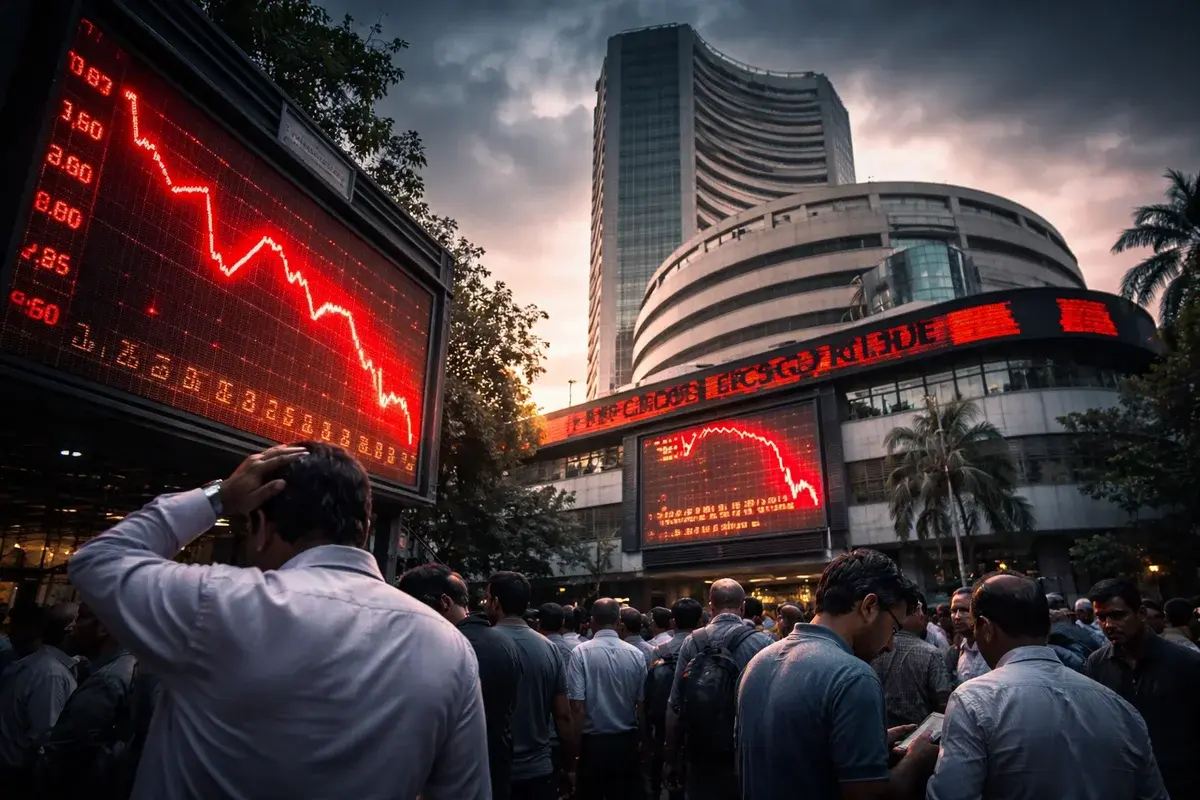
Indian equity markets witnessed a sharp decline on Wednesday as benchmark indices came under heavy selling pressure. The BSE Sensex plunged more than 1,000 points, while the Nifty 50 slipped below the 24,000 level, reflecting heightened investor caution. The sell-off was triggered by escalating geopolitical tensions in the Middle East, persistent foreign institutional investor (FII) selling, weakness in the Indian rupee, and profit booking after the previous session’s rally.
Indian benchmark indices faced a steep correction during the trading session as investors reacted to global uncertainties and domestic market pressures.
At around mid-day trading, the BSE Sensex dropped nearly 974 points to 77,185, while the Nifty 50 declined more than 275 points to around 23,986.
The sharp fall wiped out nearly ₹96,964 crore from the total market capitalization of companies listed on the Bombay Stock Exchange.
Heavyweights including Axis Bank, Mahindra & Mahindra, Bajaj Finance, Bharti Airtel, HDFC Bank, and Bajaj Finserv were among the biggest losers, declining between 2% and 4%.
Meanwhile, stocks such as Adani Ports and Special Economic Zone, NTPC Limited, Sun Pharmaceutical Industries, and Tech Mahindra managed to post gains during the volatile session.
The sell-off was widespread across sectors, with several indices on the National Stock Exchange turning negative after briefly trading in positive territory during early morning trade.
The Nifty Auto index emerged as the biggest loser, falling nearly 2%, reflecting selling pressure in automobile stocks.
The Nifty Private Bank index also declined more than 1.8%, indicating weakness in financial stocks, which carry significant weight in benchmark indices.
However, the Nifty Pharma index managed to gain more than 1%, as defensive sector stocks attracted buying interest during market volatility.
Geopolitical tensions in the Middle East have emerged as one of the biggest drivers of global market volatility.
The ongoing conflict between Iran and Israel has intensified in recent days, with reports of heavy military strikes and retaliatory attacks across multiple regions. The situation has raised fears of a prolonged conflict that could disrupt global energy supplies.
Iran has warned that it may block oil shipments through the Strait of Hormuz, one of the world’s most critical oil transit routes. Any disruption to this shipping lane could significantly impact global oil markets and trigger further volatility in financial markets.
Geopolitical uncertainty often prompts investors to reduce exposure to risk assets such as equities.
Currency markets also contributed to the negative sentiment in equities.
The Indian rupee opened weaker against the US dollar, trading around ₹91.93 per dollar, compared with the previous close of ₹91.80.
Earlier this week, the rupee had touched a record low of ₹92.35 per dollar, reflecting pressure from rising crude oil prices and foreign investor outflows.
Currency weakness often increases inflationary pressures in import-dependent economies like India, making investors cautious.
Foreign institutional investors have continued to sell Indian equities, adding to the downward pressure on markets.
Market data shows that foreign portfolio investors sold Indian equities worth approximately ₹4,672 crore in the previous session.
In the first week of March alone, FIIs sold more than ₹21,800 crore worth of Indian shares.
Persistent foreign selling typically signals declining global risk appetite and often leads to increased volatility in emerging market equities.
Another factor contributing to the market decline is profit booking by traders and investors.
Indian markets had witnessed a strong rally in the previous session, with the BSE Sensex gaining more than 600 points and the Nifty 50 closing above 24,250.
The rally was driven by optimism that geopolitical tensions could ease and crude oil prices might stabilize.
However, after the sharp rebound, many traders chose to lock in profits, leading to renewed selling pressure during the current session.
Oil prices have been extremely volatile in recent weeks due to geopolitical developments in the Middle East.
Earlier, crude oil prices surged above $110 per barrel amid fears of supply disruptions. However, prices later fell below $90 per barrel as expectations grew that the conflict might de-escalate.
Currently, Brent crude oil futures are trading near $86.98 per barrel, continuing their recent downward trend.
Despite the decline in oil prices, uncertainty surrounding global energy supplies continues to influence investor sentiment.
Technical analysts believe the Nifty 50 may remain volatile in the near term.
Earlier, analysts had identified 24,150 as an important support level for the index. With this level already breached, further downside could open the possibility of a decline toward 23,800.
On the upside, the 24,300–24,370 range is considered a strong resistance zone. A sustained move above this level would be necessary for the index to regain bullish momentum.
Looking ahead, the direction of Indian equities will depend on several key factors:
If geopolitical tensions ease and crude prices remain stable, markets could regain some stability in the coming sessions.
However, continued uncertainty in global markets may keep volatility elevated.
The sharp decline in Indian equities reflects a combination of global and domestic factors affecting investor sentiment. The BSE Sensex falling more than 1,000 points and the Nifty 50 slipping below 24,000 highlights the sensitivity of markets to geopolitical developments and foreign investor activity.
While near-term volatility may persist, analysts believe the long-term outlook for Indian equities remains supported by strong economic fundamentals and structural growth drivers.

Financial journalist specializing in market analysis, stock research, and investment trends. Dedicated to providing accurate, timely insights for informed decision-making.
Credentials: Experienced financial journalist with expertise in equity markets and economic analysis
The information provided in this article is for educational and informational purposes only and should not be construed as financial, investment, or legal advice. Finscann does not provide personalized investment recommendations.
For detailed terms and conditions, please read our Disclaimer and Terms of Service.
Bombay Stock Exchange will conduct a market-wide mock trading session on March 14 to test trading systems across equity, derivatives, currency, and...

Akasa Air partners with Noida International Airport to establish its first MRO facility in India, strengthening aviation infrastructure and...

India faces a major LPG shortage as global supply disruptions push prices higher. Restaurants shut, businesses struggle, and households feel the...

Indian markets fall sharply as Nifty drops 300 points and Sensex declines 900 amid rising oil prices, LPG shortages, and sector-wide selling pressure.

Petrol prices in India remain a key economic driver in March 2026, influenced by crude oil, rupee-dollar exchange rates, and taxes affecting...