Loading market data...
India’s neobank Fi will discontinue banking services on its platform as its partnership with Federal Bank ends, directing users to access accounts via FedMobile.
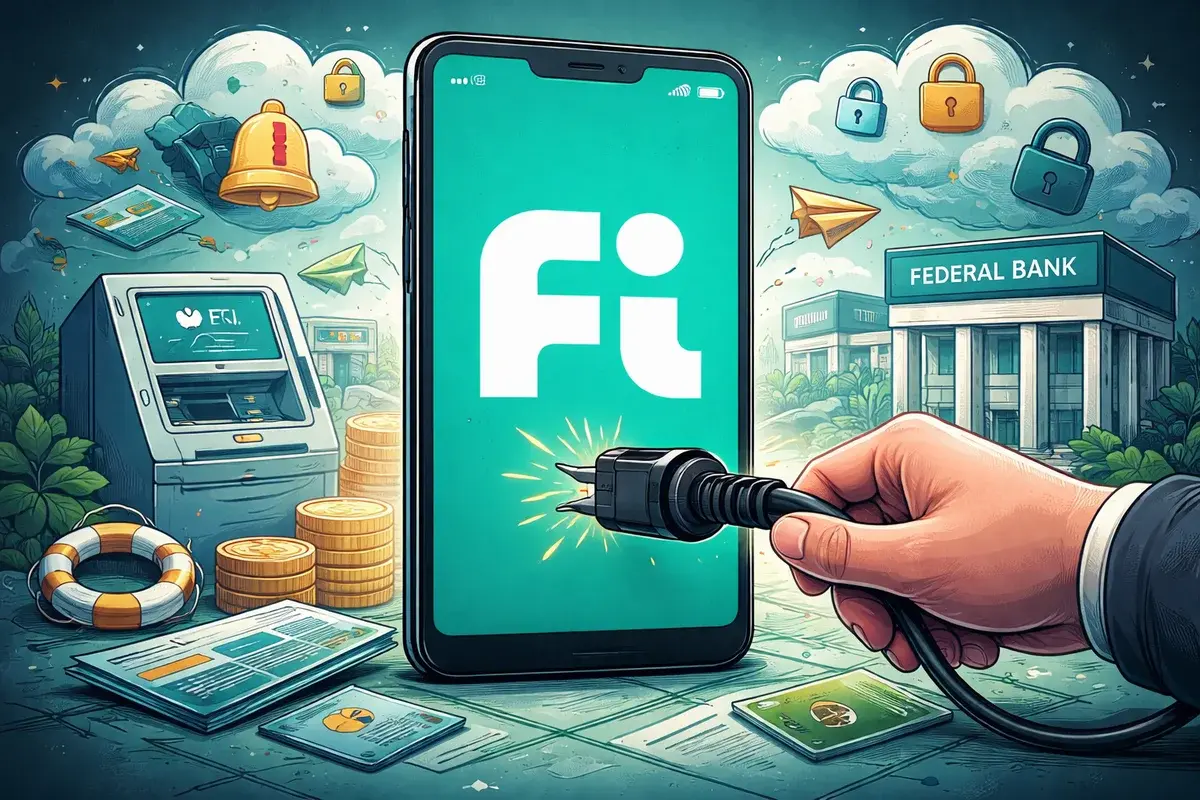
India’s fintech startup Fi is discontinuing banking services on its mobile platform, marking a significant shift in its operating model more than four years after launching app-based banking in partnership with Federal Bank. Customers who opened digital savings accounts through the Fi app have been informed that the platform will soon stop offering banking services directly, though their savings accounts with Federal Bank will remain fully operational. Users will instead access their accounts through the bank’s own mobile banking application, FedMobile, as Fi winds down its interface for core banking services.
| Key Metric | Details |
|---|---|
| Startup | Fi |
| Founded | 2019 |
| Founders | Sujith Narayanan, Sumit Gwalani |
| Partner Bank | Federal Bank |
| Customers | 3.5+ million |
| Transactions | 1+ billion |
| Total Funding | ~$169 million |
| Key Investors | Ribbit Capital, B Capital, Alpha Wave Global, Peak XV Partners |
Founded in 2019 by former Google Pay India executives Sujith Narayanan and Sumit Gwalani, Fi emerged as one of the new generation of fintech startups seeking to transform digital banking experiences for younger consumers. The company launched its app-based banking platform in 2021 through a partnership with Federal Bank, enabling users to open digital savings accounts and access budgeting tools, spending insights, and financial management features through a mobile interface.
Neobanks like Fi typically operate by partnering with licensed financial institutions rather than holding banking licenses themselves. Under this model, the partner bank manages regulated financial services such as deposits and compliance, while the fintech company focuses on customer experience, digital design, and financial tools. This approach has allowed startups to rapidly launch digital banking products without building traditional banking infrastructure.
Fi’s platform was designed to appeal to India’s growing base of young, tech-savvy consumers who prefer mobile-first financial services. By integrating features such as automated savings rules, financial analytics, and personalized insights, the company positioned itself as a digital alternative to conventional banking interfaces.
The fintech’s banking services were built on its partnership with Federal Bank, a private-sector lender that provided the regulated banking infrastructure behind Fi’s app. Through this collaboration, users could open savings accounts and conduct financial transactions while interacting primarily with Fi’s user interface.
However, recent communications to customers indicate that the partnership structure is changing. Customers received an email from Fi stating that banking services on the Fi app will soon be discontinued, though their underlying savings accounts with Federal Bank remain unaffected. According to the message, account holders will continue to have full access to their funds through Federal Bank’s mobile application.
In a separate communication, Federal Bank confirmed that the partnership with Fi is ending as part of what it described as a “business re-alignment.” The bank advised customers to transition to its official digital banking platform, FedMobile, to manage their accounts going forward.
Despite the discontinuation of banking services within the Fi app, the company emphasized that users’ savings accounts remain secure and fully operational. Customers who opened accounts through Fi will retain their existing Federal Bank accounts without needing to take additional steps to transfer funds or close accounts.
The primary change involves the platform through which customers access their banking services. Instead of managing their finances through the Fi interface, account holders will now use Federal Bank’s mobile banking channels. The transition effectively shifts the customer experience from a fintech-led interface to a traditional banking application.
For many users, the change represents a shift away from Fi’s specialized financial management tools and back to standard banking features provided by the partner bank.
Since its launch, Fi has attracted significant venture capital investment from prominent global investors. The startup has raised approximately $169 million across multiple funding rounds, according to startup intelligence platform Tracxn.
Its investor base includes major venture firms such as Ribbit Capital, B Capital, Alpha Wave Global, and Peak XV Partners (formerly Sequoia Capital India).
The Bengaluru-based fintech reported serving more than 3.5 million customers and facilitating over one billion transactions through its platform since launching its digital banking services. These figures highlight the scale of adoption achieved by neobanking platforms in India’s rapidly evolving fintech ecosystem.
Fi operates within a growing segment of digital financial platforms often referred to as neobanks. These companies provide mobile-first banking experiences built on top of traditional banking infrastructure. The sector has expanded rapidly in India over the past few years as fintech startups seek to capture the country’s expanding base of digitally connected consumers.
Fi competes with several other fintech platforms offering similar services, including Jupiter, Open, and Slice. Each of these companies operates through partnerships with licensed banks while offering specialized financial tools through their own digital platforms.
The competitive landscape has intensified as startups attempt to differentiate themselves through innovative features such as budgeting automation, credit products, and integrated financial management services.
India’s fintech sector has witnessed rapid growth over the past decade, supported by widespread smartphone adoption, digital payment infrastructure, and government initiatives promoting financial inclusion. Digital platforms have transformed how consumers interact with financial services, enabling faster payments, simplified account management, and access to new financial products.
However, the neobank model has also faced regulatory scrutiny and operational challenges. Since fintech startups do not hold full banking licenses, they must rely heavily on partnerships with regulated banks to deliver financial services. Changes in these partnerships can significantly impact the operations of digital banking platforms.
Industry analysts note that evolving regulatory frameworks and strategic shifts among partner banks have prompted several fintech companies to reconsider their business models.
Fi’s decision to wind down banking services on its platform raises questions about the evolving structure of fintech–bank partnerships in India. While the startup has not publicly detailed its long-term strategy following the discontinuation of its banking interface, industry observers suggest the company may explore new product offerings or financial services that extend beyond traditional neobanking.
For customers, the immediate impact appears limited to a change in the user interface through which they access their accounts. However, the development underscores the complex dynamics of fintech partnerships in an industry where regulatory oversight, operational dependencies, and business realignments can significantly influence product offerings.
As India’s digital financial ecosystem continues to mature, companies like Fi will likely need to adapt their strategies to navigate regulatory requirements, partnership structures, and competitive pressures within the rapidly evolving fintech landscape.

Financial journalist specializing in market analysis, stock research, and investment trends. Dedicated to providing accurate, timely insights for informed decision-making.
Credentials: Experienced financial journalist with expertise in equity markets and economic analysis
The information provided in this article is for educational and informational purposes only and should not be construed as financial, investment, or legal advice. Finscann does not provide personalized investment recommendations.
For detailed terms and conditions, please read our Disclaimer and Terms of Service.
Bombay Stock Exchange will conduct a market-wide mock trading session on March 14 to test trading systems across equity, derivatives, currency, and...

Akasa Air partners with Noida International Airport to establish its first MRO facility in India, strengthening aviation infrastructure and...

India faces a major LPG shortage as global supply disruptions push prices higher. Restaurants shut, businesses struggle, and households feel the...

Indian markets fall sharply as Nifty drops 300 points and Sensex declines 900 amid rising oil prices, LPG shortages, and sector-wide selling pressure.

Petrol prices in India remain a key economic driver in March 2026, influenced by crude oil, rupee-dollar exchange rates, and taxes affecting...