Loading market data...
The US officially implements a 10% tariff following a Supreme Court ruling, reshaping trade policy expectations. Explore detailed analysis of the tariff impact on global markets, currency movements, inflation risks, and geopolitical dynamics.
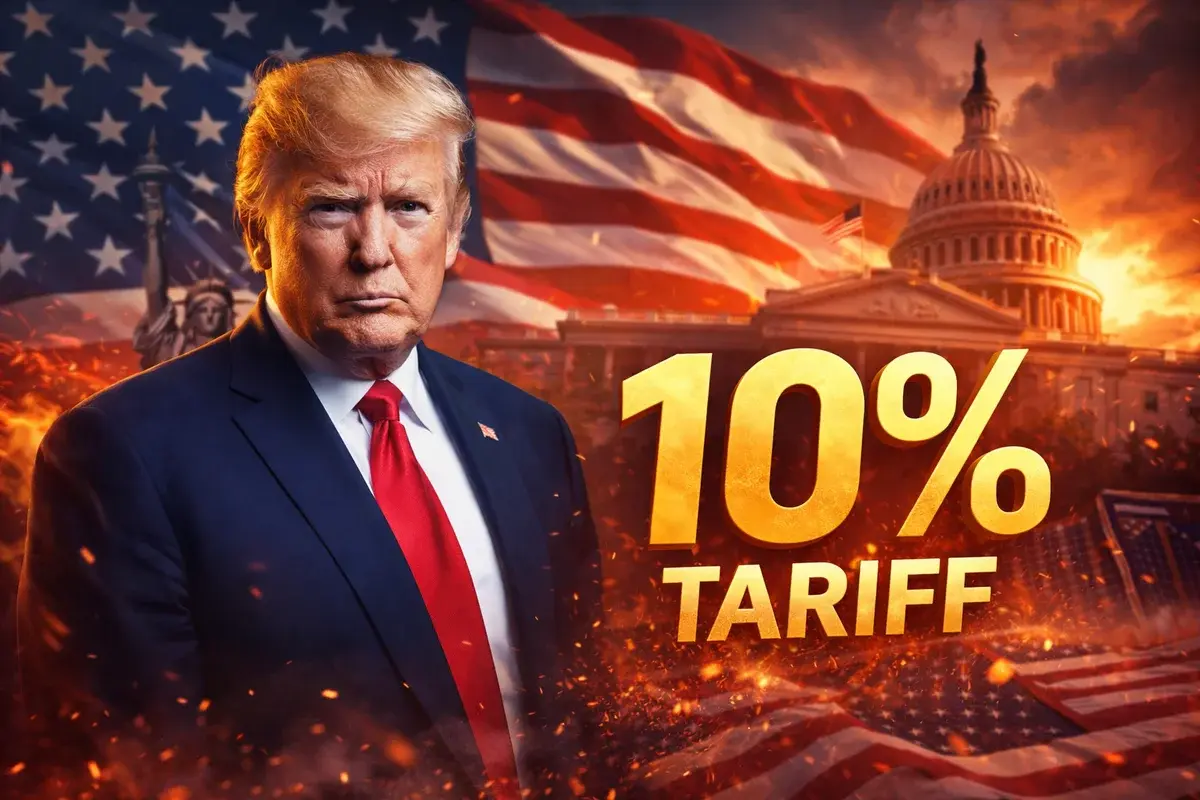
In a significant policy twist, new US tariffs have officially taken effect at 10%, lower than the previously announced 15% rate by former President Donald Trump.
The clarification came via a notice from US Customs and Border Protection (CBP), creating immediate confusion in global markets over the actual implementation timeline and trade policy direction.
The development follows a US Supreme Court decision that struck down earlier tariff measures, prompting a revised tariff announcement that appears to have been partially scaled back.
The notice indicates:
This suggests either:
| Event | Announcement | Status |
|---|---|---|
| Supreme Court strikes down previous tariffs | Tariffs invalidated | Confirmed |
| Trump announces 10% tariff | Friday | Implemented |
| Tariff increased to 15% | One day later | Not yet enforced |
| Current effective rate | 10% | Active |
The gap between announcement and enforcement is now the core issue impacting markets.
Tariff uncertainty creates ripple effects across:
Even a 5% tariff differential can materially impact:
The 10% implementation instead of 15% provides temporary cost relief for:
However, the statement that the 15% rate “would reportedly be imposed later” keeps uncertainty elevated.
Markets dislike ambiguity more than bad news.
Tariff unpredictability often triggers:
Tariffs directly affect:
| Economic Variable | Impact Mechanism |
|---|---|
| Inflation | Higher import costs |
| Dollar Strength | Safe-haven flows |
| Trade Balance | Import compression |
| Corporate Margins | Input cost increase |
A 15% tariff would have amplified inflationary pressures compared to 10%.
The 10% enforcement tempers immediate shock but does not eliminate future risk.
This situation follows a Supreme Court ruling that struck down previous tariff actions under emergency powers.
Now, tariffs are being reintroduced under different legal frameworks, potentially:
This introduces legal fragility into trade policy implementation.
Possible scenarios behind the 10% enforcement:
A 10% base tariff could act as leverage before raising it to 15%.
Documentation and compliance systems may not yet reflect the 15% revision.
The 15% announcement may function as pressure in ongoing trade discussions.
Investors should monitor:
| Sector | Sensitivity to Tariff Changes |
|---|---|
| IT & Software | Medium |
| Auto & Auto Ancillaries | High |
| Electronics | High |
| Industrial Manufacturing | Medium-High |
| Agriculture | Medium |
Emerging markets, especially export-driven economies, remain vulnerable.
The tariff adjustment comes amid:
Trade policy is increasingly becoming a political instrument rather than purely economic.
While tariffs are currently set at 10%, the market cannot ignore the potential shift to 15%.
The key issue is not the percentage itself — but the policy unpredictability.
Global markets will likely remain volatile until clarity emerges on:
In trade policy, execution clarity often matters more than announcement rhetoric.
Tariffs are live at 10%. 15% remains on the table. Markets are watching the fine print.
Uncertainty is now the primary risk factor.

Financial journalist specializing in market analysis, stock research, and investment trends. Dedicated to providing accurate, timely insights for informed decision-making.
Credentials: Experienced financial journalist with expertise in equity markets and economic analysis
The information provided in this article is for educational and informational purposes only and should not be construed as financial, investment, or legal advice. Finscann does not provide personalized investment recommendations.
For detailed terms and conditions, please read our Disclaimer and Terms of Service.

Indian solar stocks face sharp decline after new US import duties of 126%, impacting major players like Waaree Energies and Adani Green.

Potpie AI secures $2.2 million in pre-seed funding led by Emergent Ventures with backing from All In Capital, DeVC, and PointOne Capital.

China’s export controls targeting major Japanese industrial companies escalate geopolitical tensions, raising supply chain risks, margin pressure,...
Meta AI director faces email crisis as OpenClaw unexpectedly deletes crucial data. FinScann analyzes the financial and ethical implications for Meta...
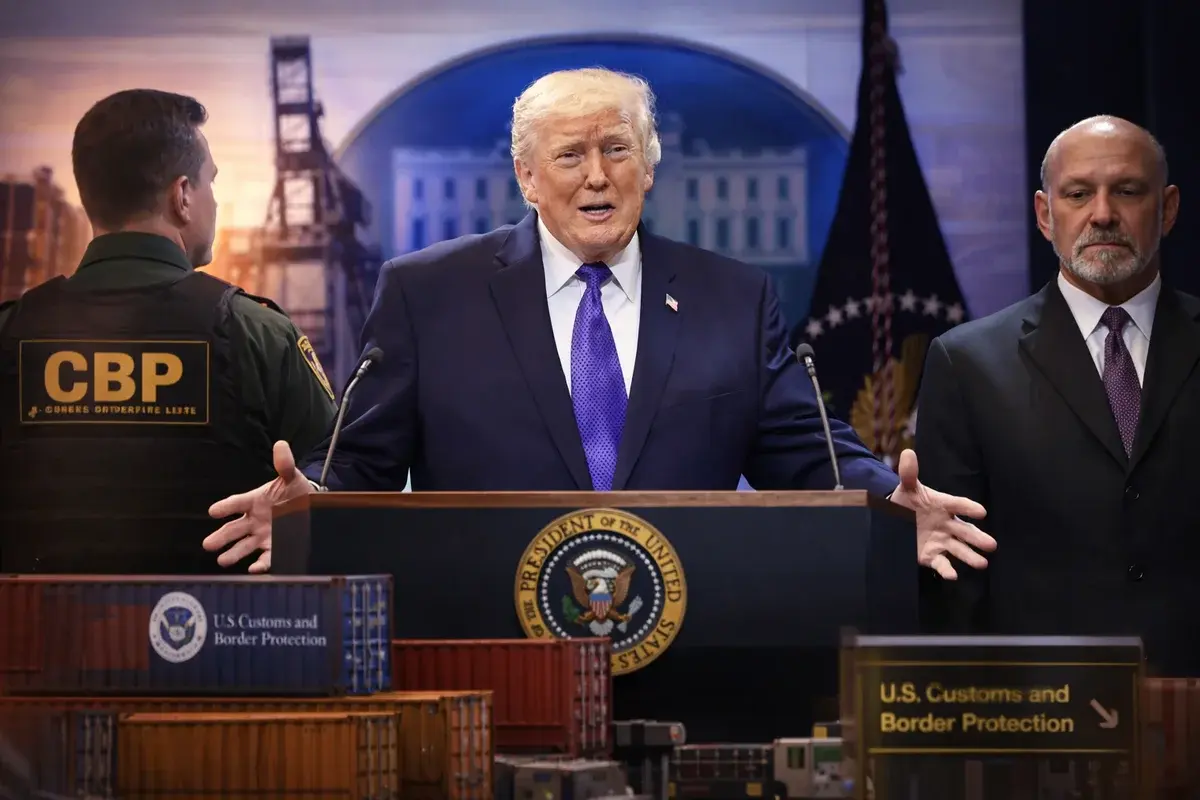
US Customs and Border Protection halts 'illegal' IEEPA tariffs after Supreme Court ruling, impacting global trade.