Loading market data...
China’s export controls targeting major Japanese industrial companies escalate geopolitical tensions, raising supply chain risks, margin pressure, and valuation uncertainty across Asia’s aerospace, defense, and technology sectors.
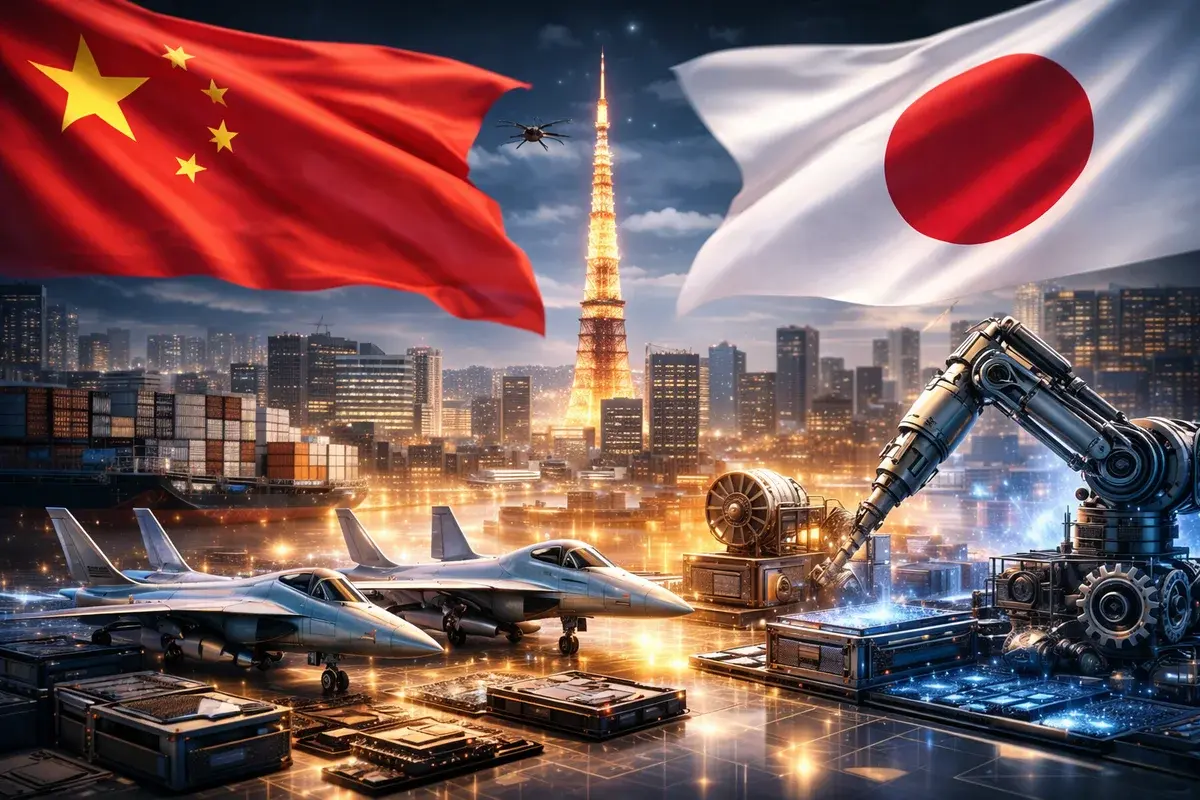
Beijing has placed 20 Japanese companies on its export control list, restricting dual-use technology transfers amid rising Taiwan-related tensions. The move directly impacts industrial heavyweights including Mitsubishi Heavy Industries, Kawasaki Heavy Industries, and Fujitsu, raising risks of supply chain disruption, margin pressure, and geopolitical-driven valuation resets. For investors, the episode underscores the growing premium on capital discipline, EBITDA visibility, and geopolitical risk pricing in Asia’s manufacturing and defense sectors.
Geopolitics has once again intruded into Asia’s industrial balance sheet.
China’s decision to add 20 Japanese firms to its export control list marks a strategic escalation in economic statecraft. The restrictions effectively bar Chinese exporters from supplying dual-use goods to the designated companies.
The move follows controversial remarks from Japan’s leadership regarding Taiwan, a topic Beijing treats as a core sovereignty issue. While political rhetoric has flared before, this action signals something more structural: the weaponization of technology supply chains.
In a global environment already shaped by de-risking strategies, yield compression in export-driven economies, and a broader valuation reset across cyclical sectors, this development could alter capital allocation decisions across Northeast Asia.
Among those placed on the list are some of Japan’s most strategically important industrial names:
These firms are not peripheral players. They are core pillars of Japan’s defense, aerospace, heavy engineering, semiconductor systems, and advanced manufacturing ecosystem.
China has also placed 20 additional companies on a watchlist, requiring individual export license approvals and risk assessments, an administrative bottleneck that can be equally disruptive.
| Metric | Details |
|---|---|
| Founded | 1884 |
| Sector | Aerospace, Defense, Heavy Machinery |
| Revenue Model | Industrial systems, defense contracts, energy solutions |
| Market Position | One of Japan’s largest industrial conglomerates |
| Key Financial Metrics | Revenue ~¥4.6 trillion; EBITDA margin ~11–13%; moderate leverage |
| Competitive Edge | Defense contracts, global energy exposure, advanced manufacturing |
Mitsubishi Heavy Industries is deeply embedded in global defense and energy infrastructure projects. Any disruption in component sourcing, especially dual-use electronics, specialty materials, or industrial controls, could affect production cycles and working capital management.
The immediate financial risks include:
• EBITDA margin compression if alternative suppliers command higher prices • Inventory buildup as firms hedge supply disruptions • Cash flow volatility due to delayed production schedules • Potential order deferrals from global clients
Japanese heavy industrials already operate in a competitive pricing environment. Many of these firms are not high dividend yield plays like traditional dividend stocks or blue-chip stocks with stable consumer exposure. Instead, they depend on long-cycle contracts and export-driven revenue.
If sourcing costs rise 3–5%, EBITDA margins could face meaningful compression, particularly in aerospace and industrial systems divisions where input costs are sensitive to specialty components.
China’s export control mechanism reflects a broader strategic pivot, leveraging technology access as geopolitical currency.
From a business model durability perspective:
• These firms rely on complex cross-border supply chains • Capital efficiency depends on stable component flows • Unit economics weaken when substitution costs rise • Scalability becomes constrained if export licenses slow procurement
The regulatory landscape has shifted from tariff wars to technology gating. Dual-use classification introduces ambiguity, and companies may need enhanced compliance systems, raising administrative costs.
“Institutional investors are increasingly prioritizing EBITDA visibility and sustainable cash flow generation over top-line growth,” says a Mumbai-based fund manager tracking the sector. “Geopolitical volatility now sits alongside interest rate risk in valuation models.”
While risks are elevated, structural growth factors remain intact:
• Defense spending expansion in Japan • Aerospace demand recovery • Renewable energy infrastructure build-out • Semiconductor equipment investment • Diversification away from China sourcing
Japan’s push to strengthen domestic semiconductor capacity could offset part of the disruption. However, near-term friction remains unavoidable.
• Margin pressure from higher input costs • Regulatory retaliation or escalation • Competitive intensity from Korean and US players • Demand slowdown if regional trade weakens • Currency volatility
This episode also increases the probability of a regional valuation reset if tensions persist.
| Segment | Current Momentum | Outlook | Capital Flow Sentiment |
|---|---|---|---|
| Aerospace & Defense | Strong | Positive but volatile | Selective inflows |
| Heavy Engineering | Moderate | Stable | Neutral |
| Semiconductor Equipment | High | Structural growth | Strong |
| Industrial Robotics | Strong | Positive | Stable |
| Cross-Border Supply Chains | Fragile | Uncertain | Cautious |
| Company | Revenue Scale | EBITDA | Valuation | Strategic Position |
|---|---|---|---|---|
| Mitsubishi Heavy Industries | Large-cap | ~11–13% | Mid-teens P/E | Defense & energy leader |
| Kawasaki Heavy Industries | Large-cap | ~8–10% | Lower multiple | Diversified industrial |
| Fujitsu | Large-cap | ~9–12% | Tech-driven valuation | IT & digital infrastructure |
Technology and defense exposure may cushion downside, but geopolitical risk premiums will likely widen.
Long-term investors should focus on balance sheet strength, debt levels, and diversification of supplier networks. Firms with stronger capital discipline and higher cash runway flexibility will navigate disruptions more effectively.
Short-term traders should expect volatility around diplomatic headlines and monitor currency movements alongside official responses from Tokyo and Beijing.
A sustained P/E compression could create entry opportunities if fundamentals remain intact and tensions stabilize.
Watch for increased capex toward domestic sourcing or strategic inventory accumulation as a sign of adaptive capital allocation discipline.
Investors seeking exposure to Japanese equities can use global brokerage platforms such as Fidelity, Charles Schwab, Robinhood, and Interactive Brokers that offer access to Tokyo-listed stocks.
Q: Why is China targeting dual-use exports specifically? Dual-use goods have both civilian and military applications, making them strategic leverage points in geopolitical disputes.
Q: Could this escalate into broader trade restrictions? Yes. Export controls often precede retaliatory measures if diplomatic tensions intensify.
Q: How does this impact supply chain resilience trends? It accelerates diversification efforts and domestic manufacturing investments.
Q: Are these companies fundamentally weak? No. The risk is geopolitical rather than operational mismanagement. Financial fundamentals remain relatively stable.
Geopolitics is no longer a headline risk. It is embedded into valuation frameworks. As Asia’s industrial giants recalibrate sourcing and compliance strategies, investors must factor in not just earnings growth but geopolitical durability. The companies that adapt fastest may ultimately generate alpha in an increasingly fragmented global order.
⚠️ DISCLAIMER: We Are Not Financial Advisors

Financial journalist specializing in market analysis, stock research, and investment trends. Dedicated to providing accurate, timely insights for informed decision-making.
Credentials: Experienced financial journalist with expertise in equity markets and economic analysis
The information provided in this article is for educational and informational purposes only and should not be construed as financial, investment, or legal advice. Finscann does not provide personalized investment recommendations.
For detailed terms and conditions, please read our Disclaimer and Terms of Service.

Indian solar stocks face sharp decline after new US import duties of 126%, impacting major players like Waaree Energies and Adani Green.

Potpie AI secures $2.2 million in pre-seed funding led by Emergent Ventures with backing from All In Capital, DeVC, and PointOne Capital.
The US officially implements a 10% tariff following a Supreme Court ruling, reshaping trade policy expectations.
Meta AI director faces email crisis as OpenClaw unexpectedly deletes crucial data. FinScann analyzes the financial and ethical implications for Meta...

US Customs and Border Protection halts 'illegal' IEEPA tariffs after Supreme Court ruling, impacting global trade.