Loading market data...
RBI’s February 2026 draft norms impose 100% refund liability, ban kickbacks, and tighten suitability rules to curb ULIP mis-selling. The move could compress fee income, impact life insurers’ margins, and trigger valuation reset across banking and NBFC stocks.
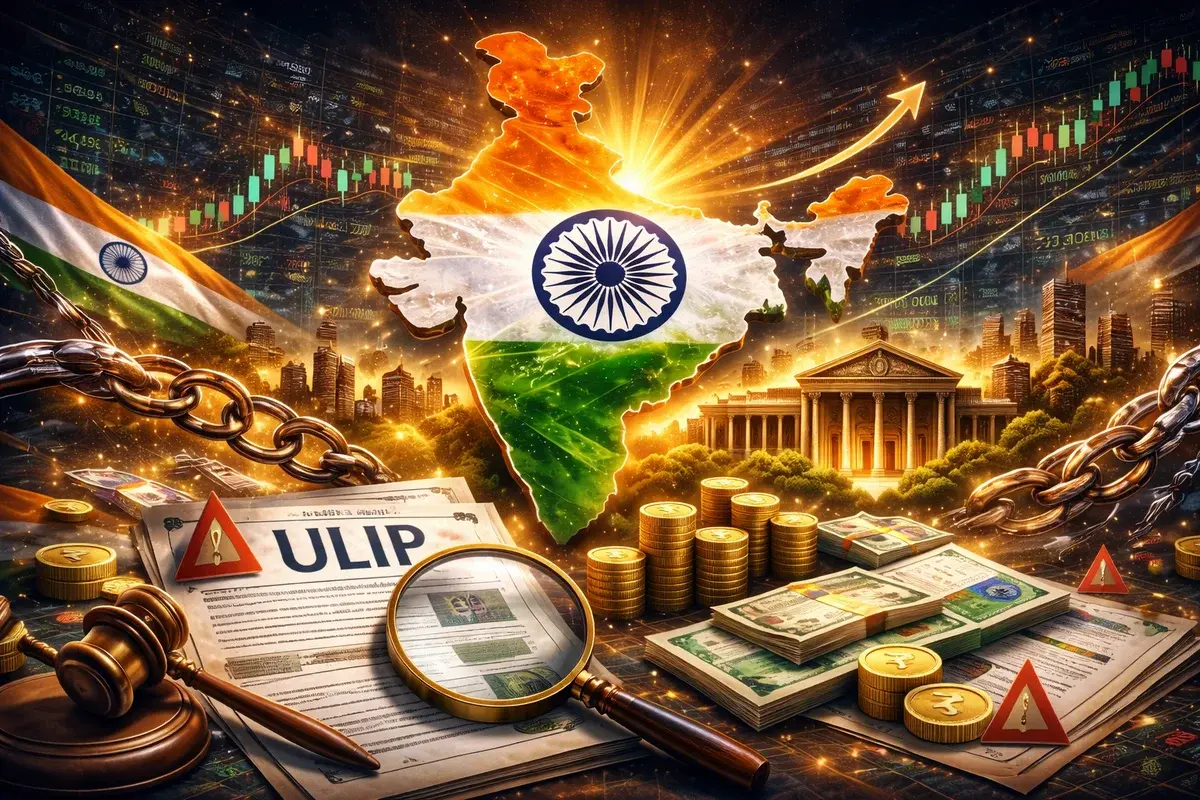
After years of aggressive cross-selling that pushed opaque Unit-Linked Insurance Plans (ULIPs) onto unsuspecting depositors, the Reserve Bank of India’s February 2026 draft norms have fundamentally altered India’s bancassurance economics. With 100% refund liability, zero kickbacks, and a strict suitability framework, banks now bear full financial responsibility for mis-selling. The regulatory reset threatens fee income streams, compresses life insurer distribution margins, and may reshape capital flows across banking, NBFCs, and insurance stocks. Long-term investors must reassess EBITDA margins, fee sustainability, and valuation multiples across the financial sector.
Introduction: The Silent Fee Engine Behind Indian Banking
For over a decade, India’s banking system quietly scaled a high-margin, low-capital revenue stream: third-party financial distribution. Insurance particularly ULIPs became a powerful fee engine.
In an era of net interest margin pressure and yield compression, non-interest income often differentiated high P/E banks from average performers. Bancassurance commissions, carrying operating margins upwards of 60%, provided clean, capital-light profitability.
But this fee pool was built on asymmetry informational, behavioural, and trust-based.
Retail depositors seeking fixed deposits frequently exited branches holding long-tenure, market-linked insurance products. Documentation was signed. Suitability was often secondary to targets.
The risk sat with households. The income accrued to institutions.
That architecture has now been challenged.
The Regulatory Shock: RBI’s February 2026 Draft Norms
In February 2026, the Reserve Bank of India introduced draft norms that materially alter bancassurance economics.
Core Provisions
| Regulatory Measure | Implication for Banks | Financial Impact |
|---|---|---|
| 100% Refund Liability | Bank compensates full principal + loss | Direct P&L risk |
| Suitability Doctrine | Consent ≠ protection | Legal & compliance burden |
| Zero Incentives | Ban on kickbacks | Fee income compression |
| No Forced Bundling | Loans cannot be tied to insurance | Lower cross-sell leverage |
The most disruptive element is the liability transfer. Earlier, reputational risk dominated. Now, balance-sheet risk is explicit.
How Bancassurance Became a High-Margin Machine
Banks leveraged three structural advantages:
• Deep CASA relationships
• Branch-level trust capital
• Data on customer income & deposits
Representative Bank Fee Structure
| Metric | Typical Range |
|---|---|
| Fee Income Share of Total Revenue | 15–25% |
| Insurance Commission Share of Fee Income | 25–40% |
| Distribution EBITDA Margin | 60–70% |
| Capital Requirement | Minimal |
For large private banks, insurance cross-selling materially enhanced return on equity (ROE).
But high-margin income streams dependent on regulatory arbitrage rarely sustain indefinitely.
Insurance Sector Impact: Margin Compression & EV Risk
Private life insurers, especially ULIP-heavy franchises, relied heavily on bank-led distribution.
Company Snapshot: HDFC Life Insurance
| Metric | Details |
|---|---|
| Sector | Life Insurance |
| Distribution Mix | Significant bancassurance |
| Revenue Model | Premium + Investment Spread |
| EBITDA Profile | High operating leverage |
| Valuation Metric | Embedded Value (EV) Multiple |
If commission structures reset downward:
• New Business Margins (NBM) could compress • Embedded Value growth may moderate • EV multiples may de-rate
High-quality insurers priced for stability may face valuation recalibration.
NBFC Distribution Pivot: Defensive Partnerships
Insurers are proactively diversifying.
A recent example includes collaboration with Muthoot Finance to expand non-bank channels.
NBFC Insurance Channel Economics
| Factor | Advantage | Risk |
|---|---|---|
| Customer Reach | Semi-urban penetration | Regulatory spillover |
| Cross-Sell Potential | High | Reputational scrutiny |
| Margin Structure | Attractive | Future compliance tightening |
However, if coercive bundling persists in NBFC ecosystems, regulatory tightening could expand.
PSU Banks: Structural Insulation & Sector Overview
Public sector banks (PSU banks) are relatively less dependent on aggressive fee extraction compared to private peers.
Major PSU banks in India include:
• UCO Bank
PSU Bank Characteristics
| Parameter | PSU Banks | Large Private Banks |
|---|---|---|
| Fee Income Dependence | Moderate | Higher |
| Cross-Sell Aggression | Lower | Higher historically |
| NIM Sensitivity | Higher | Moderate |
| Regulatory Sensitivity | Elevated | Elevated |
Given lower reliance on high-margin insurance distribution, PSU dividend stocks may face milder earnings volatility relative to private peers.
Financial Metrics Under Stress
If bancassurance commission pools shrink 15–20%:
• Fee income growth could decelerate • ROE may soften • Cost-to-income ratios may rise • Valuation multiples may compress
Life insurers trading at premium EV multiples assume stable distribution economics. That assumption is under review.
“Institutional investors are increasingly prioritizing EBITDA visibility and sustainable cash flow generation over top-line growth,” says a Mumbai-based fund manager tracking the sector.
This shift could benefit capital-efficient banks with diversified fee models.
Industry Heatmap: Post-Regulation Financial Landscape
| Segment | Current Momentum | Outlook | Capital Flow Sentiment |
|---|---|---|---|
| Large Private Banks | Stable lending | Fee moderation risk | Neutral |
| PSU Dividend Stocks | Improving ROE | Relative stability | Positive |
| Private Life Insurers | Margin recalibration | EV multiple pressure | Cautious |
| NBFC Distributors | Expansion mode | Regulatory watch | Neutral |
| Direct Platforms | Structural tailwind | Long-term beneficiary | Positive |
Growth Drivers Going Forward
• Digitally enabled advisory ecosystems • Transparent, trail-based commission models • Direct-to-consumer insurance platforms • Diversified fee income (wealth, asset management) • Regulatory-compliant retirement & passive income stocks
Risk Factors
• Margin compression • Refund liabilities impacting quarterly earnings • Litigation escalation • Regulatory expansion into NBFC ecosystems • Investor sentiment-led valuation reset
Comparative Positioning
| Entity | Revenue Scale | EBITDA Strength | Valuation | Strategic Sensitivity |
|---|---|---|---|---|
| HDFC Life | Large-cap | Strong | Premium EV | High distribution exposure |
| Muthoot Finance | Large NBFC | Healthy | Moderate | Channel diversification |
| PSU Banks | Systemic | Improving | Reasonable P/E | Lower fee dependency |
Investor Takeaway
Long-Term Investors
• Track fee income share in banking earnings • Monitor New Business Margin (NBM) trajectory in insurers • Prefer institutions with capital discipline • Evaluate dividend stocks with stable ROE
Short-Term Traders
• Expect volatility during finalisation of norms • Watch quarterly commentary on commission restructuring • Monitor valuation reset zones for entry
Valuation Comfort
Buy insurers on meaningful EV multiple correction. Banks with diversified income models deserve premium only if compliance costs remain manageable.
Trading Platforms for Indian Investors
Investors can track and invest in banking and insurance stocks via:
• Zerodha • Groww • Upstox • Angel One
Each provides access to equity, derivatives, ETFs, and dividend stocks across PSU and private banks.
FAQ
Q: Why is this considered a structural reform rather than a compliance tweak?
Because liability shifts from reputational to financial, directly impacting earnings.
Q: Are PSU banks safer investments now?
Relatively, due to lower fee income reliance and stronger dividend yield profiles.
Q: Will insurance premiums decline?
Unlikely immediately, but commission structures may evolve toward trail-based compensation.
Q: Could this trigger broader financial sector reforms?
If enforcement is strong, similar suitability principles may expand to other product categories.
Conclusion: The Repricing of Trust
India’s financial system is entering a new phase where trust is no longer an abstract virtue but an enforceable liability. For years, fee-driven cross-selling quietly padded balance sheets while transferring complexity and risk to retail households. The RBI’s intervention changes that equation decisively. By placing financial accountability on distributors, the regulator has forced a recalibration of incentive structures, margin expectations, and valuation assumptions across banks and insurers. Earnings models will evolve, commission structures will mature, and capital will likely gravitate toward institutions demonstrating genuine suitability discipline rather than aggressive product pushing. In the long arc of financial history, transparency compounds more sustainably than opacity and this reform may ultimately strengthen the credibility premium of India’s banking and insurance ecosystem.

Financial journalist specializing in market analysis, stock research, and investment trends. Dedicated to providing accurate, timely insights for informed decision-making.
Credentials: Experienced financial journalist with expertise in equity markets and economic analysis
The information provided in this article is for educational and informational purposes only and should not be construed as financial, investment, or legal advice. Finscann does not provide personalized investment recommendations.
For detailed terms and conditions, please read our Disclaimer and Terms of Service.

Indian stock markets rebound sharply as Nifty surges past 25,600 and Nifty Bank climbs above 61,200, led by strong gains in IT and banking stocks.

Apple's gearing up for a significant shift in its laptop lineup with the anticipated launch of its first touch-enabled MacBook Pro series, expected...

Discover why Indian markets are surging, with Sensex gaining 500 points, even as the IT sector faces headwinds.
Indian IT majors Infosys and TCS lead a strong rebound, jumping up to 5% in February 2026 after a five-day rout fueled by AI disruption fears.

Stock market preview for February 25, 2026: Key stocks to watch including TechSolutions India, Bharat Bank, and GreenEnergy Manufacturers.