Loading market data...
Microsoft announces a strategic partnership with Starlink to deliver satellite broadband connectivity to rural, agricultural, and hard-to-reach communities. Explore the impact on digital access, cloud expansion, and the AI economy.
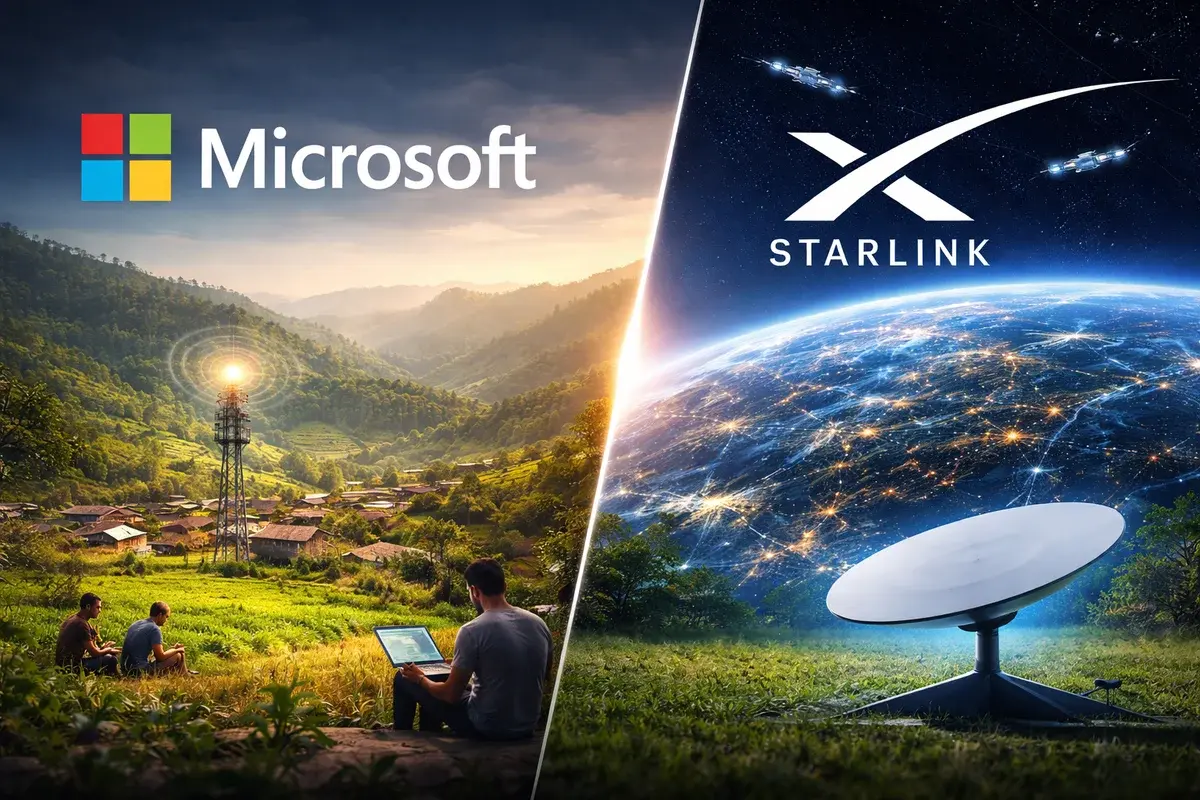
Microsoft Corp. has announced a strategic collaboration with Starlink, the satellite broadband division of SpaceX, to expand high-speed internet access in rural, agricultural, and hard-to-reach communities. The partnership integrates low-Earth orbit satellite connectivity with Microsoft’s digital access initiatives, aiming to accelerate meaningful participation in the AI-driven global economy while strengthening long-term digital infrastructure in underserved regions.
The collaboration reflects a structural shift in how large technology companies approach connectivity. While fiber and terrestrial wireless networks remain core to broadband expansion, they are often economically unviable in sparsely populated or geographically challenging areas.
By leveraging Starlink’s low-Earth orbit satellite constellation, Microsoft expands the set of tools available to deliver digital access where traditional infrastructure struggles. The initiative supports Microsoft’s broader digital inclusion mission, which has already connected hundreds of millions globally through public and private partnerships.
Rather than focusing solely on connectivity coverage, the partnership emphasizes ecosystem enablement. This includes integrating broadband with cloud services, digital skills training, and AI-ready infrastructure.
Low-Earth orbit satellites operate significantly closer to Earth than traditional geostationary systems, reducing latency and improving broadband performance. This makes satellite connectivity increasingly viable for real-time applications such as telemedicine, remote learning, precision agriculture, and cloud-based services.
| Connectivity Model | Infrastructure Dependency | Latency | Scalability in Remote Areas |
|---|---|---|---|
| Fiber | High | Very Low | Limited |
| 4G/5G Cellular | Medium | Low | Moderate |
| LEO Satellite (Starlink) | Low | Low | High |
By incorporating Starlink connectivity, Microsoft enhances resilience in locations where grid power, fiber backhaul, or tower density are limited.
Microsoft’s strategy does not stop at connectivity. The company emphasizes local deployment hubs that combine internet access with practical digital tools. These hubs may support:
• Agricultural cooperatives using AI-driven crop analytics • Healthcare centers leveraging telemedicine platforms • Educational institutions accessing cloud-based learning resources • Small enterprises connecting to digital marketplaces
By pairing connectivity with productivity platforms such as Azure cloud services and Microsoft productivity tools, the collaboration creates an ecosystem model rather than a standalone broadband solution.
For Microsoft Corp., the partnership reinforces three long-term strategic pillars:
| Strategic Pillar | Impact |
|---|---|
| Cloud Expansion | Enables Azure services in remote regions |
| AI Infrastructure | Broadens AI accessibility globally |
| Digital Inclusion | Strengthens ESG positioning |
As AI workloads become foundational to economic participation, expanding broadband access becomes an infrastructure prerequisite. Satellite-enabled connectivity allows Microsoft to extend its cloud footprint beyond traditional urban centers.
This also strengthens Microsoft’s competitive positioning in emerging markets, where connectivity constraints historically limited cloud adoption.
For Starlink and its parent SpaceX, enterprise-level collaborations add diversification beyond consumer subscriptions and government contracts.
| Revenue Channel | Traditional Model | Partnership Model |
|---|---|---|
| Consumer Broadband | Individual households | Community hubs |
| Government Contracts | Defense & emergency services | Infrastructure partnerships |
| Enterprise | Corporate connectivity | Digital ecosystem expansion |
Partnerships with global technology firms expand Starlink’s role in digital infrastructure rather than just connectivity provision.
As digital transformation accelerates, connectivity gaps create economic disparities. Rural regions often lack the bandwidth to fully participate in:
• AI-powered analytics • Cloud computing • Remote workforce integration • E-commerce platforms • Digital financial services
By combining satellite broadband with cloud platforms, the partnership aims to reduce these structural barriers.
Industry analysts increasingly view broadband as foundational infrastructure akin to electricity or transportation networks.
Global competitors exploring space-based data and connectivity include major technology and aerospace firms. However, Microsoft’s integration of satellite broadband into a comprehensive digital inclusion strategy differentiates this initiative from pure connectivity ventures.
Rather than building its own satellite network, Microsoft leverages Starlink’s established constellation, accelerating deployment timelines and minimizing capital expenditure risk.
While the collaboration is unlikely to materially impact Microsoft’s near-term revenue, it reinforces long-term ecosystem expansion.
For investors, key monitoring factors include:
• Growth in Azure adoption in emerging markets • Enterprise satellite broadband uptake • Regulatory developments affecting satellite deployment • Expansion into agricultural and remote enterprise sectors
Microsoft’s diversified revenue base limits downside risk, while satellite-enabled ecosystem expansion may strengthen long-term recurring cloud revenue streams.
Institutional investors increasingly prioritize infrastructure scalability and energy-efficient connectivity models. Partnerships that combine cloud ecosystems with satellite broadband may accelerate digital adoption curves in underserved markets.
This underscores the broader thesis that connectivity expansion is not merely philanthropic but economically strategic.
• The partnership strengthens Microsoft’s long-term digital infrastructure strategy.
• Starlink gains deeper enterprise ecosystem integration beyond direct-to-consumer models.
• Satellite broadband is emerging as a structural complement to terrestrial networks.
• AI adoption in rural and agricultural communities may unlock new economic participation layers.
• Long-term growth lies in ecosystem expansion rather than immediate revenue impact.
The collaboration between Microsoft and Starlink highlights a critical evolution in global connectivity strategy. As AI reshapes economies, broadband access becomes foundational. By combining satellite technology with cloud infrastructure, this partnership positions both companies at the intersection of space-based connectivity and the digital economy’s next phase of expansion.
⚠️ DISCLAIMER: We Are Not Financial Advisors

Financial journalist specializing in market analysis, stock research, and investment trends. Dedicated to providing accurate, timely insights for informed decision-making.
Credentials: Experienced financial journalist with expertise in equity markets and economic analysis
The information provided in this article is for educational and informational purposes only and should not be construed as financial, investment, or legal advice. Finscann does not provide personalized investment recommendations.
For detailed terms and conditions, please read our Disclaimer and Terms of Service.

NSE IX Global Access enables Indian investors to directly invest in US-listed stocks and ETFs under the LRS framework.

Prime Minister Narendra Modi becomes the first world leader to surpass 100 million followers on Instagram, marking a historic digital milestone and...

The Indian rupee strengthens to 90.85 against the US dollar amid a weaker dollar index and sustained FII inflows, though rising crude oil prices and...

H-1B visa approvals fall to a five-year low in FY25 despite a surge in petitions, raising concerns for US employers relying on skilled foreign talent...

Indian solar stocks face sharp decline after new US import duties of 126%, impacting major players like Waaree Energies and Adani Green.