Loading market data...
H-1B visa approvals fall to a five-year low in FY25 despite a surge in petitions, raising concerns for US employers relying on skilled foreign talent across technology, engineering, and research sectors.
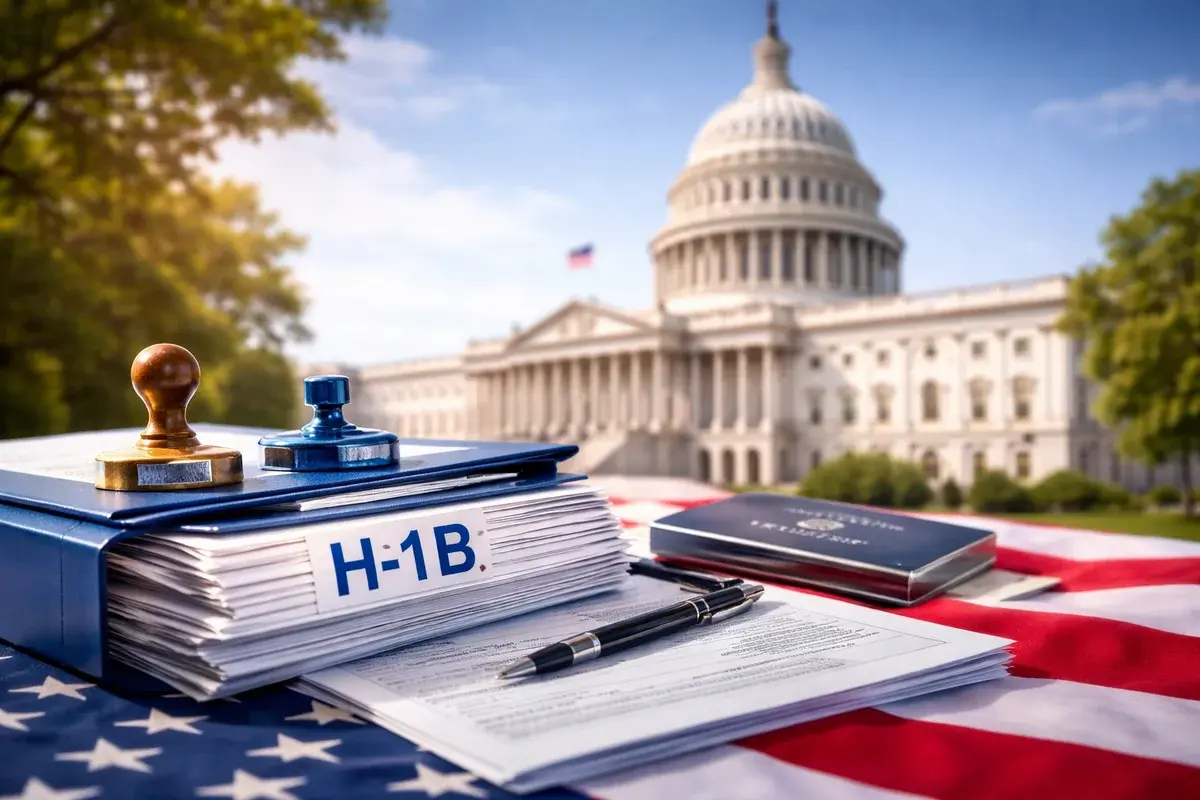
H-1B visa approvals have dropped to their lowest level in five years for the fiscal year ending September 2025, despite a sharp rise in total petitions filed. According to the latest data released by the U.S. Citizenship and Immigration Services, 456,725 H-1B petitions were submitted in FY25, but only 328,185 were approved.
This marks a significant 18 percent decline in approvals compared to FY24, raising concerns across industries that rely heavily on high-skilled foreign talent.
The data signals a widening gap between employer demand and visa approvals.
| Fiscal Year | Petitions Filed | Approvals Granted | Approval Trend |
|---|---|---|---|
| FY23 | NA | 99,805 (Q1) | Strong |
| FY24 | 427,091 | 399,402 | Stable |
| FY25 | 456,725 | 328,185 | ↓ 18% |
In the first quarter of FY25 alone (October–December 2024), approvals fell sharply to 47,821 compared to 87,018 in FY24 and 99,805 in FY23.
The contraction is notable given that petition volumes increased year over year, reflecting sustained employer demand for specialized skills.
The H-1B visa program has long served as a key channel for companies to recruit specialized professionals in:
A sustained drop in approval rates could create structural hiring constraints for US-based firms.
| Risk Area | Potential Impact |
|---|---|
| Skilled Labor Shortage | Delayed project timelines |
| Higher Wage Pressure | Increased hiring costs |
| Offshore Shift | Relocation of R&D centers |
| Innovation Slowdown | Reduced competitive advantage |
Technology firms, consulting companies, and engineering service providers are particularly exposed to approval volatility.
The decline in approvals comes at a time when multiple sectors are accelerating hiring, especially in AI, cloud infrastructure, and advanced manufacturing.
With approval rates tightening, companies may be forced to:
• Increase domestic recruitment efforts • Invest in automation to offset labor shortages • Expand offshore delivery centers • Explore alternative visa pathways
In effect, labor market competitiveness within the United States could intensify.

The H-1B visa program has historically been a critical entry route for high-skilled workers, particularly from India and other technology-driven economies.
For decades, the program has supported innovation pipelines in Silicon Valley, financial hubs, and advanced research centers. However, fluctuations in approval patterns often reflect broader immigration policy shifts and regulatory recalibration.
| Industry | Dependence Level |
|---|---|
| Technology | High |
| Engineering Services | High |
| Healthcare | Moderate |
| Academia & Research | Significant |
| Financial Services | Growing |
A five-year low in approvals may reshape long-term workforce planning strategies.
With approval rates falling despite higher petition volumes, companies must adopt adaptive talent strategies.
Organizations that proactively manage immigration risk exposure are likely to maintain competitive resilience.
While the U.S. Citizenship and Immigration Services has not formally announced sweeping structural changes to the H-1B framework, the approval slowdown suggests tighter scrutiny and evolving administrative standards.
Such developments often reflect:
• Enhanced documentation requirements • Heightened compliance review • Sector-specific sensitivity • Lottery-based allocation constraints
Employers may need stronger legal preparedness and compliance oversight moving forward.
The central question remains whether FY25 represents a cyclical dip or a longer-term recalibration in skilled immigration policy.
If approvals remain suppressed through subsequent quarters:
• Offshore innovation ecosystems may strengthen • US labor costs may rise • Talent mobility patterns could shift globally • Corporate investment strategies may realign
For now, companies must balance hiring momentum with regulatory realities.
The decline in H-1B approvals to a five-year low in FY25 marks a significant moment for global talent mobility. With 456,725 petitions filed but only 328,185 approvals granted, the gap between demand and authorization is widening.
For US employers, the implications extend beyond staffing. Innovation cycles, competitive positioning, and global expansion strategies may all be influenced by evolving immigration trends.
As the fiscal year progresses, policymakers, corporations, and global talent pools alike will be closely watching whether this decline represents a transitional tightening or a deeper structural shift in skilled immigration dynamics.

Financial journalist specializing in market analysis, stock research, and investment trends. Dedicated to providing accurate, timely insights for informed decision-making.
Credentials: Experienced financial journalist with expertise in equity markets and economic analysis
The information provided in this article is for educational and informational purposes only and should not be construed as financial, investment, or legal advice. Finscann does not provide personalized investment recommendations.
For detailed terms and conditions, please read our Disclaimer and Terms of Service.

Indian solar stocks face sharp decline after new US import duties of 126%, impacting major players like Waaree Energies and Adani Green.

Potpie AI secures $2.2 million in pre-seed funding led by Emergent Ventures with backing from All In Capital, DeVC, and PointOne Capital.
The US officially implements a 10% tariff following a Supreme Court ruling, reshaping trade policy expectations.

China’s export controls targeting major Japanese industrial companies escalate geopolitical tensions, raising supply chain risks, margin pressure,...
Meta AI director faces email crisis as OpenClaw unexpectedly deletes crucial data. FinScann analyzes the financial and ethical implications for Meta...