Loading market data...
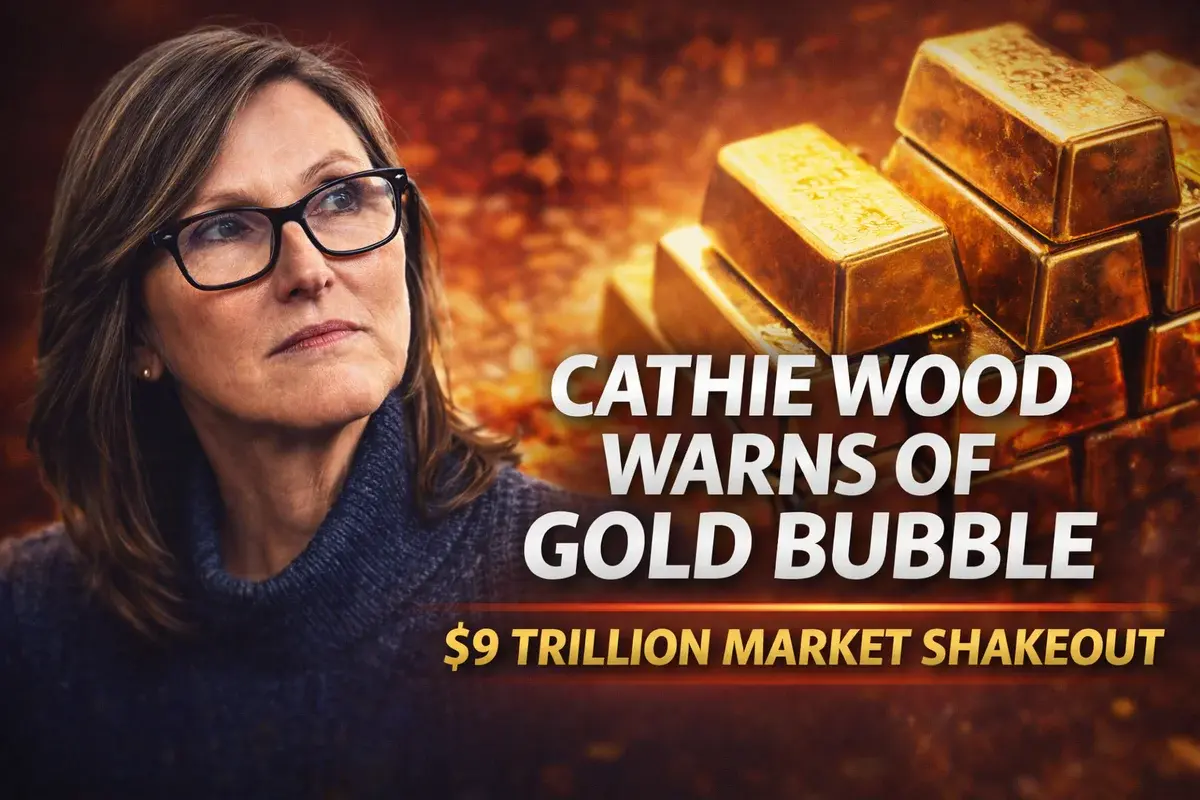
Gold’s historic rally has entered a far more dangerous phase, and one of the market’s most influential voices is now calling it out. Cathie Wood, founder and chief investment officer of ARK Invest, has issued a stark warning that gold is exhibiting classic bubble-like behavior, even as global markets recently witnessed an extraordinary $9 trillion swing in market value within a single trading session.
This was not a routine bout of volatility. It was a stress test of market structure, leverage, and investor psychology — and gold sat at the epicenter.
Why Cathie Wood Is Raising Red Flags on Gold
Cathie Wood’s warning is not based on price momentum alone. Her concern stems from valuation extremes and positioning risk that historically appear late in major market cycles.
One of the most alarming signals is the relationship between gold’s total market value and the global money supply. That ratio has surged to levels rarely seen outside moments of extreme monetary stress. Historically, when gold absorbs such a disproportionate share of global liquidity, markets tend to experience either prolonged consolidation or sharp corrective phases.
In simple terms: too much capital has crowded into gold too quickly.
Wood’s message is not that gold lacks long-term relevance — but that the current setup leaves investors exposed to sudden and severe downside shocks.
Inside the $9 Trillion Market Shakeout
The warning gained credibility after markets experienced one of the most violent trading sessions in recent memory. Across commodities, equities, derivatives, and digital assets, prices whipsawed aggressively, with an estimated $9 trillion in market value erased and restored intraday.
Gold and silver led the turbulence, but the ripple effects extended far beyond precious metals. The episode revealed how modern markets behave when leverage, algorithmic trading, and crowded positioning collide.
Three structural weaknesses were exposed:
• Crowded long positions across futures and ETFs • High leverage embedded in commodity derivatives • Thin liquidity near record price levels
When prices turned even slightly, forced selling cascaded rapidly — not because fundamentals collapsed, but because market mechanics broke down.
Why Gold Rallied So Hard in the First Place
The gold surge did not come out of nowhere. A powerful mix of macro forces fueled the move:
• Rising geopolitical tensions • Persistent inflation concerns • Massive global sovereign debt • Central bank accumulation of gold reserves • Retail and institutional momentum chasing
Gold became the asset of choice for investors seeking safety, currency protection, and insulation from policy uncertainty. As confidence in fiat systems wavered, gold absorbed capital at an accelerating pace.
But that very success may now be its weakness.
Bubble vs Structural Bull Market: The Debate Dividing Wall Street
Not everyone agrees with Cathie Wood.
Bullish strategists argue that today’s gold market is fundamentally different from past bubbles. Central banks are large, long-term buyers. Supply growth is limited. Global instability remains unresolved. From this perspective, gold is not a speculative mania but a structural hedge.
However, even long-term bulls acknowledge a critical risk: short-term positioning has become dangerously one-sided.
Gold can be a long-term winner and still suffer violent corrections. Those two truths are not mutually exclusive.
A Lesson from History Investors Can’t Ignore
The last time gold reached valuation extremes comparable to today was around 1980. What followed was not a crash overnight — but a grinding, multi-year drawdown that punished late buyers.
Today’s environment is different: global liquidity tools are more advanced, central banks are active participants, and financial markets are deeply interconnected. But history teaches one consistent lesson — when valuation and emotion peak together, risk rises exponentially.
Cathie Wood’s warning echoes that lesson.
What Smart Investors Should Do Now
This is not a call to panic. It is a call to professional risk management.
Investors should consider:
• Reducing leverage in gold-linked positions • Stress-testing portfolios for sharp intraday drops • Avoiding overconcentration in a single hedge asset • Favoring phased buying or selling instead of lump-sum decisions • Understanding the difference between physical gold and paper exposure
Gold’s role as a hedge remains valid — but how you hold it matters more than ever.
Key Signals to Watch Going Forward
Whether gold stabilizes or enters a deeper correction will depend on a few critical indicators:
• Sustained inflows or outflows from gold ETFs • Direction of the U.S. dollar and real interest rates • Central bank buying behavior • Broader risk sentiment across equities and credit markets
If gold continues to attract capital despite volatility, the bull case regains strength. If liquidity drains quickly, corrections can accelerate.
Why This Matters Beyond Gold
The $9 trillion shakeout was not just about one asset. It was a reminder that modern markets are tightly coupled, and stress in one corner can cascade rapidly.
Gold, equities, crypto, and bonds are increasingly linked through leverage and algorithmic trading. When one breaks, others can follow.
Cathie Wood’s warning should be seen as a broader market signal — not just a commodity call.
Bottom Line
Gold remains a critical asset in a world defined by uncertainty, debt, and geopolitical risk. But extreme rallies carry extreme consequences when positioning becomes crowded and liquidity thins.
Cathie Wood’s message is clear: respect gold’s long-term role, but respect short-term risk even more.
The market has already shown it can move trillions in hours. Investors who fail to prepare may discover that safety assets can feel anything but safe at the wrong moment.
Disclaimer: This article is for informational purposes only and does not constitute investment advice. Market conditions can change rapidly. Investors should conduct their own research and consult qualified financial professionals before making investment decisions.

Financial journalist specializing in market analysis, stock research, and investment trends. Dedicated to providing accurate, timely insights for informed decision-making.
Credentials: Experienced financial journalist with expertise in equity markets and economic analysis
The information provided in this article is for educational and informational purposes only and should not be construed as financial, investment, or legal advice. Finscann does not provide personalized investment recommendations.
For detailed terms and conditions, please read our Disclaimer and Terms of Service.

Gold and silver rates jump on MCX today amid dollar weakness and escalating US-Iran conflict.

Global crude oil prices have soared by 18% this week, with Brent nearing $85/barrel. FinScann analyzes the Middle East crisis, Strait of Hormuz...
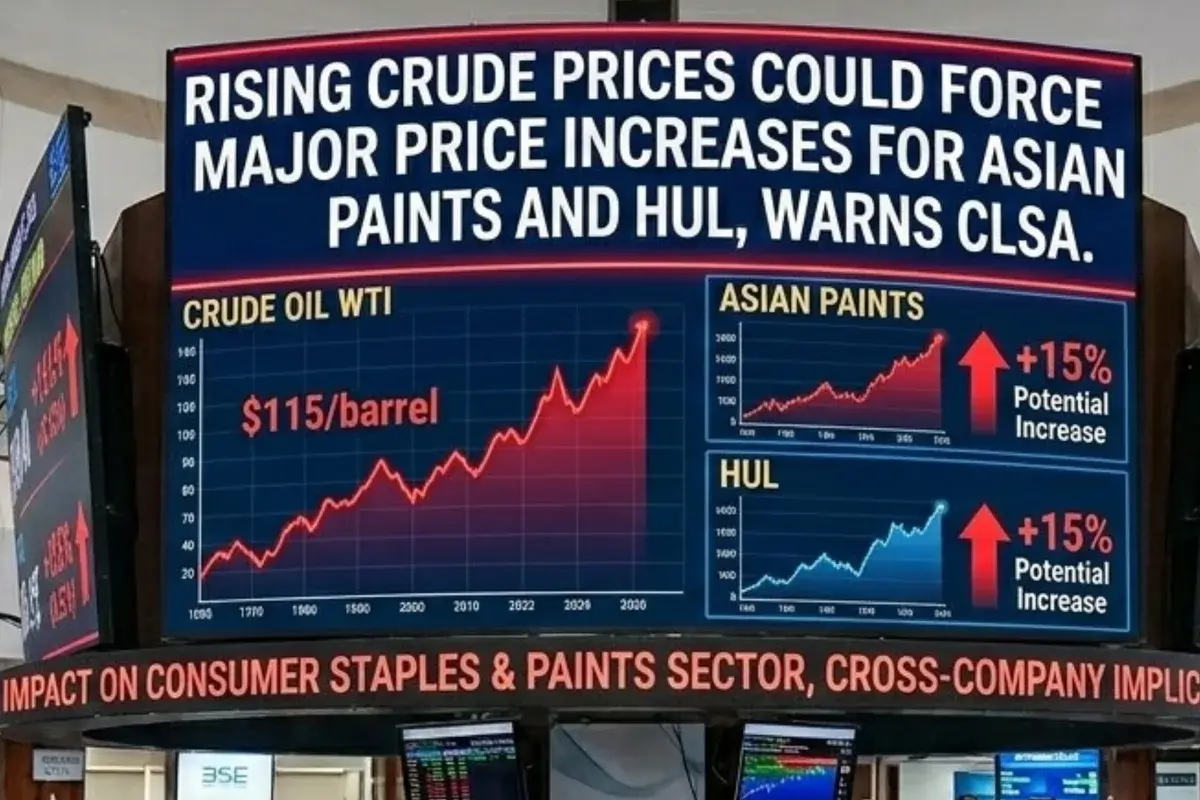
Surging crude oil prices could force major price increases for Indian giants Asian Paints and HUL, warns CLSA.

Gold prices on MCX soar to ₹1.64 lakh in March 2026, driven by intense US-Iran tensions. FinScann analyzes safe-haven demand and future outlook for...

Silver prices soar over 3% in March 2026 as Middle East tensions escalate and a weaker US dollar fuels safe-haven demand.