Loading market data...
Indian equity markets opened on a cautious note as global investor sentiment weakened amid escalating geopolitical tensions involving the United States, Israel, and Iran. Early signals from Gift Nifty indicated a gap-down movement in benchmark indices such as the Nifty 50 and Sensex. Although both indices had recovered in the previous session following several days of sharp declines, concerns over rising crude oil prices and potential inflationary pressures continued to weigh on market confidence. As India relies heavily on imported oil, sustained increases in energy prices could impact inflation levels, fiscal stability, and overall investor sentiment. Asian markets also reflected similar caution, highlighting a broader global risk-off environment. Despite strong domestic economic fundamentals and steady institutional participation, geopolitical developments remain a key factor influencing market volatility and near-term investor outlook.
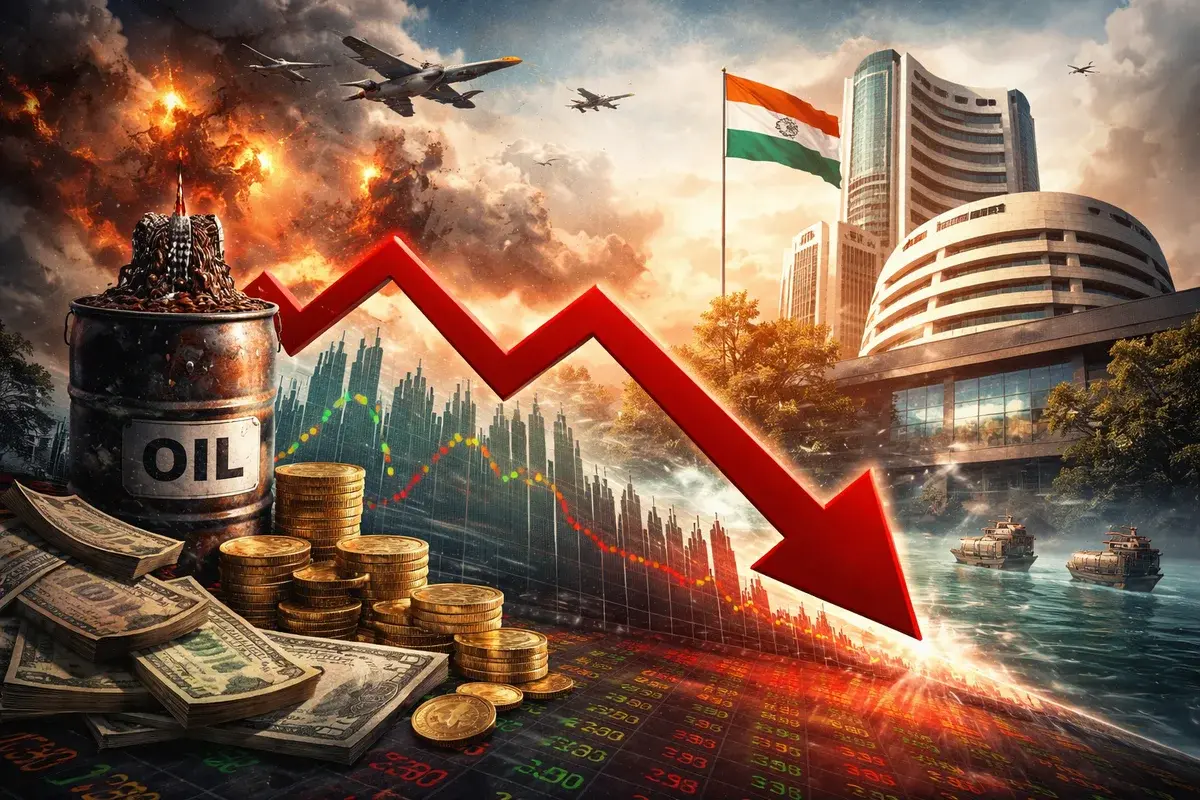
Indian equity markets are expected to open on a cautious note on Friday as escalating geopolitical tensions in the Middle East dampen global risk appetite. Early signals from Gift Nifty indicate a potential gap-down opening for domestic benchmarks, suggesting investors remain wary amid the ongoing conflict involving the United States, Israel, and Iran.
The developments come after a volatile week in global financial markets, where crude oil prices surged and equity investors shifted toward defensive assets. The uncertainty surrounding the conflict has added fresh concerns about energy supply disruptions, inflationary pressures, and broader economic stability.
India’s benchmark indices — the Nifty 50, managed by the National Stock Exchange of India (NSE), and the BSE Sensex, operated by the Bombay Stock Exchange (BSE) — managed to recover slightly in the previous trading session following steep losses earlier in the week. However, global developments now threaten to overshadow that rebound.
Early market indicators suggest domestic equities could start the day on a negative note. Gift Nifty futures — traded at the **NSE International Exchange ** (NSE IX) in Gujarat’s GIFT City — were seen trading around 24,621 in early deals, approximately 233 points below the previous close of Nifty futures.
The signal from Gift Nifty is widely used by traders as a pre-market indicator for Indian equities. The decline suggests that global investors are adopting a cautious stance ahead of the Indian market opening.
Despite Thursday’s rebound, the underlying market sentiment remains fragile. On the previous trading day, the Nifty 50 recovered by about 1.1%, reclaiming the 24,700 level after suffering multiple sessions of declines earlier in the week. The Sensex also staged a strong recovery, gaining 899.71 points as traders rushed to cover short positions.
However, analysts believe the bounce was largely technical rather than indicative of a sustained shift in investor sentiment.
| Market Indicator | Details |
|---|---|
| Gift Nifty Level | ~24,621 |
| Gap from Previous Close | ~233 points lower |
| Nifty 50 Previous Session | +1.1% recovery |
| Sensex Move | +899.71 points |
| Market Trigger | Short covering after losses |
Market participants now expect global macro factors rather than domestic triggers to dictate near-term direction.
One of the biggest concerns currently weighing on global financial markets is the ongoing geopolitical conflict involving the United States, Israel, and Iran. The tensions have triggered fears of disruptions in global oil supply routes, particularly in the strategically important Middle East region.
The surge in crude oil prices has already started influencing investor sentiment. Brent crude prices have risen sharply in recent sessions, raising concerns about energy costs and inflation. For an oil-importing economy like India, sustained higher crude prices can significantly impact macroeconomic stability.
India imports nearly 85% of its crude oil requirements, making it highly sensitive to global energy price fluctuations. Rising oil prices can widen the country’s current account deficit and increase inflationary pressures across sectors such as transportation, manufacturing, and consumer goods.
| Market Indicator | Data |
|---|---|
| India Oil Import Dependence | ~85% |
| Key Oil Benchmark | Brent Crude |
| Impact Risk | Inflation, fiscal deficit |
| Sensitive Sectors | Aviation, logistics, manufacturing |
| Global Trigger | Middle East conflict |
Higher energy costs could also influence monetary policy decisions by the Reserve Bank of India (RBI), especially if inflation risks intensify.
This combination of geopolitical risk and commodity inflation has historically led to increased volatility in equity markets.
The cautious mood is not limited to India. Across Asia, several equity markets have experienced declines as investors reassess risk amid geopolitical uncertainty.
Global investors are increasingly shifting funds toward safe-haven assets such as gold, US Treasury bonds, and the US dollar. This capital rotation often results in reduced flows into emerging markets like India.
Additionally, foreign institutional investors (FIIs), who play a crucial role in Indian market liquidity, tend to reduce exposure during periods of global uncertainty. If geopolitical tensions persist, India could witness temporary FII outflows, which may increase short-term volatility in benchmark indices.
| Market Indicator | Details |
|---|---|
| Regional Trend | Asian markets declining |
| Investor Behavior | Risk-off sentiment |
| Safe Haven Assets | Gold, US bonds, US dollar |
| Potential Impact | FII outflows |
| Volatility Outlook | Elevated in short term |
Despite these pressures, India’s structural growth story continues to attract long-term global investors.
While global developments dominate headlines, domestic economic fundamentals remain relatively strong.
India’s economic growth trajectory continues to be supported by rising consumption, infrastructure investment, and government-led reforms. Several sectors, including banking, capital goods, and manufacturing, have delivered robust earnings growth in recent quarters.
Additionally, strong domestic institutional investor (DII) participation has helped cushion the impact of foreign fund outflows during volatile periods.
Market experts believe that unless the geopolitical situation escalates significantly, Indian equities could stabilize after short-term fluctuations.
| Business Metric | Details |
|---|---|
| Key Growth Drivers | Consumption, infrastructure |
| Strong Performing Sectors | Banking, manufacturing |
| Domestic Investors | Increasing DII participation |
| Earnings Trend | Broad-based growth |
| Market Cushion | Domestic liquidity |
This domestic resilience has been a key factor behind India’s strong equity market performance over the past few years.
Looking ahead, market direction will likely be influenced by geopolitical developments and commodity price trends. Any escalation in tensions in the Middle East could trigger further spikes in crude oil prices, which may increase inflation concerns globally.
Conversely, signs of diplomatic progress or stabilization in the region could quickly restore investor confidence and support equity market recovery.
Market strategists also note that Indian equities have demonstrated resilience during previous global shocks, supported by strong domestic consumption and structural economic reforms.
However, in the near term, traders are expected to remain cautious, with volatility likely to persist.
The anticipated gap-down opening for Indian markets highlights the increasing sensitivity of equities to global geopolitical developments. Rising crude oil prices, inflation concerns, and global risk aversion are shaping short-term investor behavior. While India’s long-term growth story remains intact, near-term market expansion and financial performance will depend on how global tensions evolve. For investors and analysts tracking startup funding, investment trends, industry growth, and broader sector outlook, the current environment underscores the importance of geopolitical risk in shaping market strategy and capital allocation decisions.

Financial journalist specializing in market analysis, stock research, and investment trends. Dedicated to providing accurate, timely insights for informed decision-making.
Credentials: Experienced financial journalist with expertise in equity markets and economic analysis
The information provided in this article is for educational and informational purposes only and should not be construed as financial, investment, or legal advice. Finscann does not provide personalized investment recommendations.
For detailed terms and conditions, please read our Disclaimer and Terms of Service.

FinScann presents a deep dive into Indian stocks to watch on March 6, 2026. Navigate market volatility driven by crude oil, geopolitics, and...

Indian stock market plunges as Nifty 50 falls 285 points to 24,765 and Sensex drops 899 points.
India's benchmark indices Sensex and Nifty staged a robust recovery in March 2026, gaining significantly despite ongoing geopolitical tensions.

Geopolitical tensions surrounding the US-Iran conflict led FIIs to dump ₹12,000 crore from Indian shares.

Indian refinery stocks, including Reliance, MRPL, and CPCL, surge up to 5% after China reportedly suspends diesel and gasoline exports amidst...