
global-news
India–EU Free Trade Agreement Explained: Why PM Modi’s ‘Mother of All Deals’ Could Redefine India’s Global Trade Position
1 hours ago
Reviewed and Rewrite by
Shanaya Singh

Synopsis
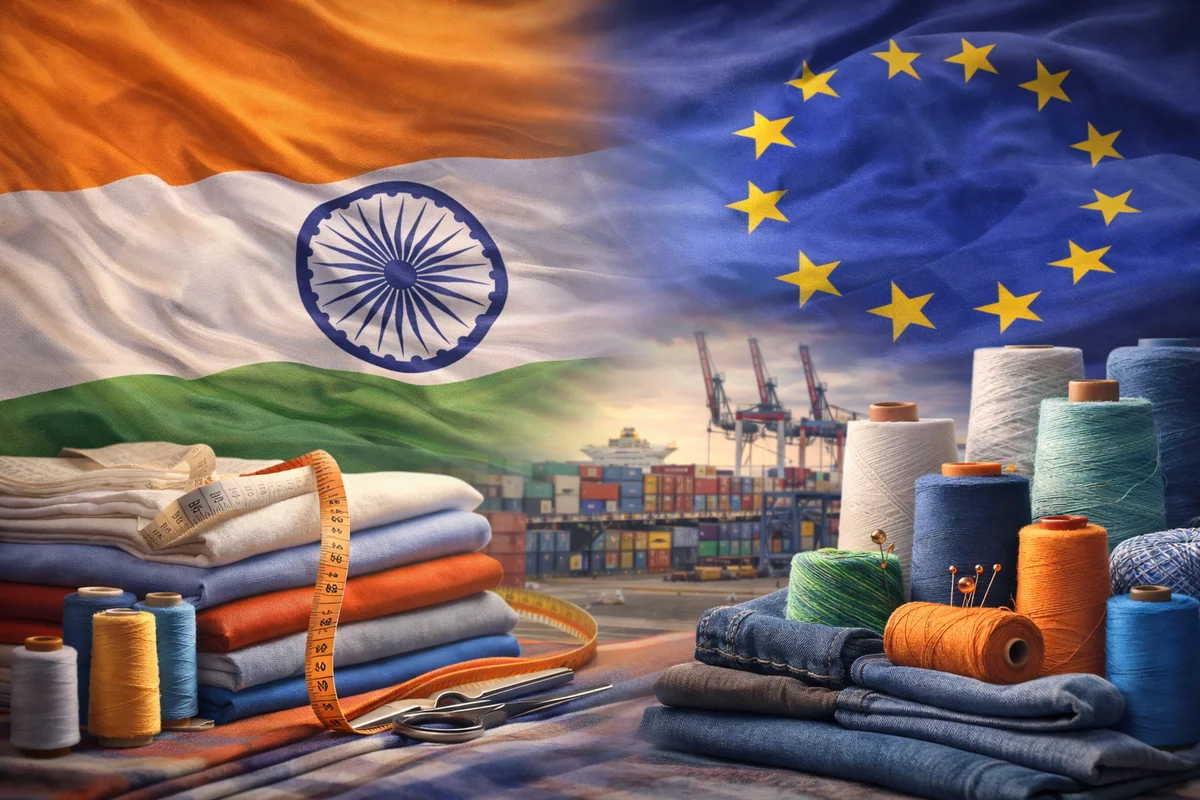
Indian textile and apparel manufacturers are closely watching the evolving India–European Union Free Trade Agreement (FTA) negotiations, as tariff reductions and improved market access could significantly reshape the sector’s export prospects. While official details remain limited, historical trade data, policy signals, and global supply-chain shifts suggest that the textile industry could emerge as one of the largest structural beneficiaries of the India–EU trade pact.
Why the India–EU Trade Deal Matters for Indian Textiles
India’s textile and apparel industry stands at a strategic crossroads.
Employing over 45 million people directly and contributing nearly 2% to India’s GDP, textiles are not just an export sector — they are a social and economic backbone. The European Union, meanwhile, is one of the world’s largest apparel and textile import markets, with annual imports exceeding €250 billion.
Yet, despite India’s scale, its share in EU textile imports remains lower than potential, constrained largely by tariff barriers, regulatory frictions, and lack of preferential access compared to competitors like Bangladesh and Vietnam.
That is where the India–EU trade deal becomes critical.
Current Reality: Why Indian Textiles Lag in the EU Market
At present, Indian textile and apparel exports to the EU face import duties ranging between 8% and 12%, depending on the product category.
By contrast:
• Bangladesh enjoys zero-duty access under the EU’s Everything But Arms (EBA) scheme • Vietnam benefits from sharply reduced tariffs under the EU–Vietnam FTA • Cambodia and Sri Lanka also enjoy preferential regimes
This tariff disadvantage directly impacts pricing, margins, and order competitiveness for Indian exporters.
Table 1: EU Import Tariffs on Apparel (Approximate)
| Country | Average EU Tariff | Trade Preference |
|---|---|---|
| India | 8–12% | No FTA |
| Bangladesh | 0% | EBA |
| Vietnam | 0–5% | EU–Vietnam FTA |
| Sri Lanka | 0% | GSP+ |
| Turkey | 0% | Customs Union |
This gap has cost India billions of dollars in potential exports over the last decade.
What the India–EU FTA Could Change for Textile Firms
Although the final tariff schedules are yet to be released, negotiators on both sides have indicated that textiles and apparel are priority sectors.
Potential changes under the trade deal
For Indian textile firms, even a 5–8% tariff reduction can dramatically improve competitiveness.
Why Timing Matters: Global Supply Chains Are Shifting
The textile industry is undergoing a global realignment.
Key global trends
• Brands are reducing dependence on China • Buyers are diversifying sourcing due to geopolitical risk • Sustainability and ESG compliance are becoming mandatory • Near-shoring and friend-shoring are accelerating
India, with its integrated textile value chain — from cotton to finished garments — is uniquely positioned to absorb this shift, provided market access improves.
The India–EU trade deal could arrive at a moment when buyers are actively looking for alternatives.
India’s Textile Strength: From Fibre to Fashion
Unlike many competing nations, India offers end-to-end textile capabilities:
• Cotton, man-made fibre, silk, wool • Spinning, weaving, knitting • Processing and dyeing • Garmenting and technical textiles
This integration reduces lead times and increases flexibility — a key advantage in fast fashion and seasonal demand cycles.
Which Segments Stand to Benefit the Most
1. Apparel and Garments
The largest beneficiary.
• Shirts, trousers, dresses, knitwear • Fast-fashion and mid-range brands • Private-label manufacturing
Tariff parity with Vietnam and Bangladesh could unlock large order shifts.
2. Home Textiles
India is already strong in:
• Bed linen • Towels • Curtains • Upholstery fabrics
Europe is a major consumption market for home textiles, especially in Germany, France, and the Nordic region.
3. Technical and Industrial Textiles
An underappreciated opportunity.
• Medical textiles • Automotive fabrics • Protective wear • Sustainable fibres
The EU’s focus on green and functional textiles aligns with India’s growing technical textile ecosystem.
Table 2: India’s Textile Export Opportunity with the EU
| Segment | Current Status | FTA Impact Potential |
|---|---|---|
| Apparel | Underpenetrated | Very High |
| Home textiles | Strong base | High |
| Yarn & fabric | Moderate | Medium |
| Technical textiles | Emerging | High (long-term) |
Sustainability: The EU’s Biggest Condition
While tariff cuts are attractive, EU buyers are increasingly focused on:
• Carbon footprint • Water usage • Chemical compliance (REACH norms) • Labour standards and traceability
Indian textile firms that invest early in sustainability are likely to gain the most.
Key EU sustainability expectations
• Organic or recycled fibres • Zero-liquid discharge processing • Digital traceability • Ethical sourcing certifications
The trade deal is expected to codify many of these requirements, pushing the industry toward long-term competitiveness.
Government Push: Aligning Policy with Trade Opportunity
India has already laid the groundwork through:
• Production Linked Incentive (PLI) scheme for textiles • PM MITRA Mega Textile Parks • National Technical Textiles Mission • Export incentive restructuring
The India–EU trade deal could act as a demand catalyst, converting policy support into actual export growth.
Employment and MSME Impact
Textiles are among India’s largest employment generators, especially for:
• Women workers • Rural and semi-urban labour • MSME clusters
Increased EU demand could:
• Expand capacity utilisation • Create new jobs • Improve wage stability • Formalise supply chains
This makes the textile angle politically and socially significant.
What Investors Are Watching
From a market perspective, investors are tracking:
• Order book visibility • Margin expansion from tariff savings • Capacity expansion announcements • Sustainability capex • Export mix improvement
While short-term stock reactions may be muted due to lack of specifics, the structural narrative is strengthening.
Risks and Challenges to Watch
Despite optimism, challenges remain:
• Phased tariff reductions may delay benefits • Compliance costs could rise • Smaller firms may struggle with ESG norms • Competition from Vietnam and Turkey remains strong • Currency volatility can impact margins
Execution, not just policy, will determine outcomes.
What Happens Next
Key milestones to track:
• Official tariff schedules • Rules of origin clarity • Implementation timelines • Sector-specific annexures • Export order data post-signing
Textile firms are likely to recalibrate strategies once these details emerge.
FAQs: India–EU Trade Deal and Textiles
Why is the EU important for Indian textile exports?
The EU is one of the world’s largest apparel import markets with high purchasing power.
How much can tariffs reduce under the trade deal?
Exact numbers are pending, but reductions of 5–12% are being discussed.
Which Indian textile segment benefits most?
Apparel and home textiles are expected to see the biggest gains.
Will small textile firms benefit?
Yes, but compliance and scale will be critical.
Is sustainability mandatory for EU exports?
Increasingly yes. ESG compliance is becoming non-negotiable.
Final Take
The India–EU trade deal could mark a turning point for Indian textile firms, transforming a long-standing disadvantage into a growth opportunity.
While details are awaited, the direction is clear: better market access, higher competitiveness, and deeper integration into global supply chains.
For an industry that employs millions and sits at the heart of India’s export ambitions, the deal is not just about tariffs — it is about reclaiming global relevance.
If executed well, Indian textiles could move from being a volume-driven exporter to a value-led global supplier in the European market.
Disclaimer
This article is for informational and educational purposes only. It does not constitute investment advice, a recommendation, or an offer to buy or sell any securities. Readers are advised to conduct their own research or consult a qualified financial advisor before making any investment or business decisions.