
global-news
India–EU Trade Deal and Indian Textile Firms: Why the Sector Could Be the Biggest Winner
2 hours ago
Reviewed and Rewrite by
Shanaya Singh

Synopsis
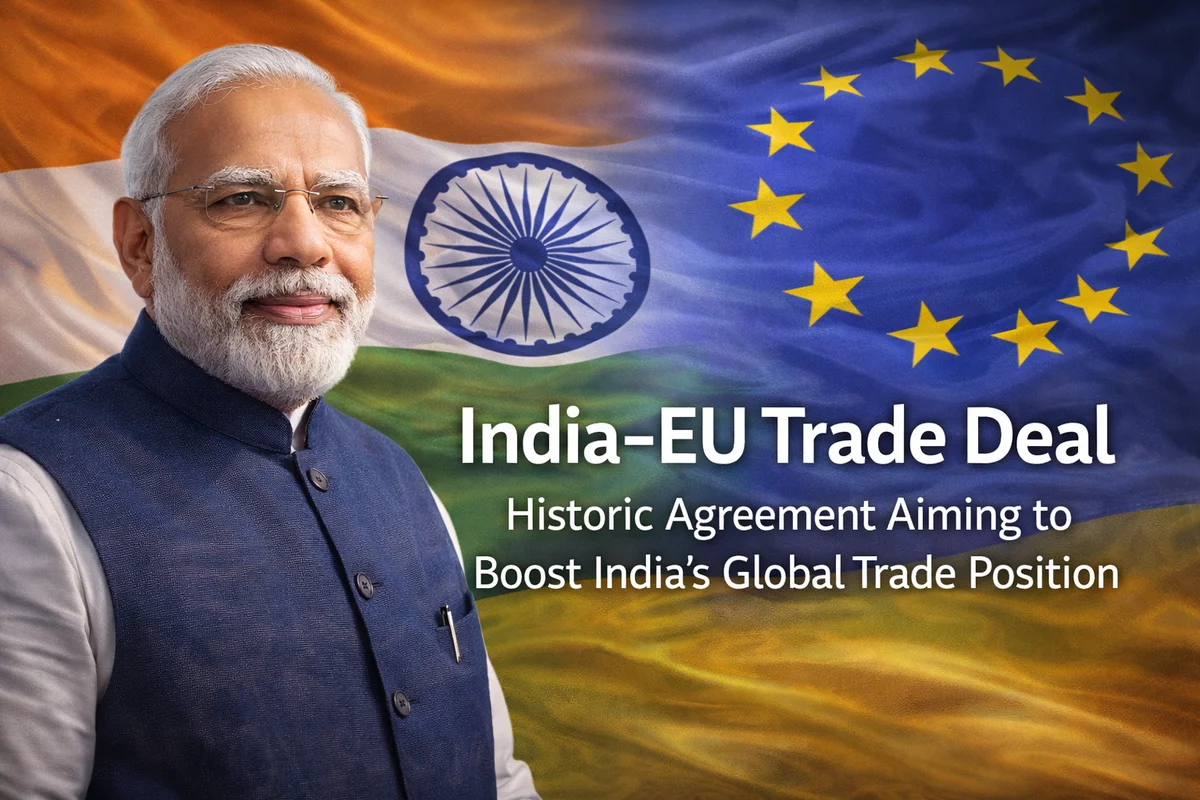
Prime Minister Narendra Modi has announced a landmark Free Trade Agreement (FTA) with the European Union, calling it the “mother of all trade deals” after nearly two decades of negotiations. The pact is expected to gradually open India’s protected market, boost exports by up to $50 billion by 2031, and strengthen India’s role in global value chains at a time of rising geopolitical and trade uncertainty.
A Defining Moment in India–EU Economic Relations
After almost 18–20 years of negotiations, India and the European Union have reached a breakthrough on a comprehensive free trade agreement, marking one of the most significant shifts in India’s trade policy in decades.
The announcement comes at a critical juncture for the global economy, with trade fragmentation, rising tariffs, and geopolitical uncertainty reshaping supply chains. By sealing a deal with the EU — the world’s second-largest economic bloc — India is signalling its intent to integrate more deeply with global markets while diversifying trade partnerships beyond the United States and China.
Prime Minister Modi described the pact as transformational, underlining its long-term strategic and economic significance rather than just near-term tariff reductions.
Why the India–EU FTA Is Being Called the ‘Mother of All Deals’
Unlike narrow trade agreements, the India–EU FTA is expected to be broad-based and multi-sectoral, covering goods, services, investment, sustainability standards, and regulatory cooperation.
Key reasons the deal is considered historic
• It involves India’s largest trading partner • It opens one of the world’s most protected large economies • It covers both manufacturing and services • It aligns India with advanced trade, ESG, and digital standards • It positions India as a counterweight in global trade realignment
Economists describe the deal as a structural shift rather than a cyclical boost.
Table 1: Why the EU Matters to India’s Trade
| Metric | Significance |
|---|---|
| EU share of India’s goods exports | ~17% |
| EU economic size | Second-largest global bloc |
| Key imports from India | Textiles, gems & jewellery, pharma, engineering goods |
| Strategic value | Market diversification, stable demand |
Export Boost: $50 Billion Opportunity by 2031
According to economists such as Madhavi Arora of Emkay Global, the India–EU FTA could raise India’s exports to the EU by nearly $50 billion by 2031, provided tariff reductions and regulatory access are implemented effectively.
How the export boost could materialise
• Tariff elimination improves price competitiveness • Better access to EU procurement markets • Improved participation in EU-linked supply chains • Increased demand for Indian manufactured and value-added goods
This is especially relevant as India looks to move up the value chain rather than rely solely on low-margin exports.
A Counter-Cyclical Shield in a Volatile Global Economy
The timing of the agreement is as important as its content.
With the global economy facing uncertainty — including renewed tariff risks from US trade policies under Donald Trump — India needs stable, long-term export anchors.
The EU trade pact could act as a counter-cyclical buffer, helping India:
• Offset slowing global demand • Reduce dependence on any single market • Stabilise export earnings during downturns • Attract long-term foreign investment
Which Sectors Stand to Benefit the Most
Manufacturing and Industrial Goods
• Engineering products • Auto components • Capital goods • Electrical equipment
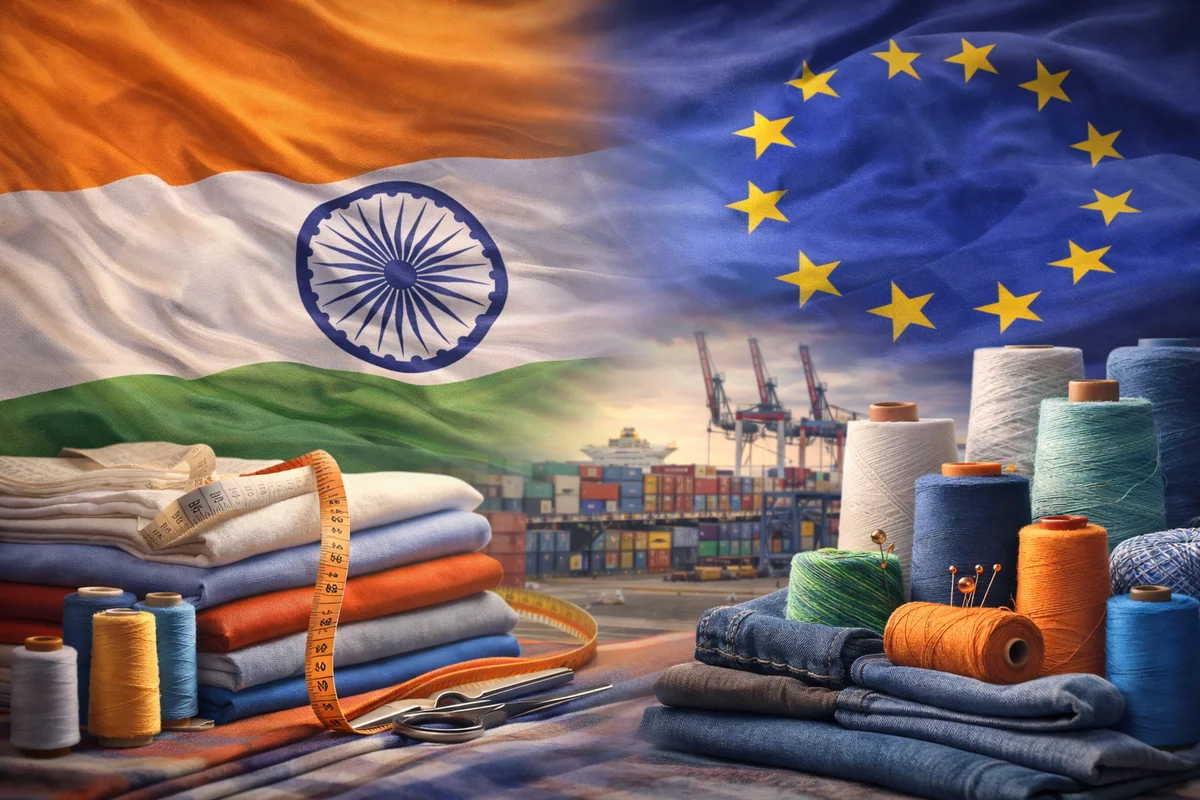
Textiles and Apparel
• Removal of tariff disadvantages versus Vietnam and Bangladesh • Strong demand from EU retailers • High employment impact
Pharmaceuticals and Chemicals
• Improved regulatory cooperation • Faster approvals and compliance alignment
Services and IT
• Professional services • Digital trade and cross-border services • Skilled mobility frameworks
Table 2: Sectoral Impact Snapshot
| Sector | Expected Impact | Time Horizon |
|---|---|---|
| Manufacturing | High | Medium term |
| Textiles & apparel | Very high | Short to medium term |
| Pharma | Moderate to high | Medium term |
| IT & services | High | Long term |
Why This Deal Matters for Global Value Chains
Global supply chains are being re-engineered due to:
• China-plus-one strategies • Geopolitical risk management • ESG and sustainability mandates • Demand for resilient sourcing hubs
The India–EU FTA places India in a stronger position to plug into European value chains, particularly in green manufacturing, clean energy equipment, and high-quality consumer goods.
Stock Market and Investor Implications
While the immediate market reaction may be muted due to phased implementation, investors are closely watching:
• Export-oriented manufacturing firms • Textile and apparel exporters • Engineering and capital goods companies • Logistics and port operators
Over time, the agreement could influence earnings visibility, valuation multiples, and capital expenditure cycles.
Challenges and Risks to Watch
Despite optimism, the deal is not without challenges:
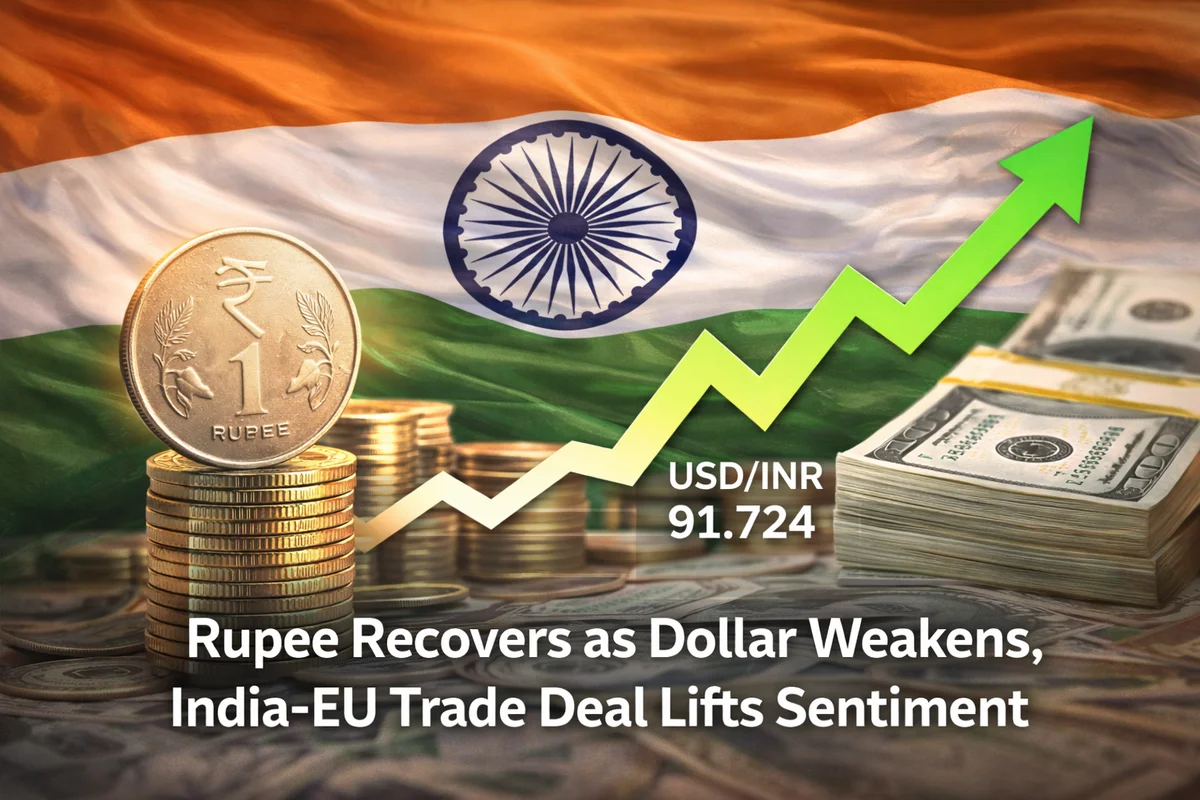
• Gradual tariff phase-outs may delay benefits • Strict EU sustainability norms raise compliance costs • MSMEs may face adaptation hurdles • Currency volatility can affect export margins • Implementation speed will be critical
Execution, not just intent, will determine success.
What Happens Next
Key next steps include:
• Legal scrubbing and ratification • Release of detailed tariff schedules • Rules of origin clarity • Sector-specific annexes • Business-level adaptation and compliance
Markets and businesses will closely track these developments over the next 6–12 months.
FAQs: India–EU Free Trade Agreement
What is the India–EU FTA?
A comprehensive trade agreement aimed at reducing tariffs, boosting investment, and deepening economic integration.
Why is it called the ‘mother of all deals’?
Because of its scale, economic impact, and long-term strategic importance.
How much can India’s exports grow?
Estimates suggest up to $50 billion by 2031.
Which sectors benefit most?
Manufacturing, textiles, pharmaceuticals, and services.
Will the impact be immediate?
No. Benefits will accrue gradually as tariffs and regulations are phased in.
Final Take
The India–EU Free Trade Agreement is more than a trade pact — it is a strategic economic realignment.
At a time when global trade is becoming fragmented, the deal anchors India to one of the world’s most stable and affluent markets. If implemented effectively, it could boost exports, strengthen manufacturing, attract investment, and elevate India’s position in global value chains.
That is why Prime Minister Modi’s description of the agreement as the “mother of all deals” is not rhetoric — it reflects the scale of opportunity the pact represents for India’s long-term economic trajectory.
Disclaimer
This article is for informational and educational purposes only. It does not constitute investment advice, financial recommendations, or a solicitation to buy or sell securities. Readers should conduct independent research or consult qualified professionals before making business or investment decisions.