
Adani Aerospace–Embraer Deal Explained: Why India’s First Commercial Aircraft Assembly Line Is a Game Changer
1 hours ago
Reviewed and Rewrite by
Shanaya Singh


Synopsis
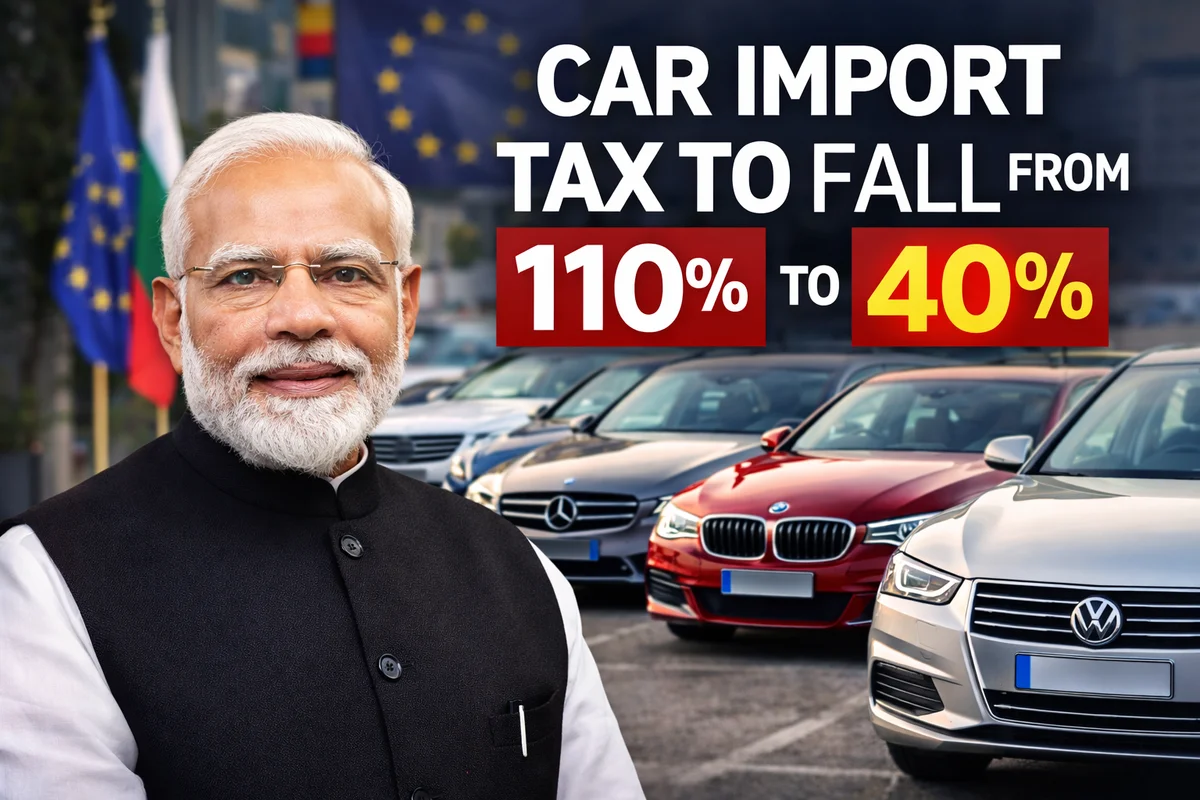
India is set to sharply reduce import tariffs on select European cars to 40% from as high as 110% under a landmark free trade agreement with the European Union, according to sources familiar with the talks. The move marks the biggest opening yet of India’s highly protected auto market and is expected to benefit European automakers while reshaping competition in the world’s third-largest car market.
India–EU Trade Talks Near Conclusion
India and the European Union are poised to announce the conclusion of long-running free trade negotiations as early as Tuesday, in what officials have dubbed the “mother of all trade deals.” The agreement is expected to significantly expand India-EU bilateral trade, improve market access, and reduce tariff and non-tariff barriers across key sectors — with automobiles emerging as one of the most consequential areas.
According to sources briefed on the discussions, the Indian government has agreed to immediately slash import tariffs on a limited number of cars imported from the EU to 40%, down from current levels that range between 70% and 110%.
What the Tariff Cut Covers — and What It Doesn’t
The initial tariff reduction will apply to select combustion-engine vehicles imported from the 27-nation EU bloc with a minimum import price of over €15,000. Over time, the import duty on these vehicles is expected to be gradually reduced to as low as 10%, significantly lowering entry barriers for European car manufacturers.
However, battery electric vehicles (EVs) will be excluded from duty cuts for the first five years, sources said. This carve-out is aimed at protecting India’s domestic EV ecosystem during its early growth phase.
After the initial five-year period, EVs are expected to follow a similar tariff-reduction schedule under the agreement.
A Major Shift for a Highly Protected Auto Market
India is currently the world’s third-largest car market by volume, behind the United States and China, but its automotive sector has long been among the most protected globally. High import duties have frequently drawn criticism from global automakers, including Elon Musk, who has cited tariffs as a key barrier to selling imported vehicles in India.
The proposed tariff cuts represent India’s most aggressive liberalisation of the auto sector so far, signalling a broader shift in trade and industrial policy under Prime Minister Narendra Modi’s government.
Who Stands to Gain the Most?
Lower import duties are expected to directly benefit European automakers, including:
• Renault
• BMW
Although many of these companies already assemble vehicles in India, high tariffs have restricted their ability to import premium and niche models. Reduced duties would allow automakers to price imported cars more competitively, test consumer demand, and fine-tune strategies before committing to larger manufacturing investments.
Quotas and Market Access
Sources indicated that India has proposed allowing up to 200,000 combustion-engine cars per year to be imported under the lower-tariff regime. While the final quota could still be revised, such a move would mark a significant expansion of market access for European manufacturers.
The quota-based approach allows India to open the market in a calibrated manner, balancing trade liberalisation with protection for domestic producers.
Why EVs Are Being Protected
The decision to exclude EVs from immediate tariff cuts reflects India’s strategic focus on building a strong domestic electric-vehicle manufacturing base. Companies such as Mahindra & Mahindra and Tata Motors have invested heavily in EV development, battery supply chains, and charging infrastructure.
Policymakers are keen to avoid undermining local investments before the sector achieves sufficient scale and cost competitiveness. After five years, EVs are expected to be included under the broader tariff-reduction framework.
Market Dynamics: Who Dominates India’s Auto Sector Today?
India’s passenger vehicle market, currently estimated at 4.4 million units annually, is dominated by Suzuki Motor through its local arm, along with domestic manufacturers Mahindra and Tata. Together, Indian brands account for nearly two-thirds of total sales, while European automakers command less than 4% market share.
With India’s auto market projected to grow to 6 million units per year by 2030, global automakers view the country as one of the most important long-term growth markets worldwide.
Investment Plans Already Taking Shape
Anticipating improved market access, European automakers are already preparing new investment strategies:
• Renault is planning a renewed India push as it looks for growth beyond Europe
• Volkswagen Group is finalising the next phase of its India expansion via Skoda
• Luxury brands are reassessing import-versus-localisation strategies
Lower tariffs could accelerate these plans, intensify competition, and expand consumer choice across price segments.
Broader Trade Impact
Beyond automobiles, the India–EU trade pact is expected to boost Indian exports of textiles, jewellery, engineering goods, and manufactured products, sectors that have recently faced pressure from high U.S. tariffs.
For the European Union, better access to India’s fast-growing consumer market offers a strategic hedge as European automakers face rising competition from Chinese manufacturers in their home markets.
What is the new car import tariff India plans to apply to EU vehicles?
India plans to cut tariffs on select EU-imported cars to 40% initially, with a roadmap to reduce them further to 10% over time.
Which cars will qualify for the lower import duty?
The lower tariff will apply to combustion-engine cars imported from the EU priced above €15,000, subject to annual quotas.
Are electric vehicles included in the tariff cut?
No. Electric vehicles will be excluded for the first five years to protect domestic EV manufacturers. After that, EVs may receive similar duty reductions.
Which companies are likely to benefit the most?
European automakers such as Volkswagen, Renault, Mercedes-Benz, BMW, and Stellantis are expected to benefit significantly.
Will this make cars cheaper in India?
Yes. Lower import duties are likely to reduce prices of imported European cars, particularly in the premium and luxury segments.
Why is India opening up its auto market now?
The move aligns with India’s broader strategy to boost trade, attract foreign investment, and integrate more deeply into global supply chains.
Final Take
India’s decision to slash car import tariffs under the EU trade deal represents a turning point for the country’s automotive industry. While safeguards remain in place for electric vehicles and domestic players, the move clearly signals a shift toward calibrated liberalisation.
If implemented as planned, the agreement could reshape competition, unlock fresh foreign investment, and redefine India’s role in the global automotive value chain — while testing how far the country is willing to open one of its most strategically sensitive sectors.