

global-news
India–EU Free Trade Agreement Explained: Why PM Modi’s ‘Mother of All Deals’ Could Redefine India’s Global Trade Position
3 hours ago
Reviewed and Rewrite by
Shanaya Singh


Introduction: A Budget Session That Could Define India’s Economic Direction
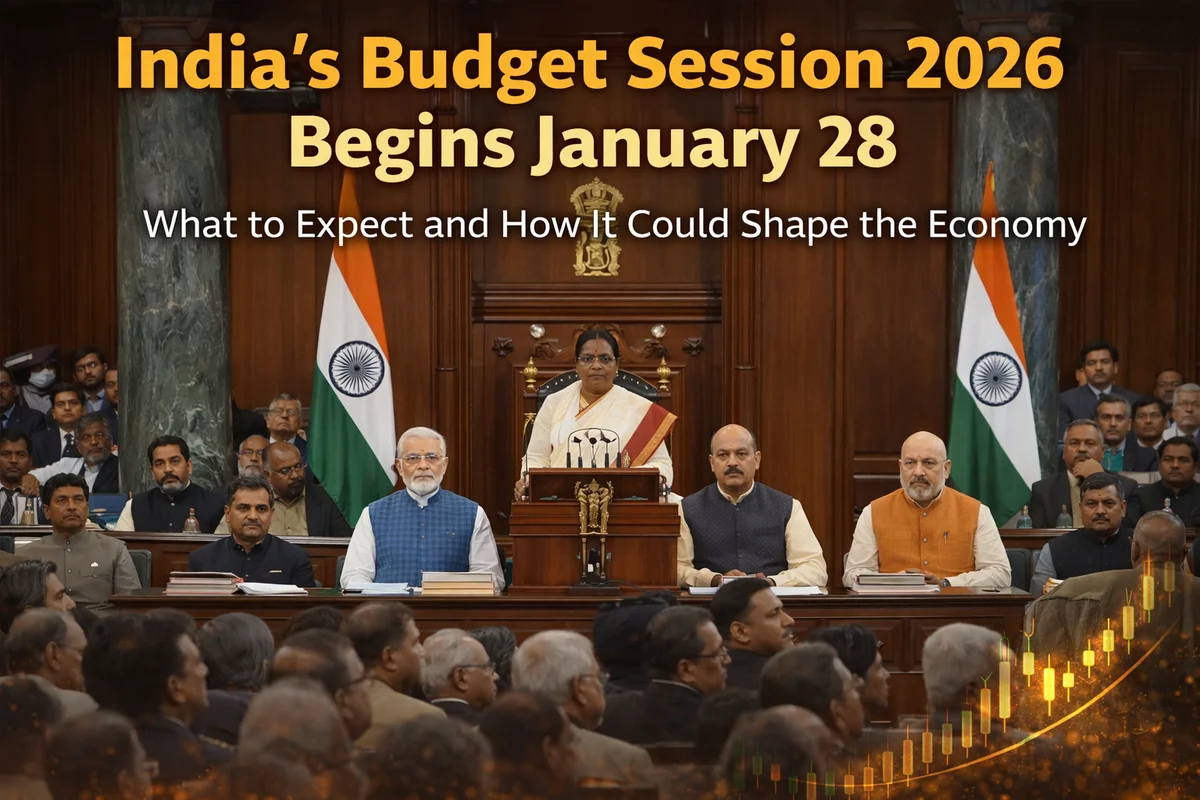
India’s Budget Session of Parliament for 2026 begins on January 28, marking one of the most important legislative periods of the year. Far more than a routine parliamentary calendar event, this session will determine the financial, economic, and policy direction of the country for the 2026–27 fiscal year.
With the government planning an all-party meeting ahead of the session, expectations are high that consensus-building, debate, and strategic decision-making will take center stage. The session will culminate in the presentation of the Union Budget 2026–27, a moment closely watched not just by lawmakers, but by markets, industries, investors, and citizens alike.
In a global environment marked by geopolitical uncertainty, slowing growth in major economies, and persistent inflationary pressures, the Budget Session 2026 is being seen as a balancing act — between fiscal discipline and growth stimulus, between political consensus and ideological differences, and between short-term pressures and long-term national priorities.
This article breaks down what the Budget Session entails, why it matters so deeply, how it is structured, and what stakeholders across the economy should realistically expect.
Understanding the Budget Session: Why It Holds Exceptional Importance
The Budget Session is traditionally the longest and most consequential session of Parliament. Unlike other sessions that focus primarily on legislation, the Budget Session revolves around the country’s financial blueprint.
At its core, the session is about:
The decisions taken during this period directly influence economic growth, inflation, employment, investment flows, and household finances.
Key Dates and Structure of Budget Session 2026
The Budget Session for 2026 has been structured into two distinct phases, allowing time for presentation, scrutiny, debate, and passage of financial legislation.
| Phase | Duration | Key Focus |
|---|---|---|
| Phase 1 | January 28 – February 13 | President’s Address, Budget Presentation, Initial Discussions |
| Recess | February 14 – March 8 | Parliamentary Committees Review Budget |
| Phase 2 | March 9 – April 2 | Budget Debate, Voting, Passage of Bills |
A total of 30 sittings are planned, reflecting the scale of legislative activity expected.
President’s Address: Setting the Legislative Tone
The session will begin with President Droupadi Murmu addressing both Houses of Parliament.
This address is not ceremonial alone — it serves as the formal articulation of the government’s policy vision and legislative agenda for the year.
Key expectations from the President’s address include:
Markets and analysts closely parse this address for early signals about the Budget’s direction.
The All-Party Meeting: Consensus or Conflict?
Ahead of the session, the government plans to hold an all-party meeting to discuss:
While such meetings aim to ensure smooth functioning, they also reveal political fault lines.
Given rising political competition and heightened public scrutiny, the tone of this meeting could shape the nature of parliamentary debates during the session.
Union Budget 2026–27: The Centerpiece of the Session
The Union Budget is the single most impactful outcome of the Budget Session.
It will define:
At a time when India is positioning itself as a global manufacturing and investment hub, budgetary clarity and credibility will be critical.
Economic Backdrop: Why Budget 2026 Matters More Than Usual
The Budget Session is unfolding against a complex economic backdrop.
Key challenges include:
At the same time, India continues to show:
The Budget must therefore protect growth while preserving fiscal discipline.
Market Context: Why Investors Are Watching Closely
Financial markets traditionally react sharply to Budget-related developments.
During the Budget Session, markets track:
Even parliamentary debates and opposition pushback can move sentiment, particularly in rate-sensitive sectors.
Sector-Wise Expectations from Budget Session 2026
| Sector | Key Expectations |
|---|---|
| Infrastructure | Higher capex, roads, railways, ports |
| Manufacturing | PLI extensions, export incentives |
| Banking & Finance | Credit growth support, fiscal clarity |
| Energy | Renewable push, energy security |
| Healthcare | Increased allocation, affordability |
| Education | Skill development, digital learning |
| Agriculture | MSP clarity, rural spending |
| Startups & MSMEs | Tax relief, funding access |
Opposition’s Role: Accountability and Debate
The Budget Session is also the primary platform for the Opposition to scrutinize government policy.
Key opposition focus areas are expected to include:
Robust debate, while politically charged, is essential for democratic accountability.
Why the Recess Matters More Than It Appears
The recess between February 14 and March 8 is not idle time.
During this period:
This process ensures that budgetary decisions are scrutinized beyond headline announcements.
Second Phase: Where Decisions Become Law
The second phase of the session is where:
This is when policy intent translates into enforceable law.
Implications for Businesses and Corporates
For businesses, the Budget Session provides:
Industries often delay major decisions until Budget outcomes are clear, highlighting the session’s real-world impact.
Implications for Households and Individuals
For individuals, Budget Session outcomes influence:
Even indirect tax changes ripple through daily expenses.
Historical Perspective: Why Budget Sessions Shape Legacies
Many landmark reforms in India have emerged from Budget Sessions:
Budget Sessions often define the economic legacy of governments.
Potential Risks During the Session
Despite its importance, risks include:
Smooth conduct of the session is therefore critical.
Frequently Asked Questions
Why is the Budget Session so important?
Because it determines the government’s financial and economic roadmap for the year.
When will the Union Budget be presented?
During the first phase of the session, shortly after January 28.
How long does the Budget Session last?
From January 28 to April 2, 2026, with a mid-session recess.
Why do markets react to the Budget Session?
Because fiscal policy, taxes, and spending directly affect corporate earnings and economic growth.
What happens after the Budget is presented?
It is debated, reviewed by committees, and finally passed during the second phase.
Looking Ahead: A Session That Could Shape FY27 and Beyond
As India prepares to enter the Budget Session of Parliament for 2026, expectations are high, scrutiny is intense, and stakes are elevated.
This session will not only decide how money is spent, but also what kind of growth India prioritizes, how it balances equity and efficiency, and how it positions itself in an uncertain global economy.
For policymakers, it is a test of vision. For markets, a test of confidence. For citizens, a test of delivery.
Conclusion: More Than a Budget, a National Moment
The Budget Session 2026 is not just a legislative requirement — it is a national moment of economic reckoning and opportunity.
With Parliament convening on January 28, all eyes will be on the decisions, debates, and directions that emerge.
What unfolds over the next few months will shape India’s economic narrative for years to come.
And that makes this session one of the most consequential in recent history.
--