Loading market data...
Tejas Networks signs a significant agreement with NEC Corporation for 5G Massive MIMO radio supply. FinScann analyzes the impact on share price amidst recent Q3 losses.
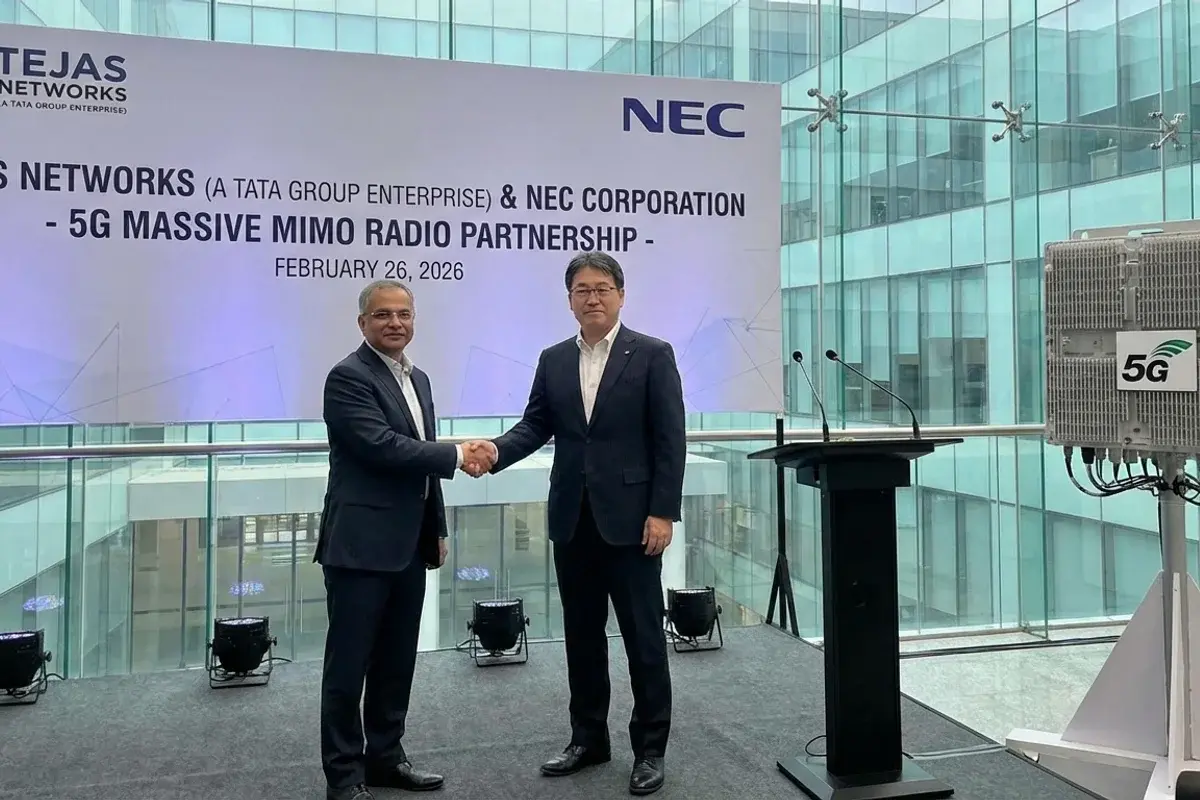
Bengaluru-based Tejas Networks (NSE: TEJASNET, BSE: 540595), a leading optical and data networking products company and a part of the Tata Group, has today, February 26, 2026, announced a pivotal agreement with NEC Corporation to manufacture and supply 5G Massive MIMO radios. This strategic collaboration significantly strengthens Tejas Networks' global presence in the mobile networks sector and aims to achieve critical supply-chain diversification and resilience for NEC's expansive ecosystem. The news comes amidst a challenging financial period for Tejas Networks, making this international contract a crucial development for its future trajectory and investor sentiment in the Indian telecom equipment market.
The Catalyst
The agreement with Japan's NEC Corporation positions Tejas Networks as a key manufacturing and supply partner for advanced 5G Massive MIMO radios. This partnership is designed to combine NEC's global reach with Tejas Networks' established expertise in carrier-class product development, fostering the co-creation of leading-edge 5G/5G-Advanced solutions. The product portfolio under this collaboration is expected to include versatile Radio Access Network (RAN) suites, notably high-capacity 32TR and 64TR Massive MIMO radios that adhere to both 3GPP and O-RAN standards. This deal is a significant step for Tejas Networks to expand its international business in the rapidly evolving mobile networks domain, replicating its domestic successes on a global scale.
Financial Forensics
While the specific financial value of the NEC Corporation contract has not yet been disclosed, its strategic importance cannot be overstated, especially in light of Tejas Networks' recent financial performance. The company reported a consolidated net loss of ₹196.55 crore in Q3 FY26 (ended December 31, 2025), a sharp contrast to a net profit of ₹165.67 crore in the corresponding quarter of the previous fiscal year. Total revenue from operations for Q3 FY26 plunged 88.38% year-on-year to just ₹306.79 crore from ₹2,642.24 crore, primarily due to delays in large project shipments and billing, including the much-anticipated BSNL 4G/5G add-on order worth ₹1,526 crore.
As of Q3 FY26, Tejas Networks maintained an order book of ₹1,329 crore. The prolonged delay in the BSNL order has led to elevated inventory levels, exceeding ₹2,300 crore, impacting working capital and contributing to continued net losses. The partnership with NEC Corporation offers a critical avenue for diversifying revenue streams and reducing dependence on single large domestic projects like the BSNL rollout, which has faced significant execution delays. This new contract underscores the global recognition of Tejas Networks' indigenous technology and manufacturing capabilities, a key advantage reinforced by the Tata Group's backing.
Tejas Networks: Key Financials & Order Book (₹ Crores)
| Metric | Q3 FY26 | Q3 FY25 | % Change (YoY) |
|---|---|---|---|
| Net Revenue | 307 | 2,642 | -88.38% |
| Net Profit (Loss) | (196.55) | 165.67 | -218.64% |
| Order Book (as of Q3 end) | 1,329 | N/A | N/A |
| Net Debt | 3,349 | N/A | N/A |
| Cash Balance | 537 | N/A | N/A |
Source: Tejas Networks Q3 FY26 Financial Results
Market Impact
The announcement of the NEC Corporation agreement is expected to provide a much-needed boost to Tejas Networks' share price and overall investor confidence, which has been dampened by the recent weak financial results and ongoing challenges. On January 9, 2026, Tejas Networks shares closed at ₹416.70, having tanked 5.68% following its Q3 results. The stock has seen significant volatility, trading near its 52-week low of ₹294 recently.
This new international contract signals strong validation for Tejas Networks' 5G technology and its potential for global expansion, counteracting some of the negative sentiment. The broader Indian telecom equipment market is projected to grow significantly, reaching USD 49.7 billion by FY2032 at a CAGR of 10.41% from FY2025 to FY2032, driven by continued investments in 5G infrastructure and fiber-optic networks.
However, the wider Nifty IT index has been under severe pressure in February 2026, experiencing its steepest monthly fall since 2003, with a decline of over 21% so far this month due to concerns over AI-led disruption in traditional IT services. While Tejas Networks operates in telecom equipment manufacturing rather than IT services, a broad-based sell-off in the technology sector on Dalal Street could exert some short-term pressure. Nevertheless, this new contract provides a strong fundamental trigger, potentially separating Tejas Networks' trajectory from the general IT sector headwinds. The ongoing 5G rollout in India continues at a steady pace, with over 521,729 5G base transceiver stations (BTS) installed by the end of January 2026, indicating sustained demand for telecom equipment.
Key Takeaways
For investors closely watching Tejas Networks and the Indian telecom sector, here are the critical points:
Moat Analysis: Tejas Networks' Strategic Edge
Tejas Networks' economic moat is primarily built upon its robust indigenous R&D capabilities in advanced telecom technologies, particularly in 4G and 5G Radio Access Networks. The company has invested heavily in developing a comprehensive portfolio of wireline and wireless networking products, holding over 525 global patents. This deep technological expertise allows it to cater to evolving network demands, including Massive MIMO and Open RAN architectures.
The strategic acquisition by Tata Sons (through Panatone Finvest Ltd) has provided Tejas Networks with substantial financial resources, global relationships, and strong ecosystem support, amplifying its ability to innovate and scale its business. This backing not only enhances its credibility but also aligns it with India's "Atmanirbhar Bharat" vision, giving it a competitive edge in government and defense projects. The Investment Play for Tejas Networks lies in its ability to leverage its proven technology and Tata Group synergy to capture a larger share of the rapidly expanding global 5G infrastructure market, diversifying away from domestic project dependencies and converting its strong R&D into consistent revenue growth.
Q: What is the significance of the NEC Corporation deal for Tejas Networks? A: The agreement with NEC Corporation is highly significant as it marks a major international win for Tejas Networks, validating its 5G Massive MIMO radio technology on a global scale. It diversifies the company's revenue streams beyond domestic contracts and strengthens its position as a key supplier for global 5G infrastructure.
Q: How do Tejas Networks' recent financial results (Q3 FY26) impact its outlook? A: Tejas Networks reported a substantial net loss and an 88.38% year-on-year revenue decline in Q3 FY26, primarily due to delays in the BSNL 4G/5G order. While these results indicate short-term challenges, the new NEC contract provides a strong positive signal for future revenue and profitability, especially as it reduces reliance on any single client.
Q: What are the key products Tejas Networks will supply under the NEC agreement? A: Under the agreement, Tejas Networks will manufacture and supply 5G Massive MIMO radios, which are crucial components for advanced 5G networks. These include high-capacity 32TR and 64TR radios, designed to comply with both 3GPP and O-RAN standards.
Q: What role does the Tata Group play in Tejas Networks' strategy? A: As a Tata Group company, Tejas Networks benefits from significant financial backing, strategic guidance, and global market access. The Tata Group's investment aims to build a comprehensive telecom networking business, leveraging Tejas Networks' indigenous technology for both 4G and 5G solutions, thereby enhancing its competitive edge and market reach.
Q: Is the Indian telecom equipment market still growing in 2026? A: Yes, the Indian telecom equipment market is experiencing robust growth, driven by continued investments in 5G infrastructure and fiber-optic networks. It was estimated at USD 22.5 billion in FY2024 and is projected to reach USD 49.7 billion by FY2032, growing at a CAGR of 10.41% from FY2025 to FY2032. India's 5G rollout continues steadily, with over half a million 5G BTS installed by January 2026.
Disclaimer: For information only; not investment advice. Stock market investments carry risks. Please consult a SEBI-registered advisor before investing. FinScann assumes no liability for decisions made based on this report.

Financial journalist specializing in market analysis, stock research, and investment trends. Dedicated to providing accurate, timely insights for informed decision-making.
Credentials: Experienced financial journalist with expertise in equity markets and economic analysis
The information provided in this article is for educational and informational purposes only and should not be construed as financial, investment, or legal advice. Finscann does not provide personalized investment recommendations.
For detailed terms and conditions, please read our Disclaimer and Terms of Service.

XTGlobal Infotech Ltd (NSE: XTGLOBAL) shares jump 20% to upper circuit after securing a $796,900 AI contract from the Texas Department of...

Angel One's 1:10 stock split has adjusted its share price, making it more accessible. FinScann analyzes the impact, financials, and market outlook...

FinScann reveals top 5 pivotal Indian stocks set for significant action on Feb 26, 2026. Get in-depth analysis on InfraBridge, TechGen, PharmaCare,...

Tata Technologies Limited is sharpening its focus on AI-driven engineering research and development while expanding system-level ownership across...

Steel Authority of India (SAIL) shares surge to a 20-month high after Emkay Global raises target to ₹200.