Loading market data...
Tata Motors has commenced operations at its new Tamil Nadu plant, marking a major expansion in its luxury vehicle manufacturing. The facility, which will produce models like the locally assembled Range Rover Evoque, is designed to scale up to a capacity of 250,000 vehicles annually. The move strengthens Tata Motors’ premium segment presence, supports job creation, and aligns with India’s growing focus on domestic automotive production and future EV manufacturing.

Luxury on the Assembly Line: How Tata Motors Is Rewriting India’s Premium Auto Story with Its New Tamil Nadu Plant
Tata Motors has launched operations at its new Tamil Nadu passenger vehicle plant, with the first locally assembled Range Rover Evoque rolling out under Jaguar Land Rover. The facility is set to scale up to 2.5 lakh units annually, strengthening the company’s luxury and EV ambitions. When combined with Tata Motors’ existing manufacturing network across India, the new plant signals a significant capacity expansion and a long-term premiumisation strategy.
India’s automotive sector is shifting toward premium SUVs, electrification, and export-driven growth. In this environment, Tata Motors is building a multi-plant manufacturing ecosystem designed to serve both mass-market and luxury segments.
Loading chart...
The New Tamil Nadu Facility: A Strategic Luxury Hub
The greenfield plant at Panapakkam is built as a future-ready production center.
Key highlights
This plant strengthens Tata Motors’ position in:
Inside Tata Motors’ Existing Passenger Vehicle Plants
Before the Tamil Nadu facility, Tata Motors already operated multiple major manufacturing plants across India.
Major passenger vehicle plants and capacities
| Plant Location | State | Key Models Produced | Approx. Annual Capacity |
|---|---|---|---|
| Pune (Chakan) | Maharashtra | Nexon, Harrier, Safari, EVs | ~3,00,000 units |
| Sanand | Gujarat | Tiago, Tigor, EV variants | ~3,00,000 units |
| Pantnagar | Uttarakhand | Entry-level cars, small CVs | ~1,50,000 units |
| Lucknow | Uttar Pradesh | Commercial vehicles | ~1,00,000+ units |
| Dharwad | Karnataka | Commercial vehicles | ~1,00,000 units |
Total existing PV capacity (approx.)
7–8 lakh units annually across key passenger vehicle facilities.
How the New Plant Changes the Capacity Equation
| Category | Before Tamil Nadu Plant | After Full Ramp-Up |
|---|---|---|
| Passenger vehicle capacity | ~7–8 lakh units | ~9.5–10.5 lakh units |
| Luxury vehicle production | Limited local assembly | Dedicated luxury hub |
| EV-ready plants | Select lines | Multi-plant EV ecosystem |
This effectively pushes Tata Motors toward 1 million+ annual PV capacity in the long term.
Why the Range Rover Evoque Launch Is Strategic
The decision to begin operations with the Range Rover Evoque reflects a premium-first strategy.
| Parameter | Imported Model | Locally Assembled Evoque |
|---|---|---|
| Import duties | High | Lower via CKD assembly |
| Pricing flexibility | Limited | Higher |
| Delivery time | Longer | Shorter |
| Profit margins | Moderate | Higher |
Local assembly improves:
Capacity Ramp-Up Roadmap for the New Plant
| Phase | Timeline | Capacity |
|---|---|---|
| Initial phase | First 2–3 years | 50,000–75,000 units |
| Expansion phase | 3–5 years | 1,50,000 units |
| Full-scale phase | 5–7 years | 2,50,000 units |
Expert Insight
“Localising luxury production improves operating leverage and reduces import dependency, supporting higher margins and stronger export potential.”
The Macro Shift: India’s Premiumisation Cycle
India’s auto market is witnessing a structural upgrade:
| Trend | Impact |
|---|---|
| Rising disposable incomes | More premium car buyers |
| SUV dominance | Higher-margin vehicles |
| Financing growth | Easier luxury access |
| EV adoption | New premium segments |
Luxury vehicle demand is growing faster than mass-market segments.
Financial Impact on Tata Motors
| Metric | Expected Impact |
|---|---|
| Revenue mix | Higher share of premium vehicles |
| EBITDA margins | Expansion via localisation |
| Export revenue | Strong upside |
| Capacity utilisation | Improved across plants |
Heatmap: Bullish vs Bearish Factors
Bullish factors
Bearish factors
Tata Motors vs Luxury Auto Peers in India
| Company | Strategy in India |
|---|---|
| Tata Motors (JLR) | Local luxury assembly + EV integration |
| Mercedes-Benz India | Local production expansion |
| BMW India | CKD assembly model |
| Audi India | Import-heavy structure |
Tata’s localisation strategy offers margin and pricing advantages.
EV Strategy: Multi-Plant Electrification
The Tamil Nadu plant will support:
This complements EV production at:
Employment and Economic Impact
| Impact Area | Expected Outcome |
|---|---|
| Direct jobs | Thousands over phases |
| Ancillary suppliers | Strong growth |
| State industrial output | Significant increase |
Tamil Nadu is already one of India’s largest automotive manufacturing hubs.
Key Metrics Investors Should Track
Where to Track and Trade Tata Motors Stock
Investors can track and trade Tata Motors shares through leading platforms:
FAQs
How many manufacturing plants does Tata Motors have in India?
Tata Motors operates multiple plants across Pune, Sanand, Pantnagar, Lucknow, Dharwad, and now Tamil Nadu, covering both passenger and commercial vehicles.
What is the capacity of Tata Motors’ new Tamil Nadu plant? The facility is expected to reach an annual capacity of 2.5 lakh vehicles within five to seven years.
Which was the first model produced at the plant?
The locally assembled Range Rover Evoque under Jaguar Land Rover.
What is Tata Motors’ total passenger vehicle capacity now?
After full ramp-up of the new plant, total PV capacity could exceed 10 lakh units annually.
Will the Tamil Nadu plant produce electric vehicles?
Yes, the facility is designed to produce both internal combustion and electric vehicles.
⚠️ DISCLAIMER: We Are Not Financial Advisors This article is for informational purposes only. Automotive and stock market investments involve risks. Investors should conduct their own research or consult a qualified financial advisor before making investment decisions.

Financial journalist specializing in market analysis, stock research, and investment trends. Dedicated to providing accurate, timely insights for informed decision-making.
Credentials: Experienced financial journalist with expertise in equity markets and economic analysis
The information provided in this article is for educational and informational purposes only and should not be construed as financial, investment, or legal advice. Finscann does not provide personalized investment recommendations.
For detailed terms and conditions, please read our Disclaimer and Terms of Service.
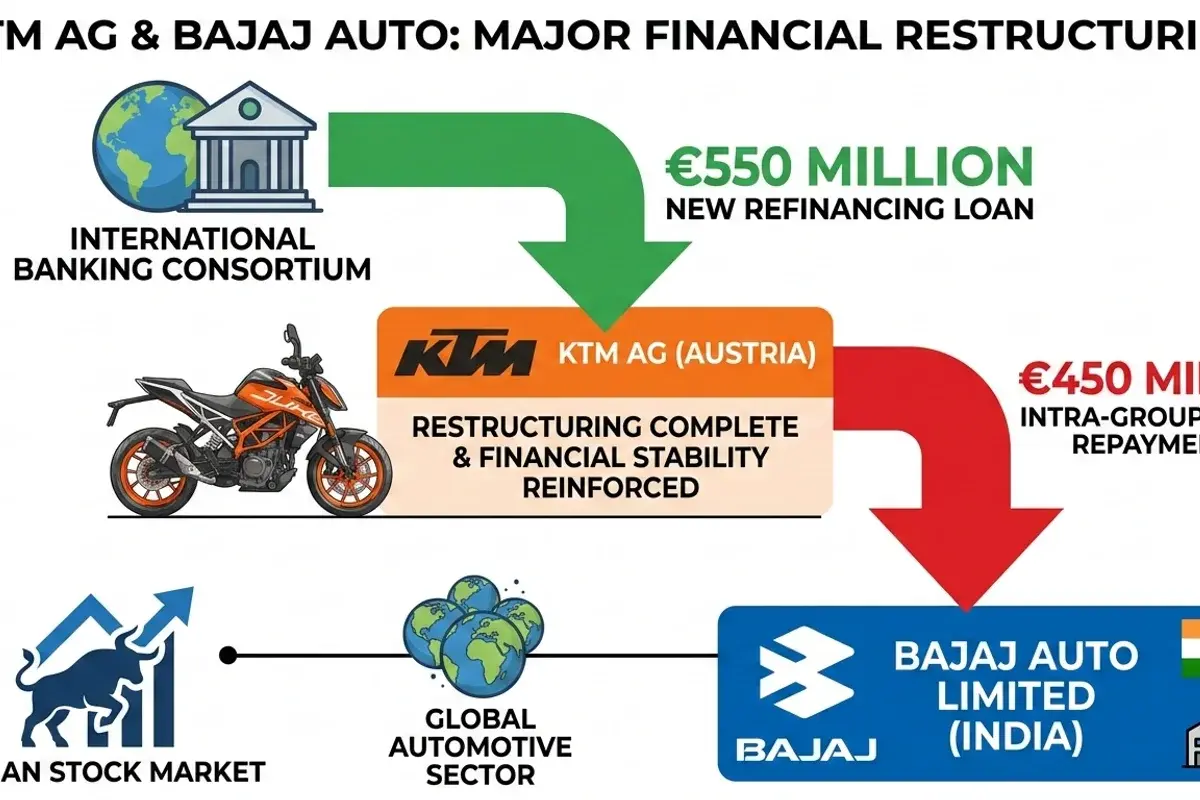
KTM AG repays €450M loan to Bajaj Auto's unit, completing restructuring. FinScann analyzes the financial impact on Bajaj Auto, Pierer Mobility, and...

Tata Elxsi launches DevStudio.ai, an ASPICE-aligned GenAI platform, poised to accelerate automotive software engineering and enhance productivity for...

Waaree Energies bags a significant 300 MW wind power project in Gujarat, marking a strategic expansion and contributing to India's ambitious...

“ABCL is entering a structurally stronger earnings phase, supported by synchronized momentum across lending, AMC, and insurance.

BSE shares surge over 4% after SEBI's critical nod for Sensex Next 30 index derivatives, bolstering its market position and revenue potential.