Loading market data...
ONGC’s renewed oil drilling in Bihar after 50 years and its reported deepwater rig expansion. Explore financial impact, dividend outlook, capex risks, crude price sensitivity, and long-term investment implications for Indian energy stocks.
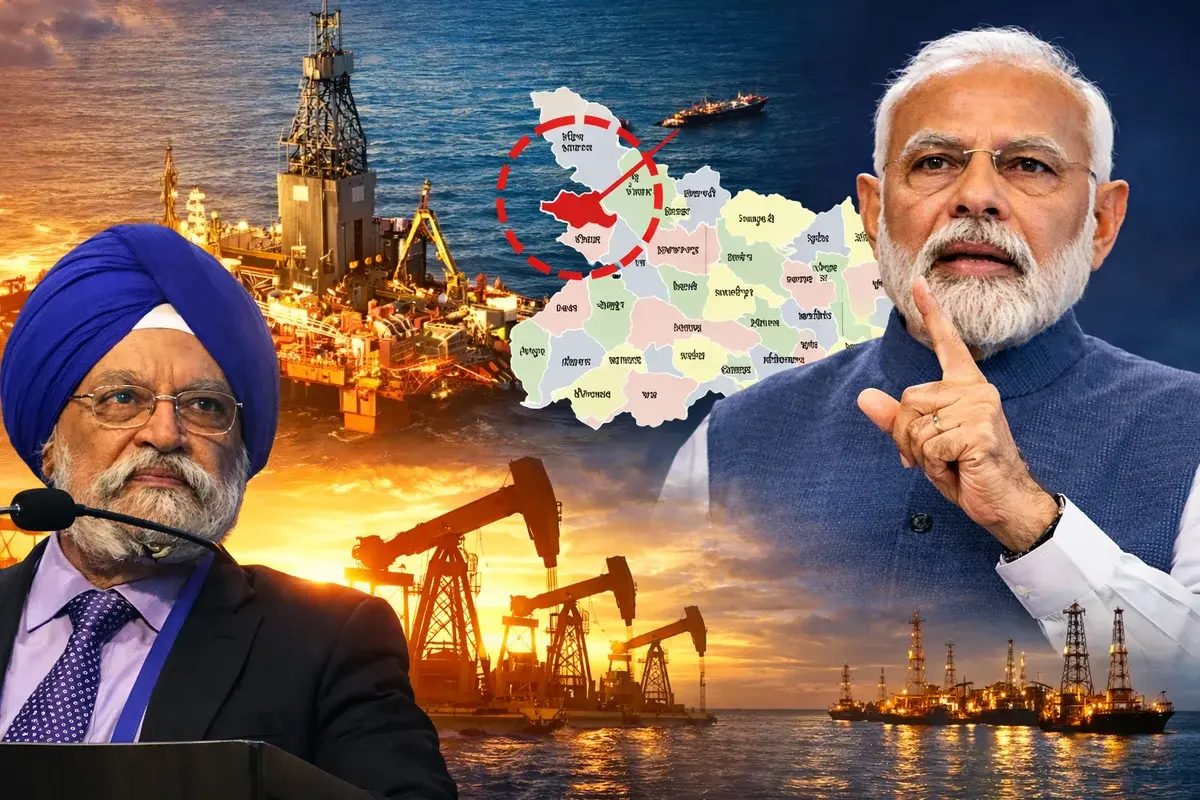
After nearly five decades, Oil and Natural Gas Corporation (ONGC) has reportedly restarted drilling operations in Bihar while simultaneously ordering five specialised deepwater rigs — potentially among the largest offshore expansion efforts in South Asia. If executed at scale, this dual onshore–offshore strategy could materially reshape India’s upstream production outlook, import dependency trajectory, and long-term energy security calculus.
India’s energy equation is under structural pressure. Crude oil imports account for over 85 percent of domestic consumption, exposing the economy to geopolitical shocks, freight volatility, and currency risks. At the same time, global oil markets remain sensitive to Middle East instability, OPEC+ supply discipline, and demand shifts from China and the United States.
Against this backdrop, renewed exploration in Bihar and a parallel push toward deepwater rig expansion by ONGC signals a multi-pronged upstream acceleration strategy. The timing is critical. Brent crude volatility, India’s current account sensitivities, and rising industrial energy demand make domestic production expansion strategically important.
If the reported developments materialize fully, they represent both a symbolic and operational milestone.
| Metric | Details |
|---|---|
| Founded | 1956 |
| Sector | Upstream Oil & Gas Exploration & Production |
| Ownership | Government of India (Majority PSU) |
| Core Operations | Onshore & Offshore Hydrocarbon Exploration |
| Market Cap (Approx.) | Large-cap PSU |
| Revenue Model | Crude oil & natural gas production |
| Strategic Assets | Mumbai High, KG Basin, Offshore Deepwater Fields |
| Competitive Edge | Scale, PSU backing, offshore expertise |
ONGC remains India’s largest upstream energy producer and a central pillar of national energy security strategy.
ONGC previously conducted exploratory activities in parts of Bihar decades ago, but commercial viability was limited at the time due to technological constraints and uncertain reserves.
The renewed focus suggests:
If the Gopalganj region or adjacent blocks demonstrate viable hydrocarbon reserves, Bihar could emerge as a new onshore energy cluster. While expectations should remain calibrated — early-stage drilling does not guarantee commercial discovery — even moderate success would diversify India’s upstream geography.
From a macroeconomic lens, incremental domestic barrels reduce import dependency and support the rupee during oil price spikes.
The reported order of five specialised deepwater oil rigs is arguably more impactful than the Bihar exploration news.
Deepwater projects require:
Yet they also offer:
ONGC’s offshore portfolio, including Mumbai High and KG Basin assets, has historically been the backbone of India’s domestic production. Expanding deepwater capability signals a long-horizon production strategy.
ONGC’s financial performance typically tracks global crude price cycles.
| Financial Indicator | Strategic Insight |
|---|---|
| EBITDA Margins | Highly sensitive to Brent crude |
| Net Profit Margins | Volatile but strong in high-price cycles |
| Dividend Yield | Often attractive among PSU dividend stocks |
| Capex Allocation | Elevated in expansion cycles |
| Debt Profile | Manageable relative to asset base |
| Free Cash Flow | Dependent on crude realizations |
As a blue-chip PSU dividend stock, ONGC has historically attracted income-oriented investors seeking high dividend yield exposure. However, heavy capex for deepwater expansion could temporarily compress free cash flow before production ramps up.
Capital discipline will be critical to prevent yield compression from overexpansion.
Upstream exploration remains capital intensive but strategically indispensable. ONGC’s government backing provides resilience during commodity downturns.
Private upstream participation in India remains limited compared to global peers. ONGC retains scale advantage, regulatory familiarity, and infrastructure depth.
Deepwater expansion enhances production scalability but requires:
Offshore investments must deliver internal rates of return above cost of capital. Historically, deepwater economics become compelling when Brent sustains above certain price thresholds.
Hydrocarbon licensing reforms and production-linked incentives have improved investor confidence. However, environmental clearances and land acquisition challenges remain execution risks.
• Rising domestic energy demand • Policy push for reduced import dependency • Improved offshore extraction technology • Favorable crude pricing cycles • Exploration reforms under Hydrocarbon Exploration Licensing Policy • Infrastructure expansion in eastern India
If successful, Bihar drilling could unlock a new regional hydrocarbon narrative.
• Exploration failure risk in Bihar • Deepwater project cost overruns • Crude price volatility • Environmental regulatory hurdles • Capital misallocation concerns • Global demand slowdown impacting realizations
Energy remains cyclical, and execution discipline determines long-term value creation.
| Segment | Current Momentum | Outlook | Capital Flow Sentiment |
|---|---|---|---|
| Indian Upstream Oil | Moderate | Stable | Selective |
| Offshore Deepwater | Increasing | Positive | Strategic |
| PSU Energy Stocks | Stable | Income-Oriented | Defensive |
| Global Oil Markets | Volatile | Uncertain | Cautious |
Capital markets currently favor dividend stocks and defensive energy plays amid global uncertainty.
Long-term investors should monitor:
Short-term traders may react to exploration updates, crude price movement, and policy signals.
Valuation comfort depends on sustained crude realizations and disciplined capital allocation. If ONGC balances expansion with dividend continuity, it may retain appeal among passive income stock investors.
Investors tracking ONGC and other Indian energy stocks can access equities through Zerodha, Groww, Upstox, and Angel One.
Q: Is drilling in Bihar guaranteed to yield oil? No. Exploration success depends on geological viability and commercial recoverability.
Q: Why is deepwater expansion important? Deepwater fields typically offer larger reserve potential and long-term production stability.
Q: Could this reduce India’s oil imports significantly? Meaningful impact would depend on reserve scale and production timelines.
Q: Will dividends be affected by capex? Large capital investments could impact free cash flow in the short term, but long-term production growth may support dividend sustainability.
ONGC’s reported return to Bihar after nearly 50 years, combined with ambitious deepwater rig expansion, signals renewed upstream momentum. Whether this marks a structural production revival or remains a symbolic gesture depends on geological success and capital discipline.
For India, the stakes are strategic. For investors, the calculus revolves around execution, crude pricing, and dividend continuity.
⚠️ DISCLAIMER: We Are Not Financial Advisors

Financial journalist specializing in market analysis, stock research, and investment trends. Dedicated to providing accurate, timely insights for informed decision-making.
Credentials: Experienced financial journalist with expertise in equity markets and economic analysis
The information provided in this article is for educational and informational purposes only and should not be construed as financial, investment, or legal advice. Finscann does not provide personalized investment recommendations.
For detailed terms and conditions, please read our Disclaimer and Terms of Service.

FinScann analyzes Zinema Media & Entertainment's ₹14.80 crore preferential issue at ₹10 per share and its strategic acquisition of Beontyme...

Anlon Technology Solutions secures a major ₹281.9 Million contract. FinScann analyzes the financial impact, market implications, and future outlook...

Paras Defence shares surged 13% as West Asia tensions escalate, coinciding with its bold entry into advanced semiconductor packaging (OSAT) for AI...

Discover how a single Japanese-backed company built a 60% dominance in India’s automotive OEM paint industry.
FinScann analyzes Indian defence stocks like BEL, BDL surging on geopolitical tensions. Plus, Citi's cautious outlook on IT giants Infosys and HCL...