Loading market data...
Gold and silver remain two of the most important precious metals for investors in India and worldwide. While gold is considered a stable safe-haven asset, silver offers higher growth potential due to strong industrial demand and market volatility.
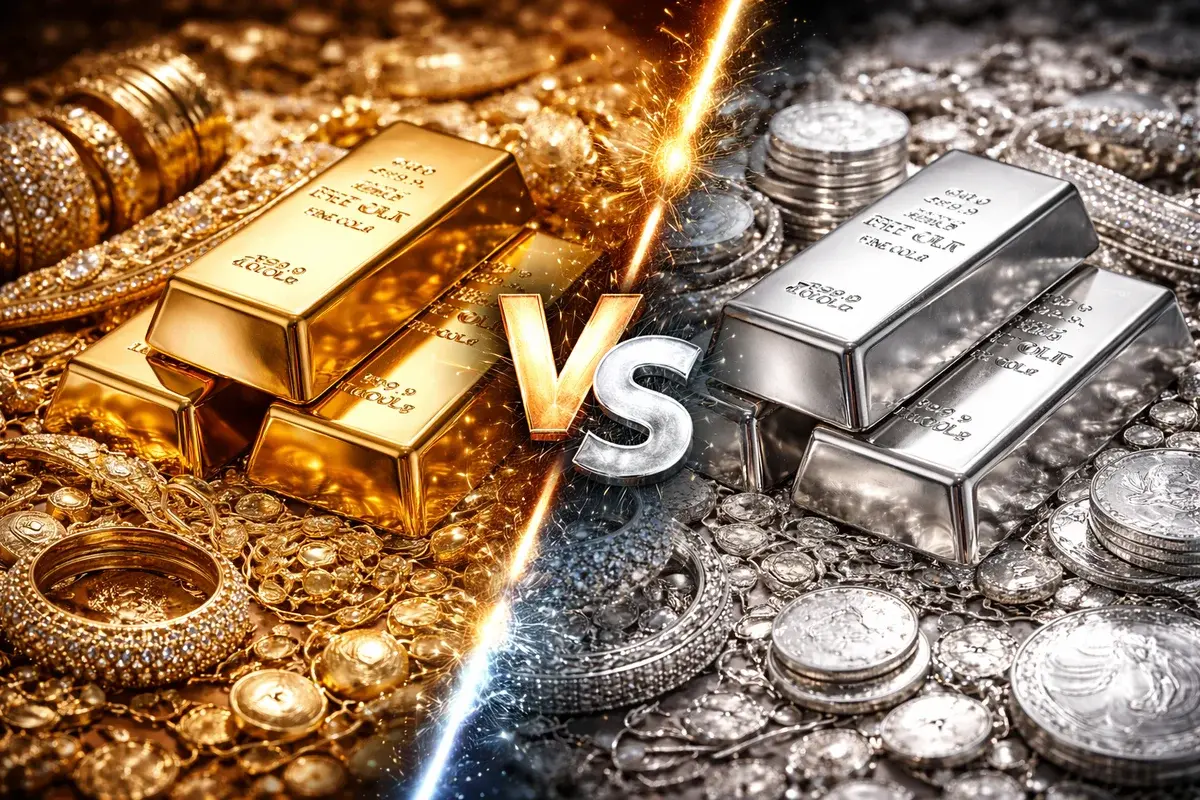
Gold and silver have been used as stores of value for thousands of years, but in modern financial markets the two metals behave very differently. Investors often compare them when deciding how to diversify their portfolios, especially during periods of inflation, geopolitical tension, or financial market volatility.
In India, both metals are widely purchased for jewellery, investment, and cultural purposes. However, their price drivers and market dynamics differ significantly. Gold is primarily influenced by investment demand and global monetary policies, whereas silver prices are strongly linked to industrial demand from sectors such as electronics, renewable energy, and manufacturing.
Understanding the differences between gold and silver can help investors make better decisions regarding portfolio diversification, risk management, and long-term wealth preservation.
The price difference between gold and silver is significant due to their scarcity, demand patterns, and market perception.
| Metal | Approx Price (India) | Unit |
|---|---|---|
| Gold (24K) | ₹1.6 lakh | 10 grams |
| Silver | ₹2.8–₹3 lakh | 1 kilogram |
Gold is far more valuable per gram due to its rarity and higher demand as a financial asset.
Recent market volatility has pushed both metals to elevated levels as investors increasingly move toward safe-haven assets during periods of economic uncertainty.
| Factor | Gold | Silver |
|---|---|---|
| Market Role | Safe-haven asset | Industrial + investment metal |
| Price Volatility | Relatively stable | Highly volatile |
| Industrial Use | Limited | Extensive |
| Storage | Easy due to high value density | Bulkier and harder to store |
| Investment Stability | Strong long-term hedge | Higher growth potential but riskier |
Gold is typically viewed as a store of value, while silver acts as both a precious metal and industrial commodity.
Gold prices are influenced by macroeconomic factors and investor sentiment. Major drivers include:
During periods of crisis or geopolitical tensions, investors often move into gold as a safe-haven asset.
Silver has a more diversified demand base. Apart from jewellery and investment demand, it is heavily used in industry.
Major industrial uses include:
Because of these industrial applications, silver prices often rise during periods of economic growth and technological expansion.
Silver has historically been more volatile than gold and often delivers stronger percentage gains during commodity bull markets.
For example:
However, the higher volatility means silver can also experience sharper price declines.
One of the most widely used indicators in precious metals markets is the Gold–Silver Ratio (GSR).
The ratio measures how many ounces of silver are required to buy one ounce of gold.
| Gold Price | Silver Price | Gold-Silver Ratio |
|---|---|---|
| High gold price | Lower silver price | High ratio |
| Rising silver demand | Higher silver price | Lower ratio |
Historically:
Investors often use this ratio to decide whether to increase exposure to gold or silver.
Gold is widely regarded as a financial safe-haven asset.
Compared with silver, gold prices tend to fluctuate less dramatically.
Gold is easier to buy, sell, and store due to its high value per unit.
Many central banks hold gold reserves, reinforcing its role as a global monetary asset.
Silver can deliver larger percentage gains during bull markets.
Growing industries such as renewable energy and electronics drive strong demand.
Silver is more affordable for retail investors.
Global silver markets have periodically experienced supply shortages, which can support higher prices.
| Risk | Gold | Silver |
|---|---|---|
| Economic cycles | Less sensitive | Highly sensitive |
| Industrial demand | Low impact | High impact |
| Price volatility | Lower | Higher |
| Market speculation | Moderate | High |
Silver’s dependence on industrial demand makes it more sensitive to economic cycles.
Financial advisors often recommend holding both metals as part of a diversified portfolio.
Typical allocation strategies include:
Experts generally suggest allocating 8–10% of a portfolio to precious metals overall.
The outlook for both metals remains positive due to rising global uncertainty and strong investment demand.
Gold is expected to continue acting as a hedge against inflation and geopolitical instability.
Silver may experience stronger growth in the coming years due to expanding industrial demand in sectors such as renewable energy, electric vehicles, and advanced electronics.
However, silver is also likely to remain more volatile than gold.
Gold and silver both play important roles in investment portfolios, but they serve different purposes. Gold offers stability, wealth preservation, and protection against economic crises, making it a preferred safe-haven asset. Silver, on the other hand, provides greater growth potential due to its dual role as a precious metal and industrial commodity.
For long-term investors seeking stability, gold remains the dominant choice. For those willing to accept higher volatility in exchange for potentially higher returns, silver can be an attractive addition to a diversified portfolio.

Financial journalist specializing in market analysis, stock research, and investment trends. Dedicated to providing accurate, timely insights for informed decision-making.
Credentials: Experienced financial journalist with expertise in equity markets and economic analysis
The information provided in this article is for educational and informational purposes only and should not be construed as financial, investment, or legal advice. Finscann does not provide personalized investment recommendations.
For detailed terms and conditions, please read our Disclaimer and Terms of Service.
No related topics available
RailTel Corporation secures a ₹27 crore optical fiber cable (OFC) project from South East Central Railway, enhancing its telecom infrastructure...

RITES Ltd has secured a significant project management contract worth ₹45.19 crore from the Government of West Bengal.

Bajaj Auto Credit Limited achieves [ICRA]AAA (Stable) rating for ₹7,750 crore facilities, signaling robust financial health and lowest credit risk.

Chambal Fertilisers faces a ₹1.35 Cr income tax penalty for AY 2020-21 over education cess. FinScann analyzes the impact on CFCL stock & financials.

HG Infra Engineering has marked a significant milestone, with its wholly-owned subsidiary, H.G.