Loading market data...
The Adani Group is launching a strategic $2 billion yen-denominated debt issuance to tap into Japan’s deep liquidity and long-term investor base. Bolstered by landmark ratings from the Japan Credit Rating Agency (JCR)—including an 'A-' for Adani Ports that surpasses India's sovereign ceiling—the group aims to secure 20 to 30-year funding for its infrastructure portfolio. This move is designed to reduce dollar dependence and increase Japanese debt exposure to 10% by 2030, fueling a $100 billion capex plan.
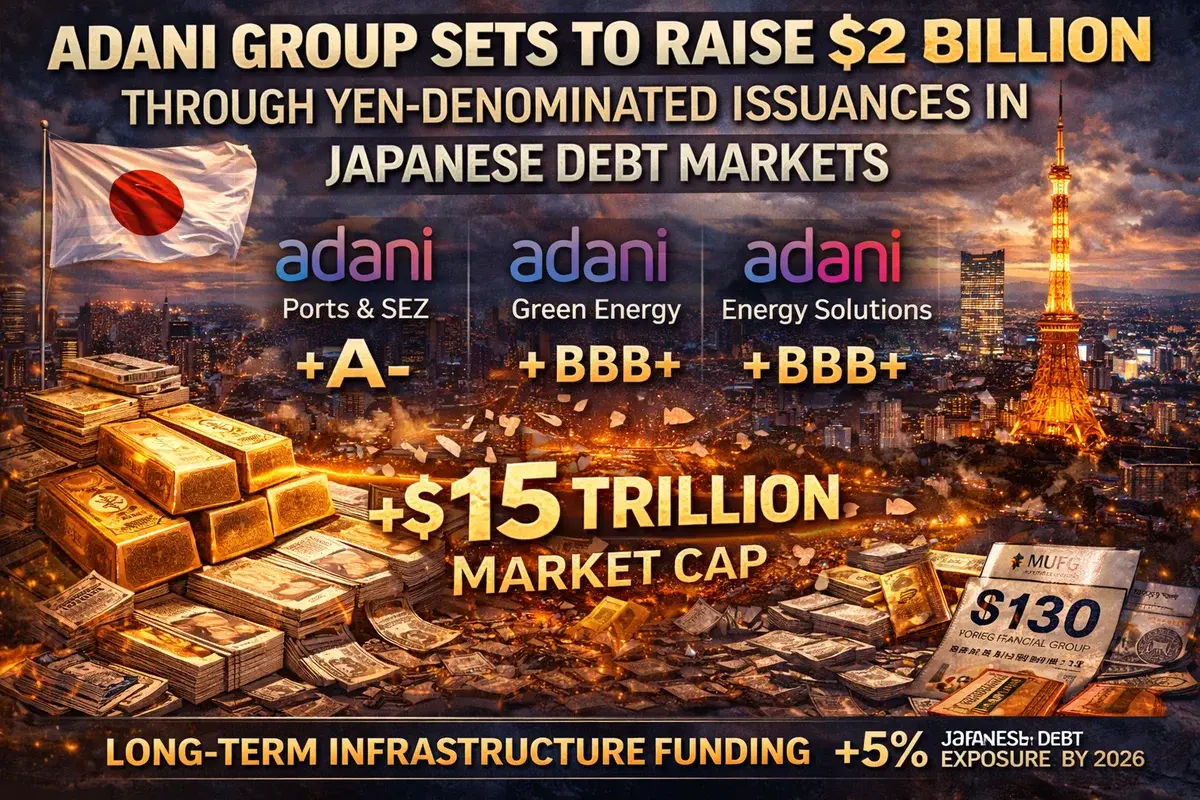
In a strategic pivot toward one of the world's deepest pools of capital, the Adani Group is preparing a massive $2 billion foray into the Japanese debt markets. This yen-denominated fundraising push marks a critical milestone in the group’s "Global Credit Journey," aimed at securing long-tenor financing that aligns with the multi-decade lifecycle of its infrastructure projects.
By shifting focus toward Japan, the conglomerate is not just seeking capital; it is actively de-risking its balance sheet from US dollar volatility and building a long-term bridge to institutional Asian investors.
1. The Debt Blueprint: 30-Year Tenures
The fundraising will be spearheaded by three pillars of the Adani portfolio: Adani Ports (APSEZ), Adani Green Energy (AGEL), and Adani Energy Solutions (AESL).
2. Landmark Ratings: Surpassing the Sovereign
Crucial to this market entry is the recent assessment by the Japan Credit Rating Agency (JCR), which has provided a massive boost to investor sentiment:
3. Deepening Japanese Ties
Adani is no stranger to Japan’s financial giants. The group already maintains strong credit lines with MUFG, Sumitomo Mitsui Financial Group (SMFG), and Mizuho. This new issuance will evolve those relationships from bilateral banking loans into broad-based institutional debt.
4. Strategic Context: The $100 Billion Capex Plan
This fundraising is the engine behind Adani’s ambitious $100 billion capital expenditure program slated through 2030.
The FinScann Verdict
Adani’s "Go East" strategy is a masterclass in financial diversification. By securing 30-year yen funding, the group is matching its long-term assets with long-term liabilities, effectively "locking in" growth at a sustainable cost. While the US markets remain volatile, Japan offers the stability and duration that India’s infrastructure build-out desperately needs.

Financial journalist specializing in market analysis, stock research, and investment trends. Dedicated to providing accurate, timely insights for informed decision-making.
Credentials: Experienced financial journalist with expertise in equity markets and economic analysis
The information provided in this article is for educational and informational purposes only and should not be construed as financial, investment, or legal advice. Finscann does not provide personalized investment recommendations.
For detailed terms and conditions, please read our Disclaimer and Terms of Service.
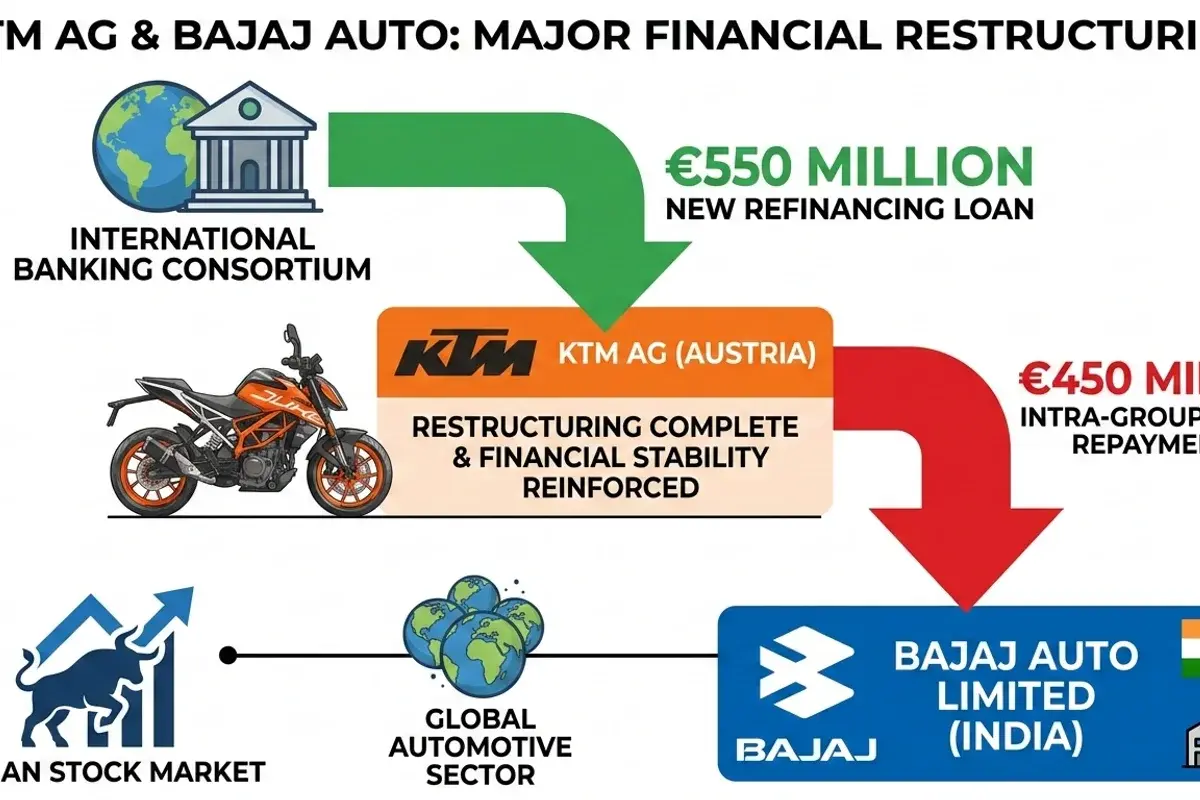
KTM AG repays €450M loan to Bajaj Auto's unit, completing restructuring. FinScann analyzes the financial impact on Bajaj Auto, Pierer Mobility, and...

Tata Elxsi launches DevStudio.ai, an ASPICE-aligned GenAI platform, poised to accelerate automotive software engineering and enhance productivity for...

Waaree Energies bags a significant 300 MW wind power project in Gujarat, marking a strategic expansion and contributing to India's ambitious...

“ABCL is entering a structurally stronger earnings phase, supported by synchronized momentum across lending, AMC, and insurance.

BSE shares surge over 4% after SEBI's critical nod for Sensex Next 30 index derivatives, bolstering its market position and revenue potential.