Loading market data...
Swiggy shuts down its 15-minute food delivery app Snacc as it shifts focus to core growth and capital discipline. Here’s what it means for quick commerce.
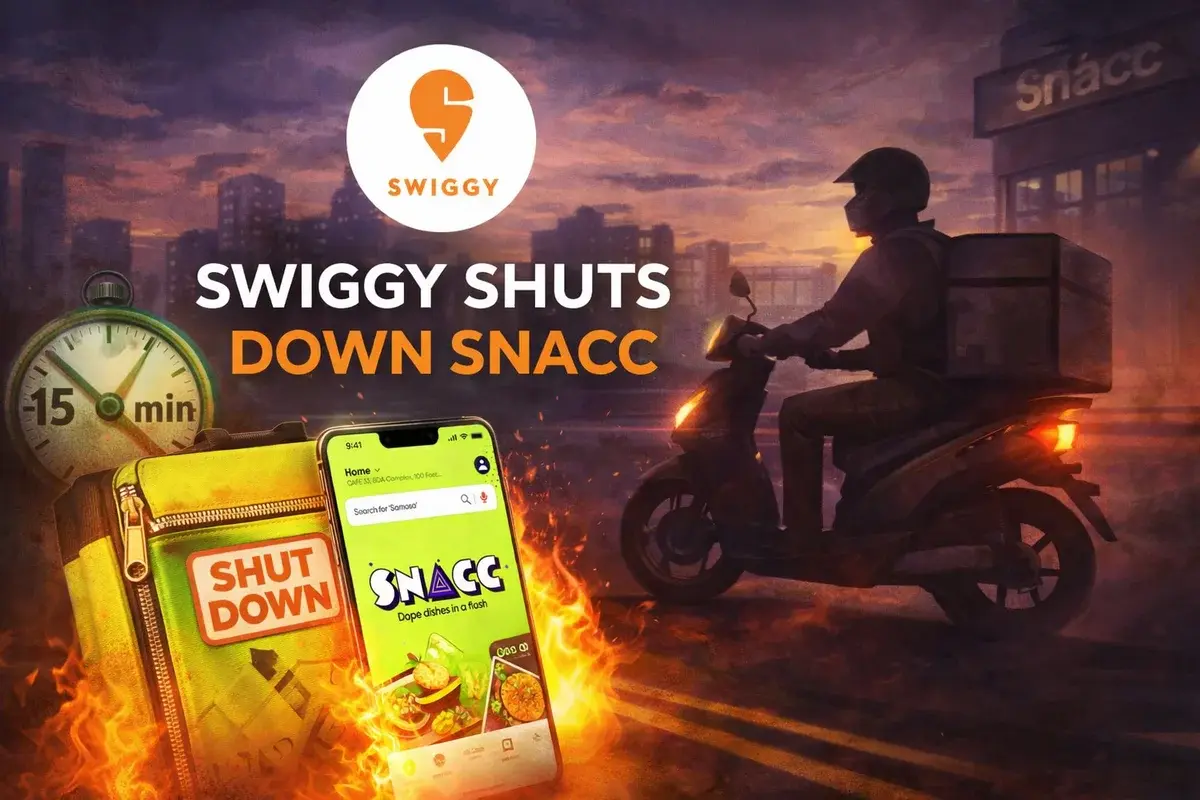
Swiggy has discontinued Snacc, its standalone 10–15 minute food delivery app, less than a year after its launch. The decision marks a strategic recalibration as the company sharpens its focus on scalable growth and disciplined capital allocation within its core food delivery operations.
Launched in January 2025, Snacc was designed as an ultra-fast delivery platform offering snacks, beverages, and ready-to-eat items through centrally stocked hubs. Positioned as a separate experiment from Swiggy’s main marketplace, the app aimed to capture the growing demand for instant gratification in urban markets.
However, despite early expansion into select areas including Bengaluru, Gurugram, and Noida, the service did not scale nationally. Its limited geographic presence and operational complexity appear to have constrained its long-term viability.
** Core Business Remains Strong**
While the ultra-fast experiment has been shelved, Swiggy’s primary food delivery business continues to perform strongly. The company has reported approximately 20.5% year-on-year growth in its food delivery segment, driven by:
This suggests that mainstream food delivery demand remains resilient, even as ultra-fast models face sustainability challenges.
** The Economics of 15-Minute Food Delivery**
The shutdown of Snacc reflects broader structural pressures in the 10–15 minute delivery segment. Unlike grocery quick commerce — where basket sizes can justify logistics costs — ultra-fast food delivery presents tighter margins due to:
Building dedicated hubs for rapid dispatch requires substantial capital expenditure, and scaling such infrastructure across cities can dilute profitability if demand density remains uneven.
The economics demand extremely high order density within micro-clusters — something only achievable in select high-demand urban pockets.
** Industry-Wide Pullback**
Swiggy’s move is not isolated. Over the past year, several companies experimenting with ultra-fast food delivery have recalibrated or paused similar services.
Some platforms discontinued their 15-minute offerings shortly after launch, while others restructured or scaled back their quick-service arms due to subdued demand in certain markets. Even large consumer technology players have reassessed rapid delivery verticals amid cost pressures and investor focus on profitability.
However, investor appetite for fast-delivery innovation has not vanished entirely. Emerging startups in the space are still exploring funding opportunities, indicating that the model may evolve rather than disappear.
** Capital Discipline Over Expansion**
Swiggy’s decision highlights a larger trend within India’s startup ecosystem: prioritizing sustainable growth over aggressive experimentation.
After years of expansion-led strategies, companies are now emphasizing:
By consolidating efforts into its main food delivery and quick commerce verticals, Swiggy appears to be optimizing resource allocation toward segments with proven scalability.
** What This Means for the Market**
The ultra-fast delivery concept may not be entirely unviable, but it likely requires:
For now, the broader takeaway is clear: speed alone cannot substitute sustainable unit economics.
Swiggy’s 20%+ growth in its core business demonstrates that conventional food delivery still has strong headroom for expansion. The company’s recalibration reflects maturity in capital allocation rather than weakness in demand.
** Looking Ahead**
As India’s digital consumption ecosystem evolves, food delivery platforms are entering a more disciplined phase — balancing innovation with profitability.
Ultra-fast experiments like Snacc serve as important learning curves. While the 10–15 minute promise may have generated excitement, long-term success in food delivery continues to depend on scale efficiency, customer retention, and operational leverage.
Swiggy’s move signals a pivot toward sustainable growth — a theme likely to define the next phase of India’s consumer internet sector.

Financial journalist specializing in market analysis, stock research, and investment trends. Dedicated to providing accurate, timely insights for informed decision-making.
Credentials: Experienced financial journalist with expertise in equity markets and economic analysis
The information provided in this article is for educational and informational purposes only and should not be construed as financial, investment, or legal advice. Finscann does not provide personalized investment recommendations.
For detailed terms and conditions, please read our Disclaimer and Terms of Service.

Deep analysis of Northern Arc Capital. Motilal Oswal projects 75% upside for this NBFC due to its strong business mix and attractive valuation.

Indian stock markets rebound sharply as Nifty surges past 25,600 and Nifty Bank climbs above 61,200, led by strong gains in IT and banking stocks.

Apple's gearing up for a significant shift in its laptop lineup with the anticipated launch of its first touch-enabled MacBook Pro series, expected...

RBI’s February 2026 draft norms impose 100% refund liability, ban kickbacks, and tighten suitability rules to curb ULIP mis-selling.

Discover why Indian markets are surging, with Sensex gaining 500 points, even as the IT sector faces headwinds.