Loading market data...
Aparna Enterprises invests ₹150 crore in a new Morbi tile manufacturing plant, boosting Vitero Tiles’ total capacity to 18 MSM. Explore financial metrics, industry growth outlook, revenue potential, and strategic market impact analysis.
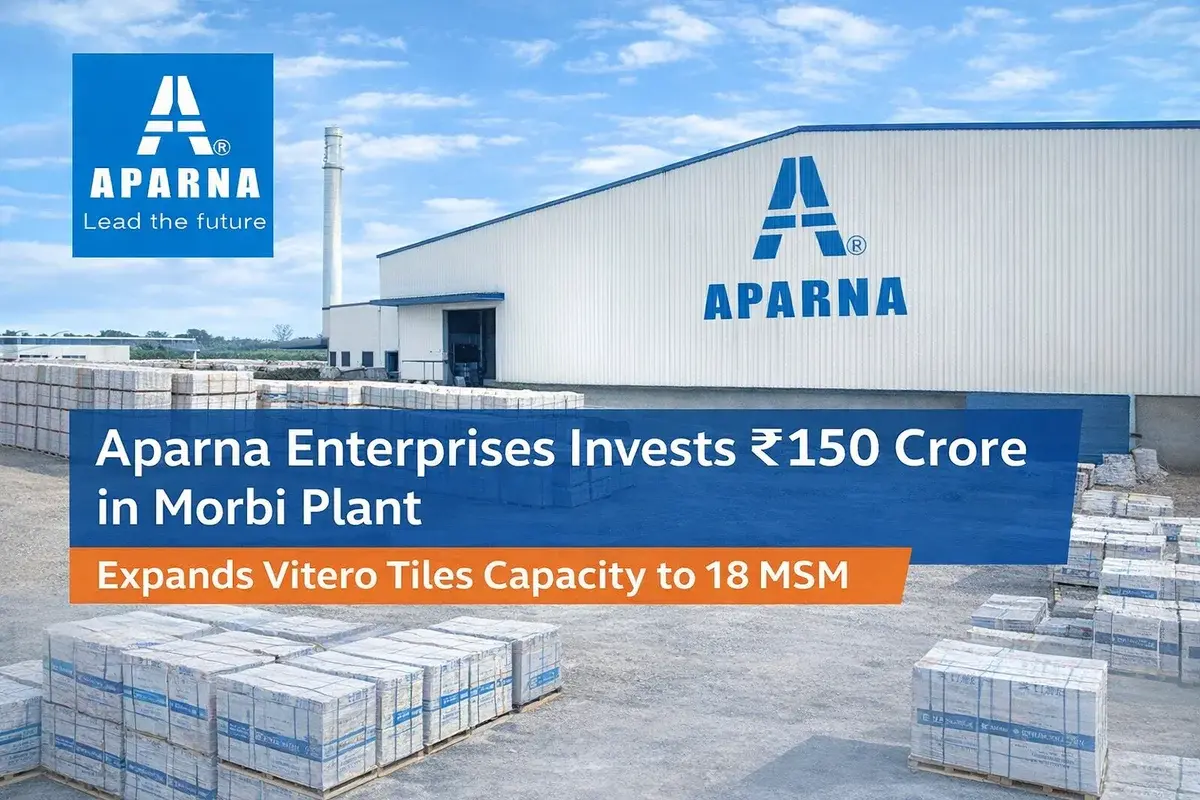
Aparna Enterprises Ltd has inaugurated a state-of-the-art tile manufacturing facility in Morbi, Gujarat, committing ₹150 crore to significantly expand the footprint of its premium brand Vitero Tiles.
The new facility contributes nearly 40% of total production capacity, lifting the company’s installed capacity to approximately 18 million square meters (MSM) annually. The expansion strengthens Aparna’s presence in high-growth regions and positions the company among India’s leading integrated tile manufacturers.
This investment comes at a pivotal time, as India’s construction and infrastructure sectors continue to demonstrate structural growth.
Morbi is widely regarded as the “Tile Capital of India,” accounting for nearly 70–75% of the country’s ceramic tile production. Establishing a facility in this region provides significant structural advantages.
| Factor | Strategic Benefit |
|---|---|
| Proximity to Mundra & Kandla Ports | Lower export logistics cost |
| Raw Material Access | Reduced input cost volatility |
| Established Industrial Ecosystem | Supply chain efficiency |
| PNG Infrastructure | Energy-efficient production |
The Morbi facility operates on Piped Natural Gas (PNG), supporting energy efficiency and enhancing cost predictability—an important margin stabilizer in tile manufacturing.
| Facility | Location | Annual Capacity (MSM) | Contribution |
|---|---|---|---|
| Existing Plant | Kakinada, Andhra Pradesh | ~10.8 | ~60% |
| New Plant | Morbi, Gujarat | 7.2 | ~40% |
| Total Installed Capacity | Pan-India | 18 MSM | 100% |
This scale materially enhances Vitero Tiles’ ability to serve North and West India efficiently while strengthening its national distribution footprint.
India’s ceramic tile industry remains one of the fastest-growing segments within the broader building materials space.
| Metric | Value |
|---|---|
| Market Size (FY25) | ₹531 Billion |
| Projected Market (FY29) | ₹769 Billion |
| CAGR (FY25–FY29) | 9.7% |
| Estimated Industry Size by 2026 | ₹75,000–80,000 Crore |
| Global Production Rank | 2nd Largest |
Growth is supported by:
Although Aparna Enterprises Ltd is privately held and does not publicly disclose detailed financials, industry benchmarking allows for scenario-based modeling.
| Metric | Assumption |
|---|---|
| Average Realization per Sq. Meter | ₹450–600 |
| Annual Production Capacity | 18 MSM |
| Potential Annual Revenue Range | ₹810–1,080 Crore |
If capacity utilization remains above 80% and premium mix improves, operating leverage could enhance EBITDA margins meaningfully.
| Metric | Industry Average |
|---|---|
| Gross Margin | 28–35% |
| EBITDA Margin | 14–20% |
| Net Margin | 7–12% |
| Energy Cost as % of Revenue | 18–22% |
Energy costs represent one of the largest expense components in tile manufacturing. PNG-based operations help reduce volatility and improve margin stability.
| Player Category | Strength | Risk |
|---|---|---|
| Morbi Cluster SMEs | Low-cost manufacturing | Limited brand strength |
| Large National Brands | Strong distribution | Higher overheads |
| Aparna (Vitero) | Scale + Geographic diversification | Competitive pricing pressure |
The dual-location model (Kakinada + Morbi) reduces regional concentration risk and enhances national reach.
Scale Advantage An 18 MSM installed capacity supports economies of scale and stronger procurement leverage.
Geographic Diversification Presence in both South and West India strengthens distribution efficiency and market responsiveness.
Product Diversification Manufacturing of vitrified and full-body tiles under one roof improves operational control.
Logistics Efficiency Proximity to export ports supports international expansion potential.
Energy Efficiency PNG-powered operations reduce production volatility and enhance ESG alignment.
| Risk | Potential Impact |
|---|---|
| Intense Morbi competition | Margin compression |
| Gas price volatility | Cost pressure |
| Real estate slowdown | Demand contraction |
| Working capital expansion | Cash flow strain |
If India’s building materials segment grows at 8–12% CAGR over the next five years, Aparna Enterprises Ltd is well-positioned to scale revenue beyond ₹1,000 crore annually, subject to capacity utilization and pricing discipline.
The Morbi expansion enhances structural positioning, improves supply chain economics, and strengthens the competitive foundation of Vitero Tiles.
The ₹150 crore investment in Morbi represents a strategic capacity expansion aligned with long-term industry growth. With total installed capacity now at 18 MSM and a strengthened geographic footprint, Aparna Enterprises Ltd has positioned itself to capitalize on India’s expanding construction and infrastructure cycle.
Execution quality, margin discipline, and dealer expansion will determine the long-term return profile of this investment.

Financial journalist specializing in market analysis, stock research, and investment trends. Dedicated to providing accurate, timely insights for informed decision-making.
Credentials: Experienced financial journalist with expertise in equity markets and economic analysis
The information provided in this article is for educational and informational purposes only and should not be construed as financial, investment, or legal advice. Finscann does not provide personalized investment recommendations.
For detailed terms and conditions, please read our Disclaimer and Terms of Service.

Deep analysis of Northern Arc Capital. Motilal Oswal projects 75% upside for this NBFC due to its strong business mix and attractive valuation.

Indian stock markets rebound sharply as Nifty surges past 25,600 and Nifty Bank climbs above 61,200, led by strong gains in IT and banking stocks.

Apple's gearing up for a significant shift in its laptop lineup with the anticipated launch of its first touch-enabled MacBook Pro series, expected...

RBI’s February 2026 draft norms impose 100% refund liability, ban kickbacks, and tighten suitability rules to curb ULIP mis-selling.

Discover why Indian markets are surging, with Sensex gaining 500 points, even as the IT sector faces headwinds.