

global-news
India to Slash Car Import Tariffs to 40% in Landmark EU Trade Deal, Reports Say
40 minutes ago
Reviewed and Rewrite by
Shanaya SIngh
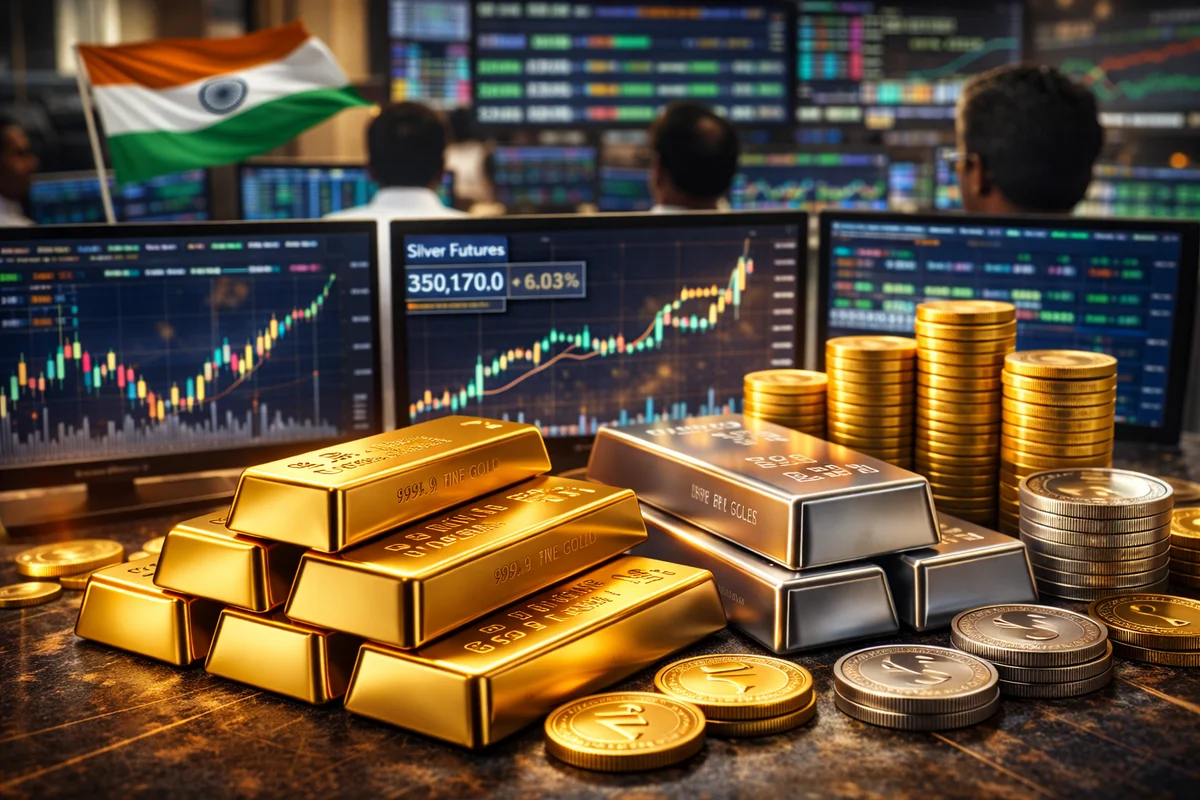

In a spectacular move that has caught the attention of investors, traders, and metals market observers, silver prices in India surged by nearly 6% to hit a fresh record high of around ₹3,54,780 per kilogram. At the same time, gold prices have also scaled new peaks, reflecting a broader rally in safe-haven assets across global markets. This surge underscores the growing investor interest in precious metals amid economic uncertainty, currency movements, and shifts in global risk sentiment.
The white metal’s rally has not only outpaced gold in recent periods but has also become one of the most dramatic price movements in commodities in recent memory. Understanding what’s driving this surge — and whether it’s sustainable — has become a key question for investors and market strategists alike.
This article explores what’s behind the record prices in silver and gold, the macroeconomic and technical drivers at play, and what lies ahead for investors in these traditional store-of-value assets.
Silver prices have climbed sharply, marking another historic peak in a long-running rally. Domestic silver prices have crossed the ₹3.5 lakh per kilogram mark, a significant milestone that reflects strong demand and tightening supply conditions.
At the same time, gold prices have continued their upward trajectory, reaching all-time highs as global investors flock to safe-haven assets amid geopolitical tensions and macroeconomic uncertainty. Both metals are now trading at levels that were considered improbable just a few years ago.
The sharp rise in silver prices is being driven by a combination of fundamental, technical, and macroeconomic forces.
Heightened geopolitical risks, policy uncertainty, and economic instability in major economies have driven investors toward traditional safe assets. Silver, like gold, benefits from this flight to safety, attracting capital that might otherwise flow into equities or riskier assets.
Unlike gold, silver has a significant industrial usage component, particularly in solar panels, electric vehicles, electronics, and emerging technologies. The rapid adoption of green energy solutions and AI-driven infrastructure has sharply boosted industrial demand, tightening the supply-demand balance.
Global silver inventories have remained under pressure as production growth has failed to keep pace with rising demand. Mining constraints, lower recycling activity, and logistical bottlenecks have contributed to a structural supply deficit, pushing prices higher.
Strong price performance has attracted momentum-based traders and institutional funds. As prices break above key resistance levels, fresh buying accelerates the rally, amplifying gains in a relatively thin market.
While both metals have rallied strongly, their underlying dynamics differ significantly.
| Feature | Silver | Gold |
|---|---|---|
| Primary Demand | Industrial + Investment | Investment + Jewellery |
| Volatility | Higher | Lower |
| Safe-Haven Role | Emerging | Established |
| Sensitivity to Economy | High (industrial demand) | Primarily macro-driven |
| Price Drivers | Supply constraints, tech demand, speculation | Inflation hedging, currency risk, central banks |
Silver’s dual role — as both an industrial metal and a store of value — makes it more volatile than gold. Over time, this volatility has translated into sharper rallies and deeper corrections.
From a technical perspective, silver has broken through multiple long-term resistance zones, triggering strong trend-following buying. Momentum indicators have entered overbought territory, highlighting both strong bullish momentum and the risk of near-term pullbacks.
Key technical signals being monitored include:
• Breakouts above historical resistance levels • Sustained volume expansion • Higher highs and higher lows on long-term charts
While momentum remains strong, analysts caution that parabolic moves are often followed by periods of consolidation or sharp corrections.
Gold continues to act as the anchor of the precious metals complex. Its rally has been supported by:
• Persistent geopolitical uncertainty • Expectations of monetary easing over the medium term • Currency volatility • Central bank accumulation of gold reserves
Gold’s traditional role as a hedge against inflation, currency debasement, and financial instability remains intact, especially as global policy clarity remains elusive.
The historic surge in silver and gold prices presents both opportunity and risk.
• Continued geopolitical and macro uncertainty • Strong industrial demand for silver • Tight supply conditions • Positive technical momentum • Safe-haven flows during equity volatility
• Profit-taking after steep rallies • Overbought technical conditions • Strong economic data reducing safe-haven appeal • Sudden shifts in monetary policy expectations • Increased supply from mining or recycling
Investors must remain aware that sharp rallies often come with heightened volatility.
Market forecasts suggest that silver could still have room to move higher over the medium term, with some projections placing prices in the ₹3,80,000–₹4,60,000 per kilogram range by the end of 2026, driven by sustained demand and macro trends.
However, experts also caution that the speed of the recent rally increases the risk of intermittent corrections and sideways consolidation.
Why are silver and gold prices rising sharply now?
Due to safe-haven demand, strong industrial usage (especially for silver), supply constraints, and macroeconomic uncertainty.
Is silver a better long-term investment than gold?
Silver can deliver higher returns but carries higher volatility. Gold remains more stable.
Could prices still rise further in 2026?
Many forecasts suggest further upside, though volatility is expected.
What risks should investors watch?
Profit-booking, policy shifts, and changes in global economic data.
Should retail investors buy at these levels?
Only after assessing risk tolerance, time horizon, and portfolio diversification.
The record-breaking surge in silver prices above ₹3.5 lakh per kilogram, alongside new highs in gold, reflects a profound shift in investor behaviour. Safe-haven demand, industrial usage, supply constraints, and macro uncertainty have converged to push precious metals into uncharted territory.
For investors, this rally represents both an opportunity to hedge risk and a reminder of market volatility. Whether prices extend higher or enter a consolidation phase, precious metals are set to remain at the centre of market attention in 2026.