Loading market data...
Waaree Energies and Premier Energies shares drop up to 15% after the US sets a 126% duty on Indian solar imports. Explore financial impact, EBITDA margins, export exposure, competitive dynamics, and strategic outlook for India’s solar sector.
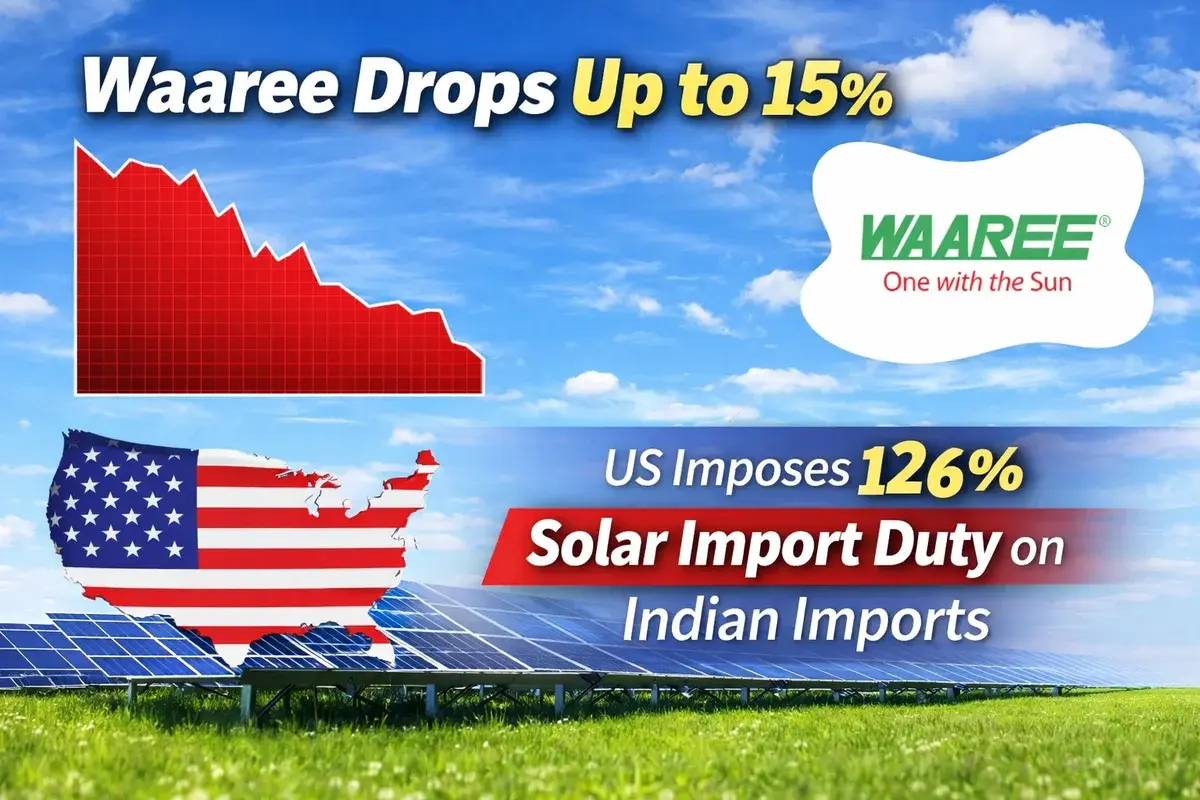
Waaree Energies Ltd. and Premier Energies Ltd. saw shares tumble up to 15% after the United States imposed an initial 126% duty on certain Indian solar imports. The move reshapes export economics, pressures EBITDA margins, and could alter competitive positioning among Indian module makers including Vikram Solar Ltd.. While near-term earnings visibility faces headwinds, strategic realignment toward US manufacturing, diversified markets, and domestic demand could determine the next phase of value creation.
Introduction: A Trade Shock in a Capital-Intensive Cycle
Global solar supply chains are once again in flux.
After years of antidumping disputes and tariff recalibrations, the US has imposed an initial 126% import duty on specified Indian solar modules. For export-heavy players, this materially alters landed-cost competitiveness in one of the world’s largest renewable energy markets.
Indian manufacturers were already navigating margin compression, global oversupply, and aggressive pricing from Chinese peers. The new tariff introduces incremental uncertainty at a time when balance sheets are leveraged for capacity expansion and vertical integration.
The market reaction was swift, with Waaree and Premier shares falling up to 15% intraday, reflecting concerns around export contraction, earnings downgrades, and potential valuation reset.
What the 126% Duty Means
The initial duty significantly raises the effective cost of Indian modules entering the US market. This could render shipments commercially unviable unless pricing structures are renegotiated, cost efficiencies are achieved, US-based production offsets import exposure, or policy exemptions emerge.
For companies that had built substantial order books around US demand, the tariff directly impacts revenue mix, order backlog execution, and net profit margins.
Company Snapshot: Waaree Energies Ltd.
| Metric | Details |
|---|---|
| Founded | 1989 |
| Sector | Solar PV Modules & Renewable EPC |
| Revenue Model | Module manufacturing, EPC projects, exports |
| Market Position | Among India’s largest solar module exporters |
| Capacity | Multi-GW manufacturing footprint |
| Strategic Focus | Integrated manufacturing, global expansion |
Financial Metrics: Waaree Energies
| Metric | Approximate Position |
|---|---|
| Revenue Growth | Strong double-digit CAGR |
| EBITDA Margin | Mid-teens range |
| Net Profit Margin | High single-digit to low teens |
| Order Book | Multi-billion dollar visibility |
| Debt Profile | Expansion-linked leverage |
| Export Exposure | Significant US contribution |
Waaree’s EBITDA margin is highly sensitive to export pricing, input cost volatility in polysilicon and wafers, and currency fluctuations. Any prolonged export disruption could pressure operating leverage.
Competitive Landscape Shift
The duty affects multiple Indian manufacturers including Premier Energies Ltd. and Vikram Solar Ltd.. The cross-company implications extend beyond immediate price reaction.
Market share redistribution could favor firms with US manufacturing presence or joint venture structures. Pricing pressure may intensify if supply is redirected toward Europe, the Middle East, or domestic markets, increasing competitive intensity. Strategic partnerships with US-based players may emerge to bypass tariff exposure. Supply chain realignment could accelerate vertical integration to reduce dependence on imported cells and wafers.
Premier Energies Snapshot
| Metric | Details |
|---|---|
| Sector | Solar Cells & Modules |
| Export Exposure | High |
| Margin Profile | Sensitive to trade barriers |
| Growth Strategy | Capacity expansion and export scaling |
The sharp share decline reflects concerns about earnings recalibration, especially if US orders form a significant portion of forward revenue guidance.
Vikram Solar Competitive Position
| Metric | Details |
|---|---|
| Sector | Solar Manufacturing |
| Market Exposure | Global exports |
| Strategic Leverage | Potential global partnerships |
Companies with diversified geographic exposure may absorb shocks better, though pricing pressures may spill over into alternate export markets.
Financial Impact Assessment
In the short term, the industry faces risks of export order cancellations, margin compression, inventory build-up, working capital strain, and potential earnings downgrades. Investor sentiment may remain cautious until clarity emerges around final duty determinations.
In the medium term, strategic adjustments could include capacity relocation to US soil, formation of joint ventures, increased domestic focus, and optimization under India’s Production Linked Incentive scheme.
Domestic Offset: India’s Renewable Momentum
India’s renewable ecosystem remains structurally robust, backed by a 500 GW renewable roadmap, government-backed project pipelines, PLI incentives for solar manufacturing, and rising corporate decarbonization commitments.
If US exports slow materially, domestic absorption may partially offset lost volumes, though pricing and margin dynamics may differ from US contracts.
Industry Heatmap: Indian Solar Manufacturing
| Segment | Current Momentum | Outlook | Capital Sentiment |
|---|---|---|---|
| Solar Module Exporters | Volatile | Uncertain | Risk-Averse |
| Domestic Solar EPC | Stable | Positive | Selective |
| Integrated Manufacturers | Stronger | Structural Growth | Constructive |
| US-Linked Capacity Builders | Improving | Advantageous | Opportunistic |
Strategic Scenarios for Waaree
One potential pathway involves US manufacturing expansion to mitigate tariff exposure and secure local contracts. Another approach could involve geographic diversification toward Europe, Latin America, and Africa to reduce dependence on US demand. Vertical integration to scale domestic cell and wafer production may help reduce cost structures. Additionally, leveraging India’s project pipeline under government renewable targets could provide steady demand.
Valuation Reset or Opportunity
Solar stocks had priced in strong export demand and global decarbonization momentum. The 126% duty introduces a valuation reset driven by lower forward earnings visibility, margin recalibration, and elevated policy risk premium.
However, long-term renewable demand remains structurally intact. Companies with balance sheet strength, diversified exposure, and agile strategy could emerge stronger post-adjustment.
Institutional Perspective
“Trade barriers create temporary dislocations, but integrated players with balance sheet strength and geographic flexibility often emerge stronger,” says a Mumbai-based renewable energy analyst. “Execution speed in adapting to new trade realities will determine long-term competitiveness.”
Investor Takeaway
Short-term traders should expect heightened volatility and potential downside if earnings guidance is revised. Long-term investors should monitor capacity relocation plans, US manufacturing strategies, and export diversification metrics. Risk monitoring should focus on working capital cycles, order backlog adjustments, and margin trajectory.
Conclusion
The 126% US import duty represents a significant inflection point for Indian solar exporters.
For Waaree Energies Ltd. and peers, this is not necessarily structural collapse but a strategic reset. Companies that adapt through localization, vertical integration, and diversification will define the next phase of India’s solar manufacturing evolution.
In renewable energy markets, policy shocks test resilience. Strategic agility determines survival.

Financial journalist specializing in market analysis, stock research, and investment trends. Dedicated to providing accurate, timely insights for informed decision-making.
Credentials: Experienced financial journalist with expertise in equity markets and economic analysis
The information provided in this article is for educational and informational purposes only and should not be construed as financial, investment, or legal advice. Finscann does not provide personalized investment recommendations.
For detailed terms and conditions, please read our Disclaimer and Terms of Service.

Steel Authority of India (SAIL) shares surge to a 20-month high after Emkay Global raises target to ₹200.

Vikram Solar secures a 378.75 MW solar module order from Indian Oil NTPC Green Energy for a 600 MW Gujarat project.
NTPC and MAHAGENCO complete the acquisition of Sinnar Thermal Power’s 1,350 MW coal plant under CIRP.

Olectra Greentech shares jump 4% after securing a ₹1,800 crore order for 1,085 electric buses.

Hindustan Aeronautics Ltd. Update Hindustan Aeronautics Ltd. (HAL) shares opened higher, breaking a two-day losing streak, as CLSA maintains an...