Loading market data...
Olectra Greentech shares jump 4% after securing a ₹1,800 crore order for 1,085 electric buses. Explore detailed financial impact, EBITDA outlook, working capital risks, EV policy tailwinds, and long term valuation potential.
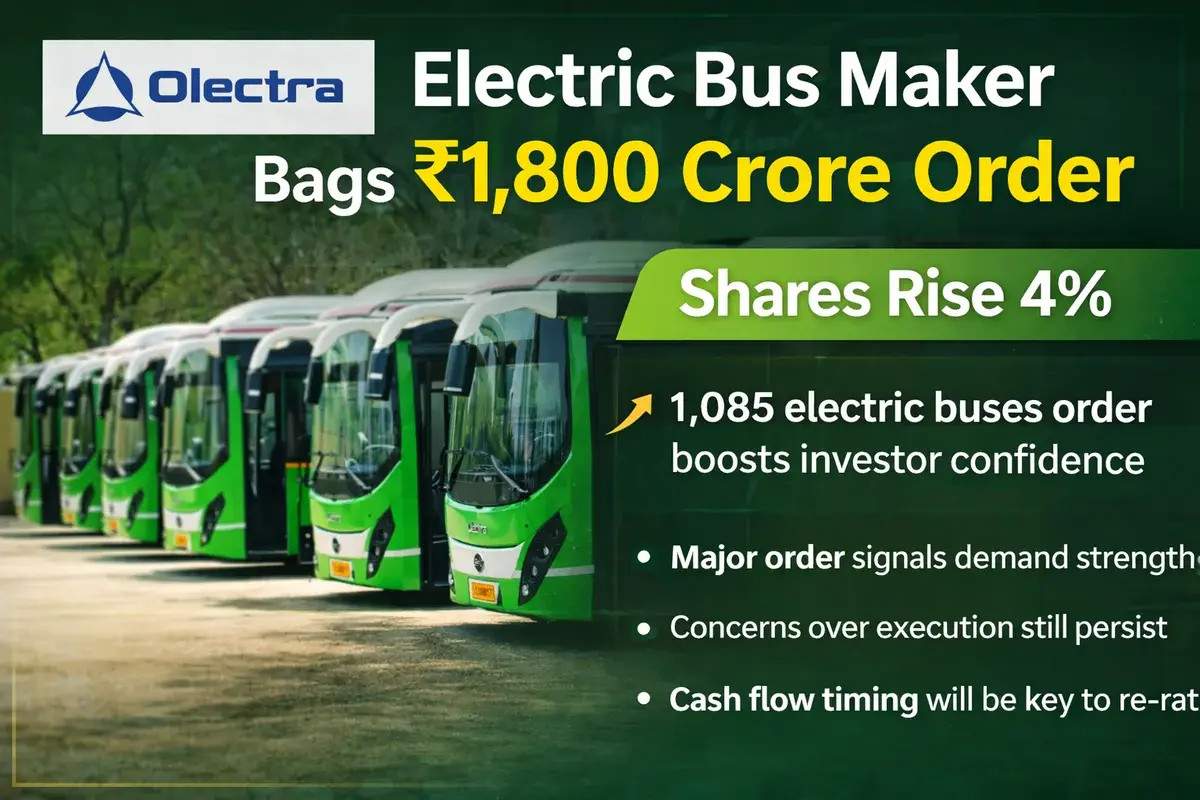
Synopsis: Shares of electric bus manufacturer Olectra Greentech Ltd. surged over 4 percent after the company announced a fresh order worth approximately ₹1,800 crore for 1,085 electric buses. The development signals strengthening order visibility, improved revenue certainty, and renewed investor confidence in India’s public EV transition. However, execution timelines, working capital cycles, margin sustainability, and cash flow conversion will determine whether this rally evolves into a structural re rating.
Market Reaction: A Relief Rally With Structural Undertones
The stock’s 4 percent rise reflects a classic infrastructure sector response. Large order inflows reduce uncertainty and improve forward revenue visibility. For capital intensive manufacturing businesses, order book expansion often acts as the first signal of earnings recovery.
Electric mobility companies have recently faced pressure from execution delays, payment cycles from state transport undertakings, battery cost volatility, and policy dependence. A confirmed ₹1,800 crore order directly addresses the demand visibility concern and improves sentiment around production utilisation and revenue continuity.
The rally suggests relief rather than speculative excess. Markets are pricing in improved near term clarity but are still waiting for confirmation through margins and cash flows.
Order Economics: Breaking Down the ₹1,800 Crore Deal
The order for 1,085 buses implies a per bus realisation in the ₹1.6 to ₹1.7 crore range. Such contracts typically span multiple quarters, meaning revenue recognition may be staggered across FY26 and FY27 depending on deployment schedules and acceptance certifications.
In electric bus manufacturing, scale matters significantly because fixed costs related to plant, tooling, battery integration, engineering, homologation and testing get absorbed more efficiently at higher production volumes and this order likely stretches across multiple quarters potentially strengthening FY27 revenue guidance depending on delivery schedule and capacity ramp up speed.
The order enhances production planning stability and improves supplier negotiation leverage which can positively impact gross margins if executed efficiently.
Company Snapshot: Olectra Greentech Ltd.
| Metric | Details |
|---|---|
| Sector | Electric Mobility and EV Buses |
| Core Business | Electric buses for public transport fleets |
| Revenue Model | Bus sales plus long term maintenance contracts |
| Key Customer Base | State transport undertakings |
| Manufacturing Base | Telangana |
| Market Position | Early mover in electric public mobility |
Olectra has positioned itself as one of India’s early entrants in electric bus deployment and has built supply capability aligned with national EV incentives and state procurement programs.
Financial Metrics: Why Order Book Expansion Matters
Electric bus manufacturers operate on a project based revenue model. Unlike passenger EV manufacturers, demand does not flow through retail channels daily but through bulk tenders that create step change revenue spikes.
A large order impacts multiple financial dimensions.
| Financial Variable | Impact of Large Order |
|---|---|
| Revenue Growth | Multi quarter visibility improves |
| EBITDA Margin | Potential operating leverage if volumes scale |
| Working Capital | Receivables rise due to STU payment cycles |
| Cash Flow Timing | Revenue booked before cash collection |
| Capacity Utilisation | Improved absorption of fixed overhead |
Higher volumes may improve EBITDA margins provided battery cell prices and raw material costs remain stable. However, government procurement cycles often delay payment, stretching working capital cycles.
India’s Public EV Push: Policy Tailwinds Remain Intact
India’s electric bus adoption is policy backed and infrastructure driven. Central and state governments continue to promote electrification under multiple initiatives.
Key structural drivers include FAME incentives, state EV mandates, urban pollution control policies, oil import reduction strategy, ESG capital flows and public transport electrification targets.
Electric buses represent a high impact decarbonisation lever because fleet electrification reduces emissions at scale. Several state transport undertakings are gradually shifting procurement preferences toward electric fleets.
The structural story remains intact even though execution varies across states.
Competitive Landscape: Where Olectra Stands
Olectra operates in a competitive but growing segment alongside Tata Motors, JBM Auto, Ashok Leyland, and PMI Electro Mobility.
Competitive positioning depends on cost competitiveness, battery sourcing efficiency, localisation levels, after sales support capability, financing tie ups and delivery timelines.
Winning large tenders enhances brand credibility and increases probability of repeat orders.
Margin Sustainability: The Critical Variable
The sustainability of this rally depends heavily on margin profile stability.
| Risk Factor | Potential Impact |
|---|---|
| Lithium price volatility | Gross margin compression |
| Imported cell dependency | Currency risk exposure |
| Subsidy delays | Cash flow pressure |
| Tender pricing rigidity | Limited ability to pass on costs |
| Execution delays | Deferred revenue recognition |
Battery costs remain the largest cost component in electric bus manufacturing. Any sustained decline in global lithium and cell prices can materially improve operating margins.
Working Capital and Cash Flow Dynamics
Infrastructure linked manufacturing businesses often face a gap between revenue recognition and cash realisation. State transport undertakings typically follow milestone based payments tied to delivery and commissioning. This creates receivable build up and increases short term funding needs.
Olectra’s ability to manage working capital discipline will be critical. Strong balance sheet liquidity reduces the risk of dilution or excessive borrowing.
Valuation Perspective: Relief or Re Rating
A 4 percent share rise signals improved near term sentiment but not necessarily a long term valuation expansion. For a sustained re rating, markets will look for order book growth continuity, EBITDA margin stability, return on capital improvement, stronger free cash flow generation, and reduced working capital volatility.
Infrastructure EV companies typically re rate only after demonstrating consistent earnings visibility across multiple quarters.
Industry Structure: Public Mobility Electrification
Electric buses sit at the intersection of clean energy transition, urban infrastructure expansion, domestic manufacturing policy and ESG investment mandates. The transition from diesel fleets to electric systems is gradual but irreversible.
Infrastructure transitions often follow a predictable sequence where orders arrive first, revenue scales later, cash flow stabilises afterward, and profitability normalises once fixed costs are absorbed at scale.
Olectra appears to be entering the second phase of this progression.
Risk Assessment
Execution remains the largest operational risk. Delays in delivery schedules can push revenue recognition into later quarters. Payment delays may stretch working capital. Competitive intensity may compress pricing. Policy changes could alter subsidy economics.
The opportunity is visible but financial outcomes will depend on operational efficiency and institutional payment timelines.
Investor Watchpoints
Short term investors should monitor quarterly revenue recognition pace, delivery execution milestones, and margin commentary. Medium term investors should track additional tender wins, capacity expansion plans, localisation progress and order backlog growth. Long term investors should evaluate return on invested capital, free cash flow generation, service revenue expansion and potential export entry.
Broader Market Context
The broader market has seen selective buying in infrastructure and capital goods names where order visibility improves. Electric mobility companies with confirmed backlog and policy support are attracting thematic capital despite broader volatility.
Olectra’s rally fits into this narrative of selective optimism within the EV infrastructure theme.
Conclusion
The ₹1,800 crore order reinforces confidence in India’s public transport electrification cycle. The 4 percent share price rise reflects improved demand visibility rather than aggressive re rating. If execution aligns with order timelines, margins stabilise and working capital remains controlled, the company could enter a stronger earnings phase.
Infrastructure transitions reward disciplined execution over headline optimism. Order size creates opportunity. Cash flow conversion creates value.

Financial journalist specializing in market analysis, stock research, and investment trends. Dedicated to providing accurate, timely insights for informed decision-making.
Credentials: Experienced financial journalist with expertise in equity markets and economic analysis
The information provided in this article is for educational and informational purposes only and should not be construed as financial, investment, or legal advice. Finscann does not provide personalized investment recommendations.
For detailed terms and conditions, please read our Disclaimer and Terms of Service.
Steel Authority of India (SAIL) shares surge to a 20-month high after Emkay Global raises target to ₹200.
Vikram Solar secures a 378.75 MW solar module order from Indian Oil NTPC Green Energy for a 600 MW Gujarat project.
NTPC and MAHAGENCO complete the acquisition of Sinnar Thermal Power’s 1,350 MW coal plant under CIRP.

Hindustan Aeronautics Ltd. Update Hindustan Aeronautics Ltd. (HAL) shares opened higher, breaking a two-day losing streak, as CLSA maintains an...
A ₹1,000-crore small-cap is transitioning from cables to advanced railway signalling under India’s Kavach rollout.