Loading market data...
Chinese scientists unveil a non-toxic water-based battery delivering 120,000+ cycles, potentially transforming grid storage and outlasting lithium-ion systems.
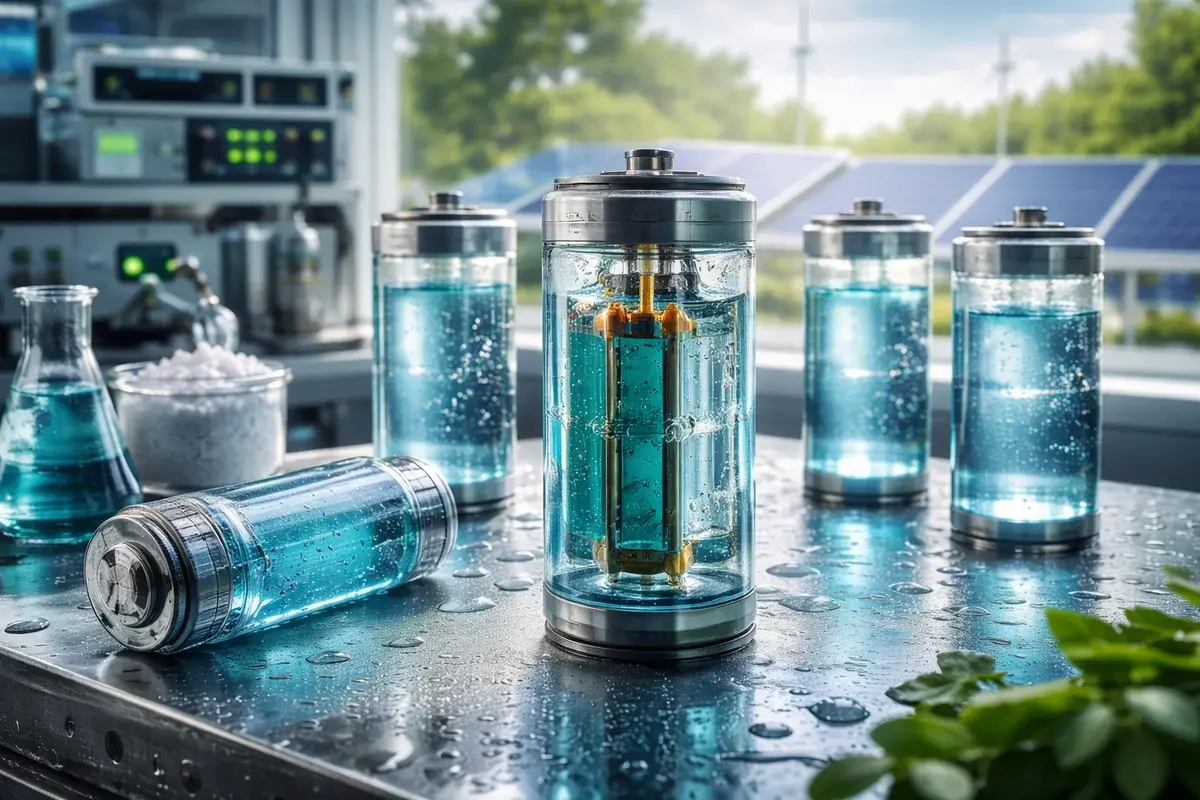
Researchers from City University of Hong Kong and Southern University of Science and Technology have unveiled a non-toxic, water-based battery capable of over 120,000 charge cycles. If scalable, the technology could dramatically outperform traditional lithium-ion systems in longevity, safety, and lifecycle economics—particularly in grid storage and renewable energy integration.
Introduction
The global energy transition is increasingly constrained not by generation capacity, but by storage durability, cost, and safety. Lithium-ion batteries, while dominant across electric vehicles and grid systems, face well-documented risks including thermal runaway, fire hazards, and lifecycle degradation.
A new breakthrough from researchers at City University of Hong Kong and Southern University of Science and Technology may signal a structural shift in energy storage architecture. The team has developed a water-based, tofu-brine-derived battery capable of delivering over 120,000 charge cycles under neutral, non-toxic conditions.
If commercialised successfully, the implications for renewable grid buffering, rural electrification, and industrial backup systems could be profound.
Technology Overview
The newly developed system is an aqueous (water-based) battery using organic electrodes and a neutral electrolyte. Unlike lithium-ion batteries, which rely on flammable organic solvents, this design operates under saltwater-like conditions.
| Feature | Water-Based Battery | Lithium-Ion Battery |
|---|---|---|
| Electrolyte Type | Neutral, water-based | Flammable organic solvent |
| Fire Risk | Minimal | High (thermal runaway risk) |
| Charge Cycles | 120,000+ | 1,000–3,000 |
| Toxicity | Low | Moderate to High |
| Disposal Complexity | Lower | Higher |
| Environmental Footprint | Reduced | Significant |
The research, published in Nature Communications, highlights long-term cycling stability under neutral pH conditions—an area where aqueous batteries historically struggled due to voltage limitations and water breakdown.
Lifecycle Comparison: A Structural Leap
Battery longevity is a critical determinant of total cost of ownership (TCO), particularly in grid-scale applications.
| Application | Typical Cycle Life (Lithium-Based) | New Water-Based Battery |
|---|---|---|
| Smartphones | ~800 cycles | 120,000+ cycles |
| EV Batteries | 1,500–3,000 cycles | 120,000+ cycles |
| LFP Grid Storage | 6,000–10,000 cycles | 120,000+ cycles |
At 120,000+ cycles, the new battery could theoretically operate for decades in grid-scale energy storage systems without significant degradation.
For renewable infrastructure operators, that changes capital expenditure modelling entirely.
Economic Implications for Energy Storage
The battery storage industry is currently dominated by lithium-ion suppliers such as CATL, BYD, and LG Energy Solution.
Lithium-ion remains attractive due to energy density and established supply chains. However, it suffers from:
| Constraint | Financial Impact |
|---|---|
| Thermal Runaway Risk | Insurance & safety costs |
| Degradation | Replacement CAPEX |
| Rare Metal Dependency | Commodity price volatility |
| Disposal Complexity | End-of-life liabilities |
A water-based battery offering significantly longer lifespan and lower safety risk could:
This is particularly attractive for solar farms, wind farms, and microgrid infrastructure.
Scalability and Commercial Viability
Despite the impressive laboratory results, scalability remains the key question.
Historically, academic battery breakthroughs often struggle with:
| Commercial Challenge | Risk |
|---|---|
| Industrial Manufacturing | Cost scaling issues |
| Energy Density Limitations | Competitive disadvantage in EVs |
| Supply Chain Integration | Infrastructure adaptation |
| Performance Outside Lab | Reliability concerns |
Energy density remains the main limitation of aqueous batteries. While ideal for stationary storage, they may not replace lithium-ion in electric vehicles where weight and compactness are critical.
However, in grid storage—where space constraints are less restrictive—the technology’s longevity may outweigh energy density trade-offs.
Strategic Applications
The most probable early adoption sectors include:
| Sector | Strategic Fit |
|---|---|
| Renewable Grid Storage | High |
| Rural Electrification | High |
| Data Center Backup Systems | Moderate to High |
| Military Installations | High |
| Consumer Electronics | Low |
The safety profile makes the system particularly attractive for urban grid storage and mission-critical backup systems.
Expert Perspective
“The economics of battery storage are increasingly driven by lifecycle durability rather than just upfront cost. If a system can reliably deliver over 100,000 cycles, it reshapes the financial modelling of grid storage infrastructure,” says an energy storage analyst based in Singapore.
Market Impact Outlook
If commercialised at scale, this technology could influence:
However, until pilot-scale validation is complete, lithium-ion incumbents are unlikely to face immediate disruption.
FAQ
Q: Is this battery likely to replace lithium-ion in EVs?
Unlikely in the near term due to lower energy density, but highly viable for grid storage.
Q: Why is 120,000 cycles significant?
It far exceeds the lifecycle of lithium-ion batteries, reducing long-term replacement costs.
Q: What is the biggest commercialization risk?
Scaling manufacturing while maintaining cost competitiveness and performance reliability.
Q: Could this reduce renewable energy costs?
Yes, by lowering storage replacement frequency and improving asset lifespan economics.
Conclusion
China’s water-based battery breakthrough may not immediately dethrone lithium-ion technology, but it introduces a compelling alternative for grid-scale storage. With over 120,000 charge cycles and minimal fire risk, the innovation addresses two of energy storage’s most persistent constraints: durability and safety.
If scalability hurdles are overcome, the technology could reshape renewable energy infrastructure economics and redefine long-term storage standards.

Financial journalist specializing in market analysis, stock research, and investment trends. Dedicated to providing accurate, timely insights for informed decision-making.
Credentials: Experienced financial journalist with expertise in equity markets and economic analysis
The information provided in this article is for educational and informational purposes only and should not be construed as financial, investment, or legal advice. Finscann does not provide personalized investment recommendations.
For detailed terms and conditions, please read our Disclaimer and Terms of Service.
HSBC posts US$29.91 billion pre-tax profit for FY2025, down 7% year on year, and declares a $0.45 final dividend.

The sharp divergence between US and Indian stock market performance in 2025 has prompted NRIs to reassess their global investment strategy for 2026.