Loading market data...
BSE Ltd. shares gained after SEBI approved new index derivatives on the Sensex Next 30. Explore the impact on BSE’s derivatives business, market competition with NSE, trading volumes, and long-term growth strategy.

India’s capital markets witnessed a notable development after the Securities and Exchange Board of India (SEBI) approved new derivative products for BSE Ltd., triggering fresh interest in the exchange’s stock and strategic positioning. The approval allows the Bombay Stock Exchange to introduce futures and options contracts on additional indices, most notably the Sensex Next 30 index, expanding its derivatives ecosystem and strengthening its competitive position against the National Stock Exchange.
The move is significant because derivatives trading forms the backbone of exchange revenue models globally. By adding new index derivatives, BSE aims to increase liquidity, attract traders, and diversify its derivatives product suite. The development has also brought BSE shares into focus among investors, as it could influence trading volumes, fee income, and the exchange’s broader market positioning.
The market regulator SEBI has granted approval for BSE to launch derivative contracts linked to the Sensex Next 30 index, an index that tracks the next set of large and liquid companies after the benchmark Sensex 30.
These contracts will include cash-settled monthly futures and monthly options, with expiry scheduled for the last Thursday of the expiry month.
The Sensex Next 30 index includes some of the largest companies in the BSE 100 that are not part of the main Sensex index but remain highly liquid and actively traded. This gives traders exposure to a broader set of large-cap stocks beyond the flagship benchmark.
| Parameter | Details |
|---|---|
| Regulator | Securities and Exchange Board of India |
| Exchange | BSE Ltd. |
| New Derivative Product | Futures and Options |
| Index Covered | Sensex Next 30 |
| Settlement Type | Cash settled |
| Contract Expiry | Last Thursday of expiry month |
| Objective | Expand derivatives ecosystem and trading liquidity |
Currently, BSE already offers derivatives contracts on the Sensex, Sensex 50, and BANKEX indices. The addition of derivatives on Sensex Next 30 expands the exchange’s derivatives product lineup and introduces new hedging and trading opportunities for investors. ([The Economic Times][2])
The Sensex Next 30 index represents companies that are just outside the benchmark Sensex but still among the largest and most liquid firms within the BSE 100 universe. These companies often represent emerging leaders across sectors and are closely tracked by institutional investors.
Many prominent companies form part of this index, including firms from sectors such as energy, automobiles, pharmaceuticals, consumer goods, and banking.
| Sector | Example Companies |
|---|---|
| Energy | ONGC, Coal India |
| Pharmaceuticals | Dr Reddy’s Laboratories, Cipla, Divi’s Laboratories |
| Consumer Goods | Britannia Industries, Nestle India |
| Automobiles | Bajaj Auto, TVS Motor Company, Eicher Motors |
| Conglomerates & Industry | Tata Motors, Hindalco Industries |
| Technology | Wipro |
| Healthcare | Apollo Hospitals |
The inclusion of these companies in derivative trading could increase liquidity and improve price discovery across this segment of the market.
For BSE Ltd., expanding derivatives offerings is not merely a product addition. It represents a strategic move in the ongoing competition between India’s two major stock exchanges.
Derivatives trading dominates exchange revenues globally because high-frequency trading and hedging activities generate large transaction volumes. The National Stock Exchange has historically dominated India’s derivatives market, especially in index futures and options. By introducing new derivative instruments, BSE is attempting to capture a larger share of this lucrative segment.
The approval also comes at a time when India’s derivatives market is expanding rapidly, with growing participation from retail traders, proprietary trading firms, and institutional investors.
India’s exchange ecosystem is largely dominated by two major players: BSE and the National Stock Exchange.
While BSE is the oldest exchange in Asia, NSE has historically led the derivatives market in terms of volume and liquidity. However, BSE has been gradually strengthening its derivatives ecosystem through new products, improved technology infrastructure, and regulatory approvals.
| Factor | BSE Ltd. | NSE |
|---|---|---|
| Founded | 1875 | 1992 |
| Core Strength | Cash equities, index ecosystem | Derivatives dominance |
| Benchmark Index | Sensex | Nifty 50 |
| Derivatives Focus | Expanding product portfolio | High liquidity market |
| Strategic Goal | Gain derivatives market share | Maintain derivatives leadership |
By adding new derivative contracts, BSE aims to narrow the liquidity gap and attract traders who seek diversification beyond the traditional Nifty-based derivatives market.
The regulatory approval could influence BSE’s operations and financial performance in several ways.
First, derivatives contracts typically generate higher transaction volumes than cash market trades. This can translate into increased fee income for the exchange. Higher trading activity also attracts market makers and institutional traders, further improving liquidity.
Second, the introduction of new indices allows BSE to expand its ecosystem of financial products, which may eventually include exchange-traded funds, structured products, and institutional hedging tools.
Third, broader derivatives offerings help strengthen the exchange’s brand as a diversified trading platform rather than just a legacy cash equities exchange.
If liquidity in these new derivative contracts builds quickly, it could materially improve BSE’s derivatives market share over the next few years.
The announcement of SEBI approval placed BSE shares in focus among investors and analysts. Market participants often view new derivatives launches as positive signals because they can expand revenue streams and strengthen an exchange’s strategic positioning.
However, investor reaction can also depend on factors such as market volatility, overall liquidity conditions, and geopolitical developments that influence trading activity.
In recent quarters, BSE has reported strong financial performance and significant profit growth, highlighting the exchange’s improving operational efficiency. The addition of new derivatives products further reinforces its growth strategy.
SEBI’s approval also reflects broader trends in India’s capital markets. The regulator has been encouraging exchanges to innovate and expand product offerings to deepen market participation.
New derivative products can help traders hedge risk more effectively and provide investors with additional ways to gain exposure to market segments that are not covered by major indices.
The move could also support India’s ambition to become a global trading hub as the country’s capital markets continue to expand.
SEBI’s approval allowing BSE Ltd. to launch derivatives on the Sensex Next 30 index represents a meaningful step in the evolution of India’s derivatives market. By expanding its product offerings, BSE is positioning itself to capture greater trading volumes, improve liquidity, and strengthen its competitive stance against NSE.
For investors, the development highlights BSE’s broader strategic push toward building a stronger derivatives ecosystem. If trading volumes grow and liquidity deepens, the move could translate into higher revenue potential and stronger long-term positioning for India’s oldest stock exchange.
In a market increasingly driven by derivatives trading and institutional participation, such regulatory approvals may play a decisive role in shaping the future competitive landscape of India’s capital markets.

Financial journalist specializing in market analysis, stock research, and investment trends. Dedicated to providing accurate, timely insights for informed decision-making.
Credentials: Experienced financial journalist with expertise in equity markets and economic analysis
The information provided in this article is for educational and informational purposes only and should not be construed as financial, investment, or legal advice. Finscann does not provide personalized investment recommendations.
For detailed terms and conditions, please read our Disclaimer and Terms of Service.
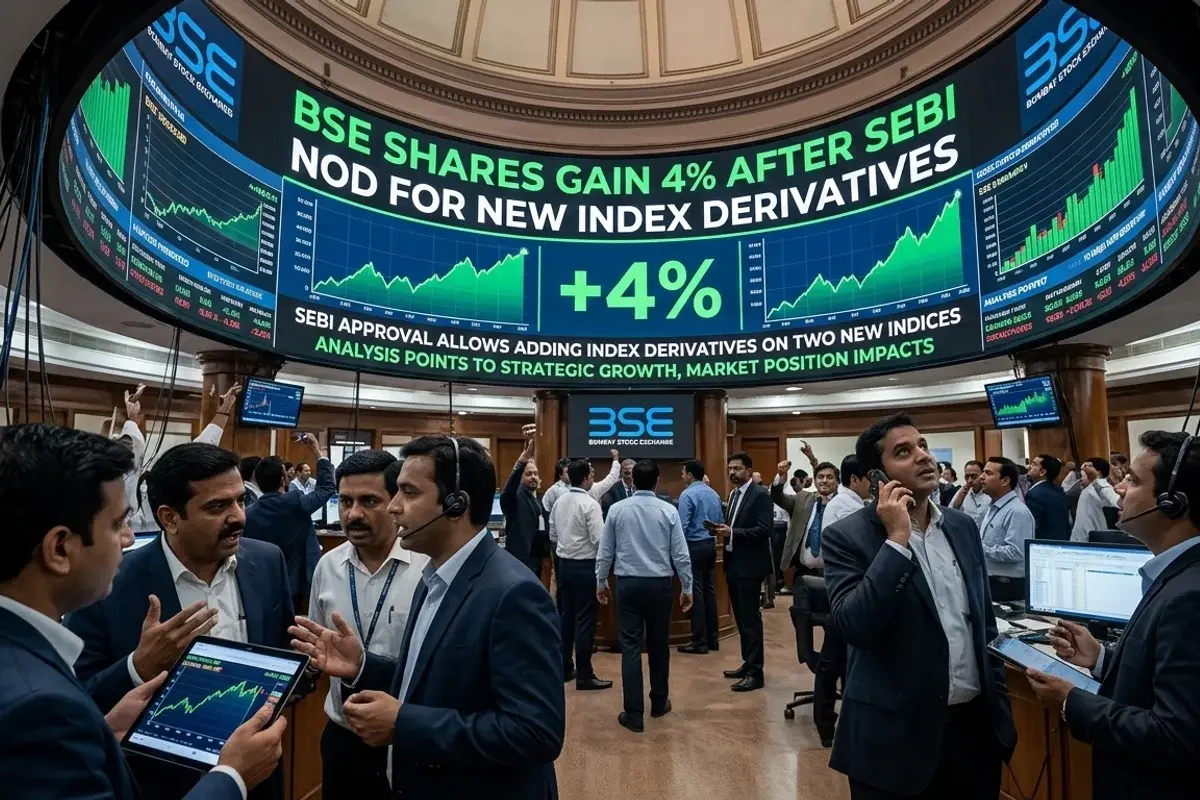
BSE shares surge over 4% after SEBI's critical nod for Sensex Next 30 index derivatives, bolstering its market position and revenue potential.

Gujarat Gas shares plunge nearly 7% as Middle East conflict disrupts R-LNG supply, forcing force majeure.

Coforge's strategic healthcare push, marked by 70.7% segment growth in FY25. Explore AI-led acquisitions, key partnerships, and market impact.

Bharat Forge stock gained after North America’s Class 8 truck orders surged to 47,200 units in February, up 159% YoY.

Paras Defence shares jump 10% after signing a crucial MoU with South Korea's Green Optics. Analyze the impact on India's defence & space sector for...