Loading market data...
The Supreme Court of India rules that Hamdard’s Rooh Afza qualifies as a food drink under the Uttar Pradesh VAT framework, reducing its tax rate to 4% and setting a key precedent for FMCG product classification disputes.
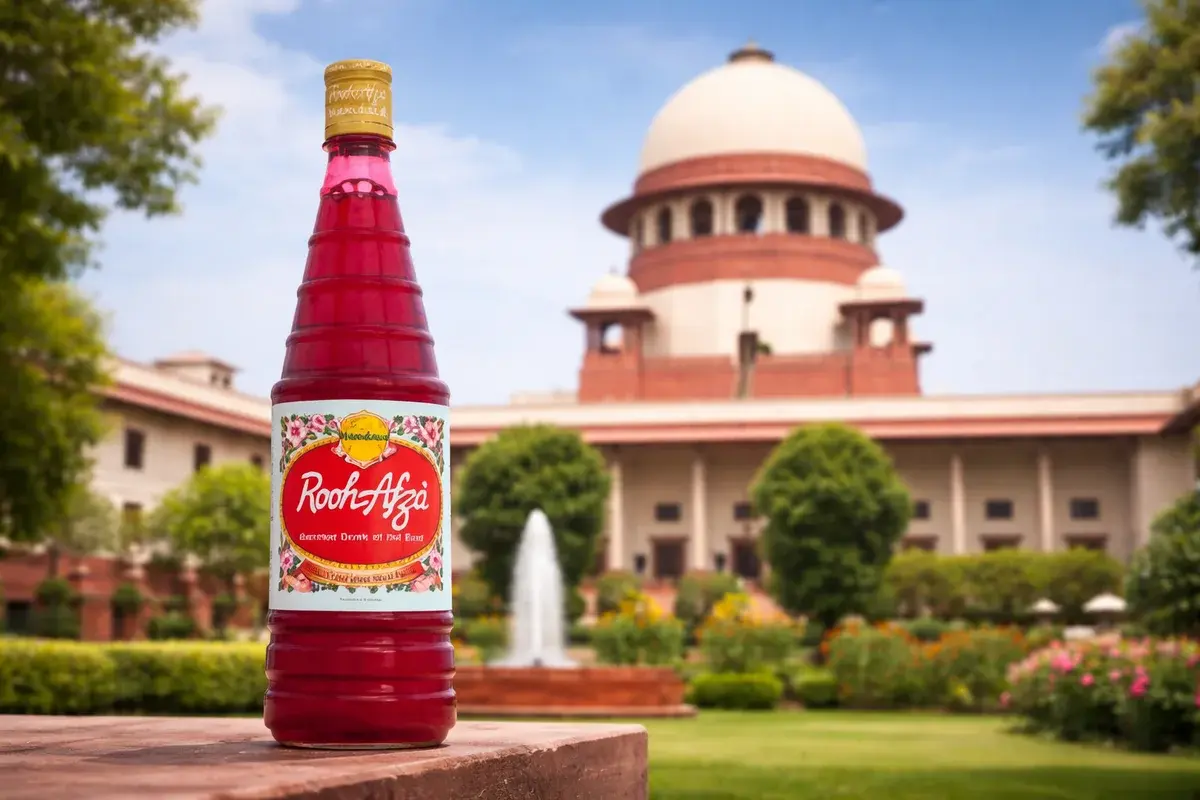
In a landmark ruling, the Supreme Court of India has classified Rooh Afza, the iconic syrup manufactured by Hamdard (Wakf) Laboratories, as a “food drink/fruit drink” under the Uttar Pradesh VAT framework. The verdict overturns an earlier judgment by the Allahabad High Court, which had treated the product as an unclassified commodity attracting a higher tax rate.
The ruling provides long-awaited clarity in a dispute that has lingered for years and carries broader implications for tax classification across India’s FMCG sector.

The Supreme Court bench comprising Justices R. Mahadevan and B. V. Nagarathna allowed Hamdard’s appeals, holding that Rooh Afza squarely falls within the specific VAT entry for food drinks rather than the residual category for unclassified goods.
| Parameter | Earlier Classification | Supreme Court Ruling |
|---|---|---|
| Product Category | Unclassified Commodity | Food Drink / Fruit Drink |
| VAT Rate | 12.5% | 4% |
| Tax Burden | Higher | Concessional |
The reduction from 12.5% to 4% represents a substantial fiscal relief, materially improving the product’s tax efficiency under the legacy VAT regime.
Product classification under indirect tax frameworks such as VAT and GST plays a critical role in determining applicable tax rates. Even minor definitional differences can significantly alter tax liability.
| Classification Category | Typical Tax Implication |
|---|---|
| Food & Beverage | Lower tax slab |
| Medicinal Product | Variable |
| Unclassified Commodity | Higher residual rate |
The Court emphasized that Rooh Afza’s composition, usage, and market perception align more closely with food and fruit-based beverages than with an undefined category.
For Hamdard (Wakf) Laboratories, the ruling strengthens both financial and strategic positioning.
| Impact Area | Expected Outcome |
|---|---|
| Tax Burden | Reduced significantly |
| Profit Margins | Improved |
| Pricing Flexibility | Enhanced |
| Competitive Positioning | Strengthened |
Lower taxation allows Hamdard greater flexibility in pricing strategy, potentially increasing volume growth or protecting margins in a highly competitive beverage market.
The judgment may influence other companies dealing with legacy VAT disputes involving classification ambiguity.
| Impact Dimension | Implication |
|---|---|
| Legacy VAT Cases | Possible reassessment |
| Product Structuring | Greater emphasis on classification clarity |
| Pricing Strategies | Adjustments based on tax savings |
| Regulatory Scrutiny | Increased documentation standards |
The FMCG industry, known for tight margins and intense competition, is particularly sensitive to tax arbitrage opportunities arising from classification decisions.
The ruling comes at a time when companies are increasingly attentive to tax compliance and regulatory classification risks. Though VAT has been largely replaced by GST, historical disputes continue to carry financial implications.
Legacy indirect tax disputes often hinge on interpretational nuances. This judgment reinforces the importance of precise product categorization, especially in consumable goods markets.
Rooh Afza, a household staple for decades, has long been positioned as a summer beverage concentrate. Its cultural significance and widespread use as a drink base strengthened Hamdard’s argument that it should fall under the food drink category.
The Supreme Court’s decision not only clarifies its tax status but also underscores judicial consistency in evaluating product classification based on functional use and consumer perception.
With clarity on classification, Hamdard can now:
Other FMCG players may review their product categorization frameworks to ensure alignment with evolving judicial standards.
The Supreme Court’s ruling marks a decisive moment in one of the FMCG sector’s notable indirect tax disputes. By recognizing Rooh Afza as a food drink under VAT norms, the judiciary has provided not just fiscal relief but also interpretational guidance for similar classification matters.
As regulatory scrutiny intensifies and tax frameworks evolve, businesses operating in consumable goods categories are likely to adopt more rigorous classification strategies to avoid prolonged disputes.

Financial journalist specializing in market analysis, stock research, and investment trends. Dedicated to providing accurate, timely insights for informed decision-making.
Credentials: Experienced financial journalist with expertise in equity markets and economic analysis
The information provided in this article is for educational and informational purposes only and should not be construed as financial, investment, or legal advice. Finscann does not provide personalized investment recommendations.
For detailed terms and conditions, please read our Disclaimer and Terms of Service.

Nothing’s Bengaluru store attracts 10,000+ visitors in 10 days, highlighting strong India demand and retail expansion plans amid PLI-driven...
The Brihanmumbai Municipal Corporation announces a record ₹80,952 crore budget for FY27, highlighting higher property tax collections, rising...

Deep analysis of Northern Arc Capital. Motilal Oswal projects 75% upside for this NBFC due to its strong business mix and attractive valuation.

Indian stock markets rebound sharply as Nifty surges past 25,600 and Nifty Bank climbs above 61,200, led by strong gains in IT and banking stocks.

Apple's gearing up for a significant shift in its laptop lineup with the anticipated launch of its first touch-enabled MacBook Pro series, expected...