Loading market data...
India’s most profitable unlisted companies in 2025 revealed. A leading fintech firm tops the list with a 48% net profit margin and ₹4,235 crore profit. Explore detailed financial analysis, sector insights, and margin comparison across IT, real estate, pharma, and biotech leaders.
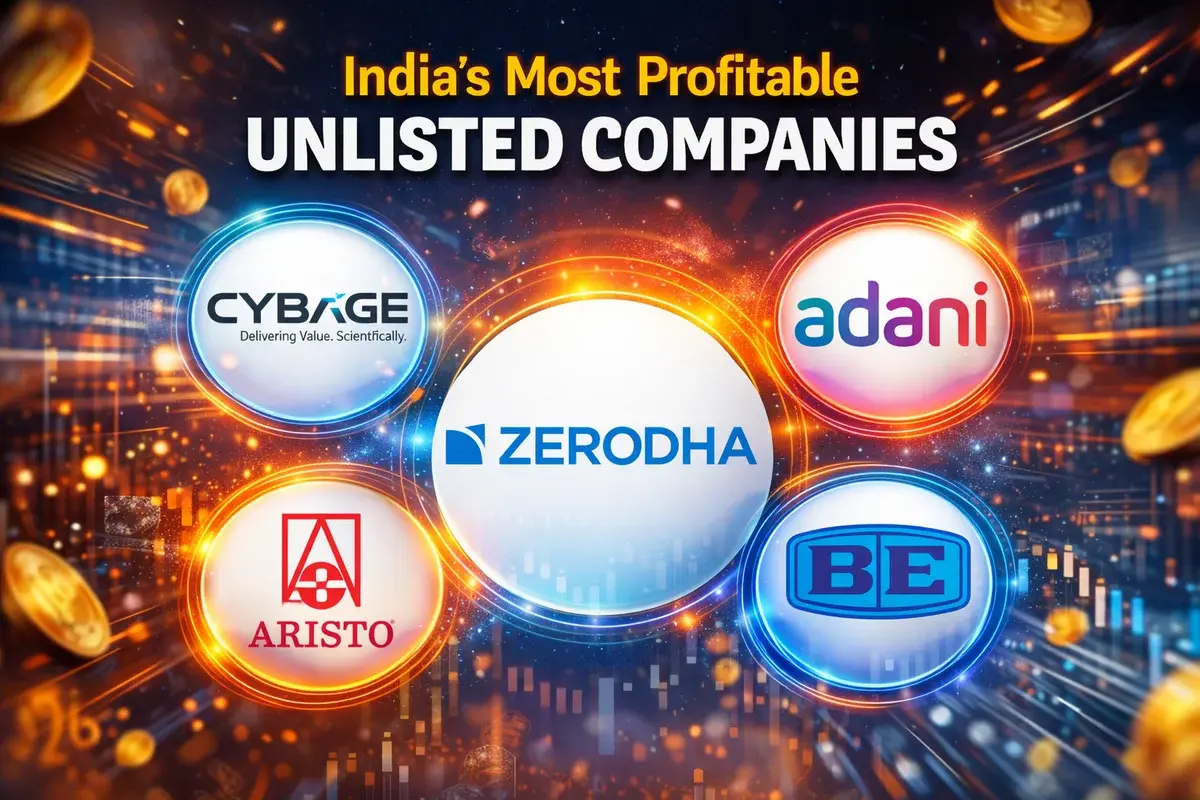
India’s unlisted corporate landscape has produced an extraordinary profitability story in FY2025. Leading the charge is Zerodha Broking, which has emerged as India’s most profitable unlisted company by net profit margin, delivering an impressive 48% margin and ₹4,235 crore in profit.
This milestone reinforces the power of asset-light digital business models in India’s evolving economy. Several other unlisted heavyweights across IT services, real estate, pharmaceuticals, and biotech have also posted exceptional financial performance, reflecting strong capital discipline and operational efficiency.
Zerodha Broking continues to redefine fintech profitability in India.
| Metric | FY2025 |
|---|---|
| Net Profit | ₹4,235 Cr |
| Net Profit Margin | 48% |
| Business Model | Asset-light fintech |
| Revenue Driver | Brokerage + Trading Volume |
| Cost Structure | Minimal infrastructure overhead |
Unlike traditional brokerage firms burdened by heavy distribution networks, Zerodha’s platform-led approach has allowed it to scale profitably without proportional cost increases. The company benefits directly from rising retail participation in Indian capital markets.
The 48% margin places it among the most efficient financial service firms in India.
Cybage Software secured the second spot with a 38% net profit margin.

| Metric | FY2025 |
|---|---|
| Net Profit Margin | 38% |
| Core Business | IT Services & Digital Engineering |
| Client Base | Global Enterprises |
| Delivery Model | Offshore-centric |
Cybage reflects the scalability of India’s IT services ecosystem. With global digital transformation demand remaining strong, Indian mid-tier IT firms are achieving superior margins through efficient execution models.
In a capital-intensive sector, Adani Properties delivered a striking 34% net profit margin and ₹7,672 crore in profit.

| Metric | FY2025 |
|---|---|
| Net Profit | ₹7,672 Cr |
| Net Profit Margin | 34% |
| Sector | Real Estate & Development |
| Business Model | Large-scale integrated projects |
Real estate margins are typically compressed due to land costs and financing burdens. Adani Properties’ performance suggests strong pricing power and demand resilience in premium segments.
ARISTO Pharmaceuticals posted a 32% net profit margin with profits of ₹1,701 crore.
| Metric | FY2025 |
|---|---|
| Net Profit | ₹1,701 Cr |
| Net Profit Margin | 32% |
| Market Presence | Domestic + International |
| Portfolio | Branded generics & specialty drugs |
India’s pharmaceutical sector continues to benefit from global generic demand and rising domestic healthcare consumption.
Biological E. rounds out the top five with a 30% net profit margin.
| Metric | FY2025 |
|---|---|
| Net Profit Margin | 30% |
| Core Business | Vaccines & Biologics |
| Growth Driver | Global vaccine demand |
| Strategic Focus | R&D + Manufacturing scale |
The company capitalized on sustained demand in vaccines and biologics markets, benefiting from international supply contracts and strong domestic distribution networks.
| Company | Sector | Net Profit (₹ Cr) | Net Margin |
|---|---|---|---|
| Zerodha Broking | Fintech | 4,235 | 48% |
| Cybage Software | IT Services | NA | 38% |
| Adani Properties | Real Estate | 7,672 | 34% |
| ARISTO Pharmaceuticals | Pharma | 1,701 | 32% |
| Biological E. | Biotech | NA | 30% |
Fintech and IT companies with minimal capital expenditure are achieving superior margins.
Technology-driven companies are scaling without proportional cost growth.
Selective land acquisition and premium pricing strategies are improving margins.
Global health spending and vaccine supply chains remain strong.
The dominance of fintech and technology firms at the top reflects India’s transition toward a digitally enabled economy. Investors are increasingly valuing:
Even in traditional sectors like real estate and pharmaceuticals, disciplined cost management is driving structural profitability improvement.
These companies are not only delivering strong current earnings but also demonstrating structural margin sustainability. As India’s economy formalizes and digitizes further, asset-light, technology-driven enterprises may continue to command premium profitability levels.
The profitability leaderboard signals a clear shift: scale plus efficiency equals margin dominance.

Financial journalist specializing in market analysis, stock research, and investment trends. Dedicated to providing accurate, timely insights for informed decision-making.
Credentials: Experienced financial journalist with expertise in equity markets and economic analysis
The information provided in this article is for educational and informational purposes only and should not be construed as financial, investment, or legal advice. Finscann does not provide personalized investment recommendations.
For detailed terms and conditions, please read our Disclaimer and Terms of Service.

Apple's gearing up for a significant shift in its laptop lineup with the anticipated launch of its first touch-enabled MacBook Pro series, expected...

RBI’s February 2026 draft norms impose 100% refund liability, ban kickbacks, and tighten suitability rules to curb ULIP mis-selling.

Discover why Indian markets are surging, with Sensex gaining 500 points, even as the IT sector faces headwinds.
Indian IT majors Infosys and TCS lead a strong rebound, jumping up to 5% in February 2026 after a five-day rout fueled by AI disruption fears.

Stock market preview for February 25, 2026: Key stocks to watch including TechSolutions India, Bharat Bank, and GreenEnergy Manufacturers.