Loading market data...
AgniKul Cosmos achieves a major milestone by test-firing three 3D-printed semi-cryogenic rocket engines simultaneously. The breakthrough strengthens India’s private space ambitions and propulsion capabilities.
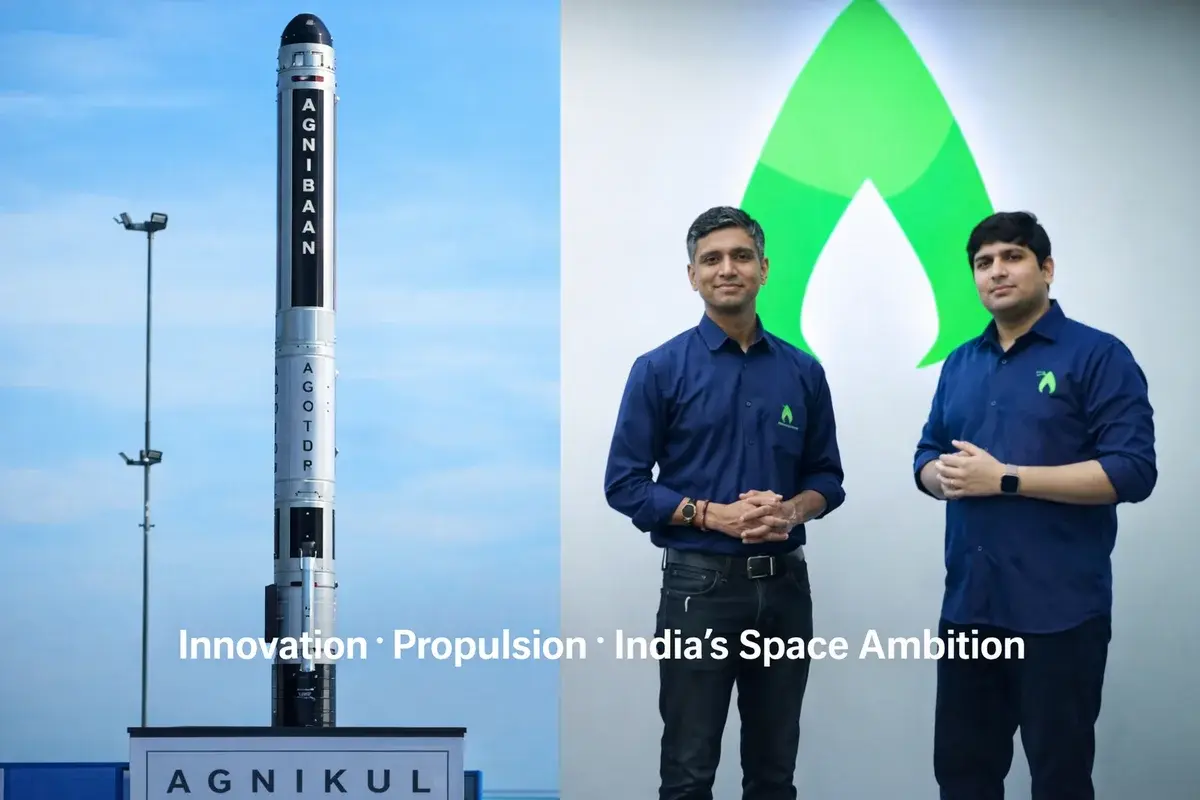
Chennai-based AgniKul Cosmos has achieved a significant propulsion milestone by successfully test-firing three semi-cryogenic rocket engines simultaneously in a clustered configuration. The development strengthens India’s private space launch ecosystem and signals increasing technological maturity ahead of commercial orbital missions.
The achievement comes at a time when global small-satellite deployment demand is accelerating and private launch vehicle companies are racing to demonstrate propulsion reliability the single most critical determinant of launch success.
Cluster testing is a defining step in launch vehicle development. While single-engine validation confirms component-level capability, clustered testing validates system-level synchronization, control logic, and propulsion stability under real-time operational conditions.
AgniKul’s engines are:
| Parameter | Details |
|---|---|
| Propulsion Type | Semi-cryogenic (liquid oxygen + kerosene) |
| Engine Design | Fully 3D-printed, single-piece hardware |
| Pump System | Electric motor-driven pumps |
| Configuration | Triple-engine clustered test |
| Control Complexity | Calibration of 6 motors and synchronized algorithms |
This clustered firing demonstrates uniform startup, steady-state stability, and coordinated shutdown critical for orbital reliability.
| Metric | Details |
|---|---|
| Founded | 2017 |
| Headquarters | Chennai, India |
| Sector | Aerospace & Launch Vehicles |
| Flagship Product | Agnibaan small satellite launch vehicle |
| Manufacturing Facility | Rocket Factory-1 (India’s private launchpad-integrated facility) |
| Technology Edge | Fully 3D-printed engines with electric pump-fed propulsion |
AgniKul differentiates itself through additive manufacturing and modular launch architecture, allowing customized payload delivery for small satellites.
AgniKul has raised over $40 million from prominent institutional investors:
| Investor | Type |
|---|---|
| Mayfield India | Venture Capital |
| Accel | Global VC |
| Celesta Capital | Deep-Tech VC |
| Speciale Invest | Early-Stage VC |
| Artha Venture Fund | Venture Capital |
Unlike asset-light startups, aerospace ventures require milestone-based capital discipline. Propulsion validation significantly reduces technical risk and strengthens investor confidence.
India’s liberalized space policy under IN-SPACe has enabled private participation alongside ISRO.
Key domestic and global comparables include:
| Company | Focus Area | Strategic Position |
|---|---|---|
| Skyroot Aerospace | Small launch vehicles | Vikram series rockets |
| Bellatrix Aerospace | Propulsion systems | In-space propulsion |
| Rocket Lab | Small orbital launches | Commercial small-launch leader |
| Firefly Aerospace | Medium lift launch vehicles | US-based launch provider |
AgniKul’s electric pump-fed architecture offers potential cost advantages over traditional turbopump systems.
The global small satellite launch market is projected to exceed $20 billion by 2030. Key demand drivers include:
| Segment | Growth Driver |
|---|---|
| Earth Observation | Climate & geospatial analytics |
| Defence Satellites | Surveillance & secure communications |
| Broadband Constellations | Global connectivity |
| IoT Networks | Data transmission infrastructure |
Modular clustered engines enable scalable launch configurations tailored to varying payload requirements.
| Area | Impact |
|---|---|
| Manufacturing Efficiency | Reduced component count via 3D printing |
| Cost Structure | Lower mechanical complexity through electric pumps |
| Scalability | Modular cluster expansion capability |
| Margin Potential | Improved long-term EBITDA margins if launch cadence scales |
| Revenue Model | Per-launch contracts & customized orbital services |
“Institutional investors are increasingly prioritizing EBITDA visibility and sustainable cash flow generation over top-line growth,” says a Mumbai-based deep-tech investor. “Propulsion validation materially de-risks aerospace startups.”
| Risk Category | Explanation |
|---|---|
| Launch Execution Risk | First commercial orbital mission success remains critical |
| Capital Intensity | Hardware scaling requires sustained funding |
| Regulatory Approvals | Launch and export compliance processes |
| Competitive Pricing | Pressure from global small-launch providers |
| Timeline Delays | Impact on valuation and funding cycles |
Q: Why is clustered engine testing important in aerospace?
Cluster testing validates synchronization and propulsion stability, which are essential for scaling launch vehicles and achieving orbital reliability.
Q: What makes AgniKul’s engine architecture different?
The company uses fully 3D-printed single-piece engines powered by electric motor-driven pumps instead of traditional turbopumps, reducing mechanical complexity.
Q: How does this milestone impact AgniKul’s valuation prospects?
Propulsion validation significantly lowers technical risk, strengthening investor confidence ahead of commercial launch revenue.
Q: When can commercial launches be expected?
Commercial launch timelines depend on regulatory clearances and final vehicle-level integration testing.
Q: Is AgniKul publicly listed?
No. AgniKul remains privately held, backed by venture capital investors.
AgniKul Cosmos’ triple-engine semi-cryogenic cluster test marks a structural milestone in India’s private space evolution. In aerospace, propulsion credibility defines competitive standing. With synchronized clustered validation complete, the company moves closer to commercial orbital deployment the ultimate test of its technological ambition and capital efficiency.

Financial journalist specializing in market analysis, stock research, and investment trends. Dedicated to providing accurate, timely insights for informed decision-making.
Credentials: Experienced financial journalist with expertise in equity markets and economic analysis
The information provided in this article is for educational and informational purposes only and should not be construed as financial, investment, or legal advice. Finscann does not provide personalized investment recommendations.
For detailed terms and conditions, please read our Disclaimer and Terms of Service.

Apple's gearing up for a significant shift in its laptop lineup with the anticipated launch of its first touch-enabled MacBook Pro series, expected...

RBI’s February 2026 draft norms impose 100% refund liability, ban kickbacks, and tighten suitability rules to curb ULIP mis-selling.

Discover why Indian markets are surging, with Sensex gaining 500 points, even as the IT sector faces headwinds.
Indian IT majors Infosys and TCS lead a strong rebound, jumping up to 5% in February 2026 after a five-day rout fueled by AI disruption fears.

Stock market preview for February 25, 2026: Key stocks to watch including TechSolutions India, Bharat Bank, and GreenEnergy Manufacturers.