Loading market data...
Pakistan's declaration of "open war" with Afghanistan after recent clashes intensifies regional instability, impacting financial markets, trade, and defence spending in February 2026.
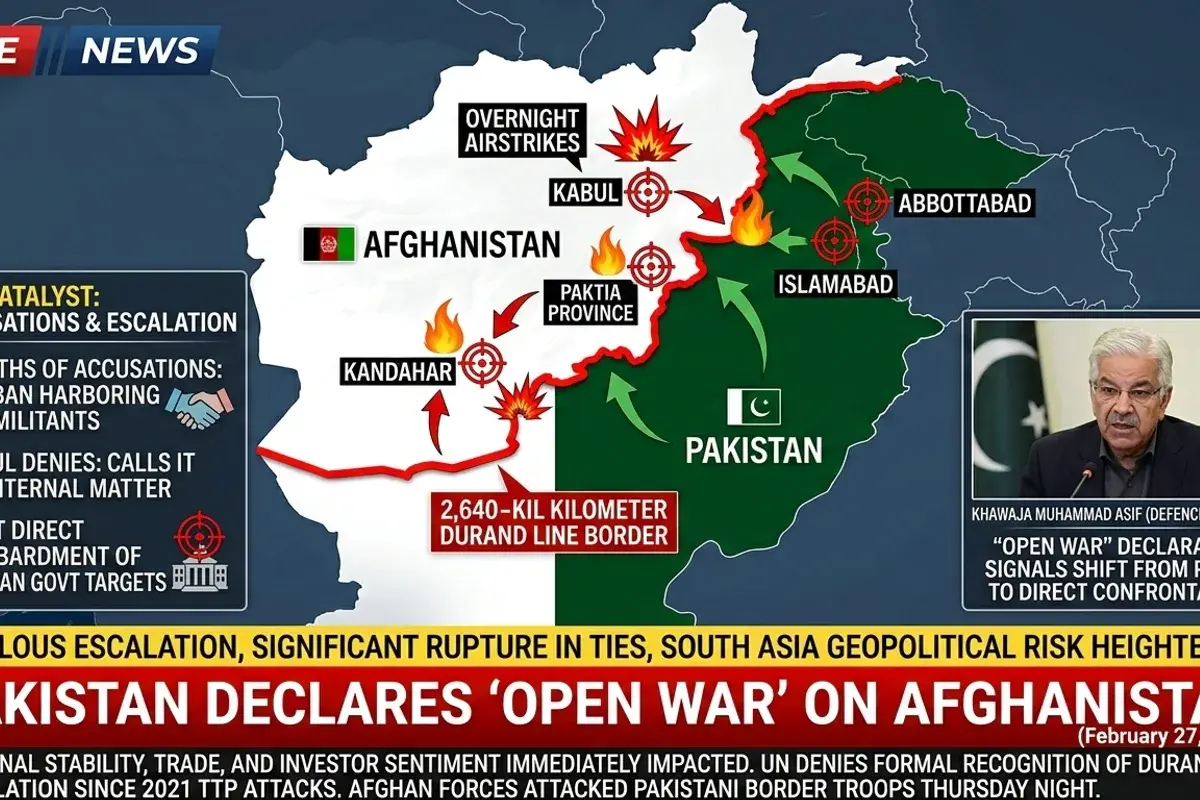
In a dramatic escalation of long-standing tensions, Pakistan has declared itself in "open war" with Afghanistan following a series of intense cross-border clashes and retaliatory airstrikes in late February 2026. This pronouncement from Pakistan's Defence Minister, Khawaja Muhammad Asif, marks a significant rupture in ties and signals heightened geopolitical risk across South Asia, with immediate repercussions for regional stability, trade, and investor sentiment. Pakistan conducted overnight airstrikes targeting Kabul, Kandahar, and Paktia province, accusing Afghanistan's Taliban government of harboring militants responsible for attacks on Pakistani soil. In response, the Afghan Ministry of Defense claimed retaliatory strikes against military targets in Islamabad and Abbottabad.
The Catalyst
The declaration of "open war" comes after months of escalating friction, rooted in Pakistan's accusations that the Taliban government provides safe haven to the Tehreek-e-Taliban Pakistan (TTP), a militant group responsible for a surge of attacks within Pakistan since 2021. Kabul, however, denies these allegations, asserting that Pakistan's security issues are an internal matter. The latest cycle of violence began with Afghan forces reportedly attacking Pakistani border troops on Thursday night, followed by Pakistan's widespread bombardment of Afghan cities. This marks the first time Islamabad has directly targeted the Taliban government itself, rather than alleged militant hideouts, signifying a perilous shift from proxy conflict to direct confrontation. The historically disputed Durand Line, the 2,640-kilometer border, continues to be a flashpoint, with Afghanistan's current government not formally recognizing it.
Financial Forensics
The economic implications of this escalating conflict are severe for both nations and carry potential spillover effects for the wider region, including India. Pakistan's economy, already grappling with inflation and external debt, faces further strain. The country approved an 18-20% increase in its defence budget for the fiscal year 2025-26, allocating ₹2.55 trillion (approximately $9.04 billion) to bolster military capabilities. This substantial increase comes at the cost of crucial development spending, with Pakistan reportedly cutting its health and environment budgets.
For Afghanistan, the conflict exacerbates an already fragile economic situation marked by low growth, high vulnerability, and international isolation since the Taliban's return to power in 2021. The prolonged closure of border crossings like Torkham has severely disrupted bilateral and transit trade, leading to significant financial losses for traders on both sides. In 2024, trade between Afghanistan and Pakistan dropped sharply to $1.6 billion from $2.5 billion in 2023, largely due to border disputes. A three-month disruption alone has resulted in an estimated USD 375 million in losses for Pakistani exporters and USD 200 million for Afghan exporters to Pakistan. Afghanistan also lost approximately USD 75 million in exports to India via the Wagah border during the same period.
Table: Economic Indicators & Conflict Impact (Hypothetical Data, February 2026)
| Indicator | Pakistan (Pre-Conflict Estimates) | Afghanistan (Pre-Conflict Estimates) | India (Pre-Conflict Estimates) | Projected Impact of Escalation |
|---|---|---|---|---|
| GDP Growth Rate (2026) | ~2.5% | ~1.7% | ~7.6% | Negative adjustment |
| Defence Spending (FY26) | ₹2.55 Trillion (↑20%) | N/A (Significant internal security costs) | Significant, potential increase | Further increase likely |
| Inflation Rate (2026) | High, persistent | ~1.0% | Moderate | Upward pressure |
| Bilateral Trade Volume | $1.6 Billion (2024, declining) | $1.6 Billion (2024, declining) | N/A (Indirectly affected) | Severe disruption |
Note: Figures are indicative and based on recent trends and reported data up to February 2026. Some Afghan data is highly conditional due to limited reporting.
Market Impact
The escalating geopolitical tensions between Pakistan and Afghanistan have already sent ripples through global and regional financial markets, including the Indian stock market. Indian equity benchmarks experienced sharp declines in late February 2026, pressured by foreign institutional investor outflows and heightened regional hostilities. The Nifty 50 slipped below the 25,200 mark, dropping 317.90 points (1.25%), while the S&P BSE Sensex tanked 961.42 points (1.17%) on a single day. Key sectors like auto and FMCG stocks were particularly affected.
Historical data suggests that while India-Pakistan tensions can cause short-term market volatility, they rarely alter the long-term trajectory of Indian equities. However, prolonged conflict or significant disruptions to trade routes could have a more sustained impact, particularly on sectors reliant on international trade or susceptible to energy price fluctuations. Defence stocks, on the other hand, often see a boost during such periods, reflecting increased security concerns.
Key Takeaways
FinScann Verdict
The Pakistan-Afghanistan conflict represents a critical flashpoint for regional stability and economic outlook. While immediate financial market reactions in India may be short-term, FinScann advises investors to closely monitor the trajectory of the conflict. Prolonged instability and trade disruptions could pose more substantial headwinds, particularly impacting Indian companies with direct or indirect exposure to the region's trade routes or energy markets. Defensive sectors and companies with strong domestic fundamentals may offer relative stability in this environment.
Q: What is the primary reason for the latest escalation between Pakistan and Afghanistan? A: The primary reason for the latest escalation is Pakistan's accusation that Afghanistan's Taliban government is harboring militants, specifically the Tehreek-e-Taliban Pakistan (TTP), who are responsible for a surge of attacks within Pakistan. Afghanistan denies these claims.
Q: How has the conflict impacted trade between the two countries? A: The conflict has severely disrupted trade, particularly through key border crossings like Torkham. Bilateral trade volumes have declined significantly, and both Pakistani and Afghan traders have incurred substantial financial losses due to closures and delays.
Q: What are the economic consequences for Pakistan? A: Pakistan faces increased economic strain, including a significant hike in defence spending (up to 20% for FY 2025-26) and diverted resources from development. This adds pressure on an economy already battling inflation and high debt.
Q: How might this impact the Indian stock market? A: The Indian stock market has already shown short-term volatility, with indices like the Nifty 50 and Sensex experiencing dips due to foreign institutional investor outflows and overall market uncertainty. While historical data suggests resilience, prolonged escalation could affect sectors exposed to regional trade or commodity price spikes.
Q: Is there a "moat" or safe haven for investors during such conflicts? A: In geopolitical conflicts, "moats" are less about specific companies and more about broader investment strategies. Investors often seek safety in defensive sectors (e.g., consumer staples, healthcare), gold, or strong domestic-focused equities with minimal external exposure. For India, a strong domestic consumption story and strategic decoupling from regional volatility could act as a relative moat.
Disclaimer: For information only; not investment advice. Stock market investments carry risks. Please consult a a SEBI-registered advisor before investing. FinScann assumes no liability for decisions made based on this report.

Financial journalist specializing in market analysis, stock research, and investment trends. Dedicated to providing accurate, timely insights for informed decision-making.
Credentials: Experienced financial journalist with expertise in equity markets and economic analysis
The information provided in this article is for educational and informational purposes only and should not be construed as financial, investment, or legal advice. Finscann does not provide personalized investment recommendations.
For detailed terms and conditions, please read our Disclaimer and Terms of Service.

Paramount Skydance seals historic $110B deal to acquire Warner Bros. Discovery, combining iconic content and streaming platforms.
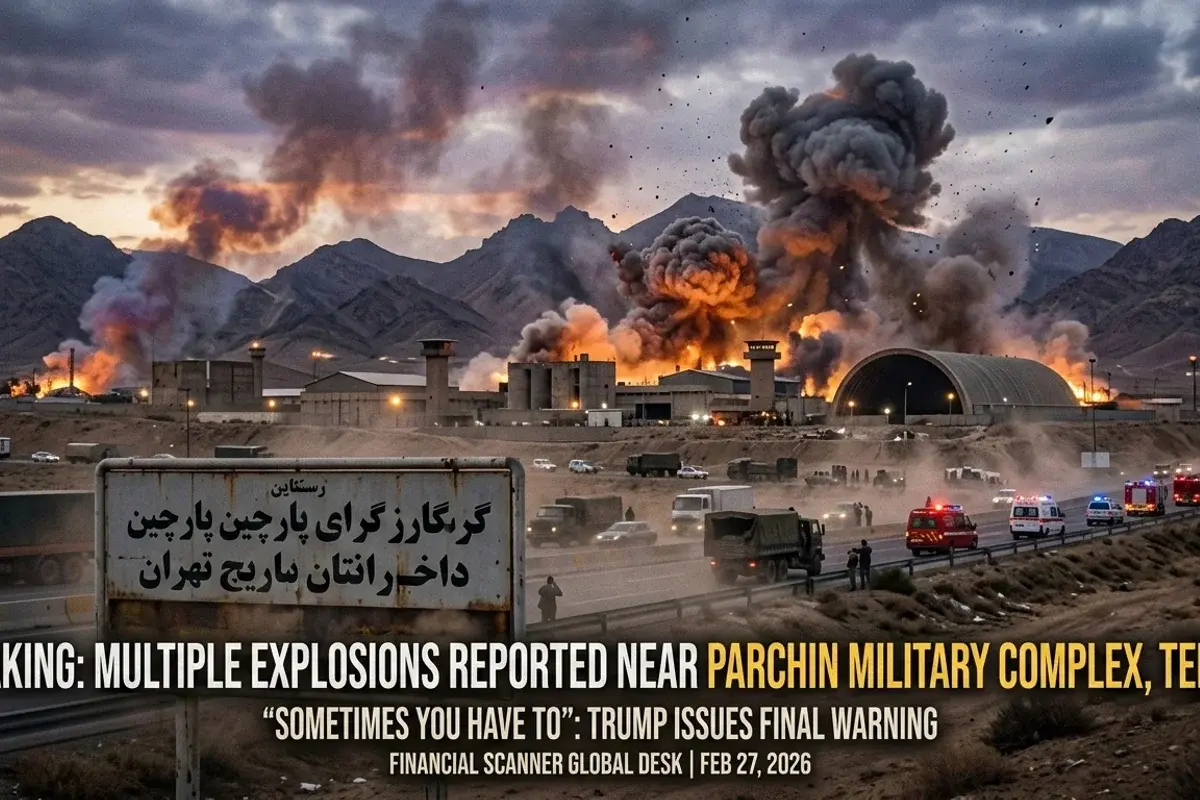
The geopolitical landscape fractured on Friday as a series of high-decibel escalations pushed the Middle East to the brink of a major military...

Amazon and OpenAI announce a groundbreaking $50 billion AI investment, reshaping the tech landscape.

Netflix's strategic exit from the Warner Bros Discovery bid fuels a significant surge in Paramount Global shares.

Microsoft announces a strategic partnership with Starlink to deliver satellite broadband connectivity to rural, agricultural, and hard-to-reach...